


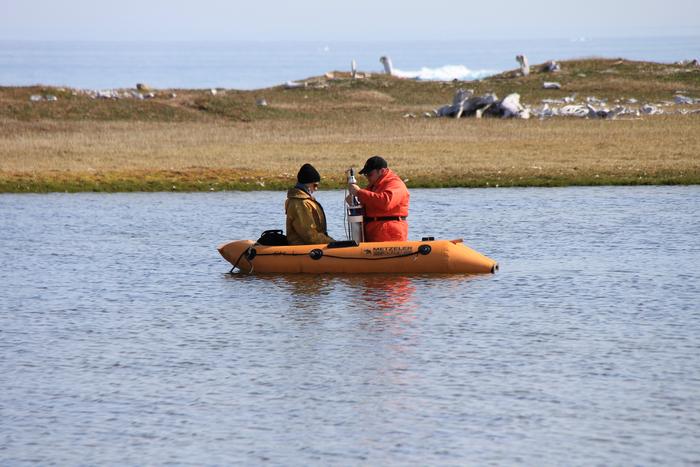
A recent study provides new insights into ancient cultures in Canada’s Arctic, focusing on Paleo-Inuit and Thule-Inuit peoples over thousands of years. Jules Blais, professor of biology at the University of Ottawa, and a team of researchers detected human presence and settlements on Somerset Island, Nunavut, by analyzing sediment samples.

Credit: Photo credit: Jules Blais, University of Ottawa
A recent study provides new insights into ancient cultures in Canada’s Arctic, focusing on Paleo-Inuit and Thule-Inuit peoples over thousands of years. Jules Blais, professor of biology at the University of Ottawa, and a team of researchers detected human presence and settlements on Somerset Island, Nunavut, by analyzing sediment samples.
The Arctic has been home to various cultures, such as the Paleo-Inuit (2500 BCE to 1250 CE) and the Thule-Inuit (1200 to 1500 CE). Although historical evidence is scarce, this recent study provides valuable insight into their presence.
The study discovered evidence of Paleo-Inuit presence on Somerset Island in Nunavut, Canada, where it was lacking. The innovative research methodologies revealed detailed information about past human history without traditional artifacts.
Professor Jules Blais says, “By analyzing pond sediment samples, we were able to construct detailed histories of site occupation. This includes clear evidence of Paleo-Inuit presence and indications that the Thule-Inuit arrived earlier than previously estimated.”
The research used archeological evidence and sedimentary biomarkers to study prehistoric settlement on Somerset Island. Sediment cores from island ponds were analyzed for trace elements and organic compounds. Results showed that the Thule-Inuit population increased from the 13th to 15th centuries. The researchers also showed high levels of metals like lead, copper, zinc and nickel in twentieth-century sediment, suggesting air pollution during that time.
Blais says, “We used generalized additive models (GAMs) and radiocarbon dating techniques to identify key time points in the sediment record corresponding to the expected dates of Thule-Inuit arrival and site abandonment. This approach allowed us to detect periods of significant change in sediment proxies, providing a chronological framework for understanding the history of human occupation on the island.”
This research underscores the importance of interdisciplinary approaches in archeology and highlights the significance of sedimentary archives in reconstructing past human activities and environmental conditions.
Blais explains the broader implications of the study. “The use of sedimentary biomarkers and bone samples to uncover prehistoric habits demonstrates the strength of interdisciplinary studies. Our discoveries not only enhance our knowledge of the Thule-Inuit and Paleo-Inuit communities in the Arctic but also demonstrate the potential of new archeological techniques.”
The study “Sedimentary biomarkers and bone specimens reveal a history of prehistoric occupation on Somerset Island (Arctic Canada)” was published July 9 in the Proceedings of the Royal Society B journal.
Journal
Proceedings of the Royal Society B Biological Sciences
Method of Research
Content analysis
Subject of Research
People
Article Title
Sedimentary biomarkers and bone specimens reveal a history of prehistoric occupation on Somerset Island (Arctic Canada)
Article Publication Date
10-Jul-2024
Cite Scienmag News
Drew Townsend. (July 11, 2024). Unveiling 1,200 years of human occupation in Canada’s Arctic. Scienmag. https://scienmag.com/unveiling-1200-years-of-human-occupation-in-canadas-arctic/
Drew Townsend. "Unveiling 1,200 years of human occupation in Canada’s Arctic." Scienmag, 11 July 2024, https://scienmag.com/unveiling-1200-years-of-human-occupation-in-canadas-arctic/. Accessed 4 September 2026.
Drew Townsend. "Unveiling 1,200 years of human occupation in Canada’s Arctic." Scienmag. July 11, 2024. https://scienmag.com/unveiling-1200-years-of-human-occupation-in-canadas-arctic/

