


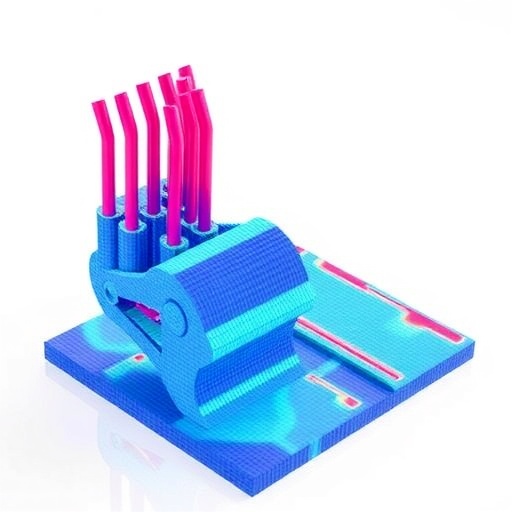
In a groundbreaking advancement for the oil extraction industry, researchers Zhao, Ma, Shi, and colleagues have unveiled a pioneering construction method that precisely models the three-dimensional dynamic configuration of reciprocating sucker rod strings within actual wellbores. Published in Scientific Reports in 2026, this innovative method promises to revolutionize the understanding of sucker rod dynamics, providing unprecedented insights into downhole mechanics and potentially enhancing production efficiency in oil wells worldwide.
Sucker rod pumping systems remain a cornerstone of artificial lift technology, vital for extracting hydrocarbons from reservoirs where natural pressure is insufficient. Despite their widespread use, accurately characterizing the real-time three-dimensional behavior of the sucker rod string inside the wellbore has eluded engineers for decades due to the complexity of downhole environments. The newly proposed method addresses these longstanding challenges by integrating advanced computational models with actual field data, thereby bridging the gap between theoretical simulations and operational realities.
The method centers around constructing a dynamic, three-dimensional representation of the reciprocating sucker rod string—a continuous series of interconnected rods that transfer surface power to the subsurface pump. Unlike prior two-dimensional approximations or static models, this approach captures the nuanced spatial displacements and interactions of the string as it flexes, twists, and reciprocates under varying load conditions. This holistic visualization accounts for nonlinear behavior resulting from wellbore deviations, friction forces, and fluid dynamics, which were previously too complex to model concurrently.
To achieve such precision, the researchers developed a sophisticated algorithm coupling multi-body dynamics with finite element modeling, incorporating the mechanical properties of the rods and real-world casing geometries. This algorithm iteratively computes the equilibrium configuration and stress distribution of the sucker rod string at every moment during a pumping cycle. By doing so, it predicts critical parameters such as bending moments, axial loads, and torsional stresses that directly impact equipment longevity and performance.
Moreover, the model incorporates dynamic boundary conditions that realistically mimic the interaction of the rod string with the wellbore wall, including contact friction and potential buckling phenomena. This feature is particularly significant for highly deviated or horizontal wells, where the sucker rod is subjected to increased lateral forces and risk of wear. The capacity to simulate these interactions enables engineers to foresee potential failure points, informing maintenance schedules and design improvements proactively.
Field validation represents a cornerstone of this research. The team collaborated with operational oil fields to gather extensive downhole measurement data using advanced fiber optic sensors and rod string instrumentation. These empirical datasets were then employed to calibrate and verify the computational model, demonstrating excellent agreement between predicted and observed sucker rod behavior. Such convergence between simulation and reality marks a crucial step toward deploying this methodology in routine field applications.
One of the major implications of this three-dimensional dynamic analysis lies in optimizing artificial lift efficiency. By precisely understanding the mechanical stresses and motion patterns of the sucker rod string, operators can fine-tune pumping parameters to minimize energy consumption while maximizing fluid displacement. This optimization not only reduces operational costs but also significantly lowers the environmental footprint of oil production through decreased power usage and equipment wear.
Furthermore, the insights gained from this modeling technique have direct consequences for enhancing the design of sucker rod components. Manufacturers can leverage detailed stress profiles to select materials with tailored mechanical properties and innovate in rod string architecture that resists fatigue and deformation more effectively. Consequently, well productivity can be sustained for longer periods without unplanned downtime caused by equipment failure.
In unconventional reservoirs, where well trajectories often include sharp bends and lateral sections, the need for accurate spatial configuration modeling becomes even more critical. The new method’s ability to precisely simulate multi-dimensional sucker rod dynamics under complex well geometries offers a significant competitive advantage. It opens avenues for deploying sucker rod pumped wells in challenging formations with greater reliability and reduced risk.
Additionally, this construction method enables real-time monitoring capabilities when integrated with digital oilfield technologies. By feeding continuous sensor data into the model, operators can obtain live visualizations of the rod string’s configuration, identify abnormal behaviors promptly, and implement corrective actions preemptively. Such predictive maintenance paradigms translate into improved safety and higher operational uptime.
The research also lays the foundation for extending the modeling framework to other artificial lift systems with similar dynamic complexities, such as progressing cavity pumps or hydraulic pumping units. The principles of combining three-dimensional dynamic simulation with in situ data acquisition can be adapted to broaden the understanding of downhole equipment mechanics beyond sucker rods.
Experts in petroleum engineering and well completion design have lauded this contribution as a paradigm shift that connects theoretical modeling, field measurements, and practical engineering needs. The comprehensive approach, backed by rigorous validation and immediate industrial applicability, embodies the future direction of intelligent oilfield technologies.
In conclusion, the construction method devised by Zhao and colleagues represents a significant leap forward in the engineering and operational management of sucker rod pumping systems. By rendering the elusive three-dimensional dynamic configuration of sucker rod strings within actual wellbores, this method enhances predictive accuracy, optimizes performance, prolongs equipment lifespan, and establishes a robust platform for integrating advanced sensor technologies. As the oil and gas sector continues to face mounting demands for efficiency and sustainability, such innovations herald a brighter, data-driven future for artificial lift solutions.
Cite Scienmag News
Denise Maddox. (May 26, 2026). 3D Dynamic Modeling of Reciprocating Sucker Rods. Scienmag. https://scienmag.com/3d-dynamic-modeling-of-reciprocating-sucker-rods/
Denise Maddox. "3D Dynamic Modeling of Reciprocating Sucker Rods." Scienmag, 26 May 2026, https://scienmag.com/3d-dynamic-modeling-of-reciprocating-sucker-rods/. Accessed 3 September 2026.
Denise Maddox. "3D Dynamic Modeling of Reciprocating Sucker Rods." Scienmag. May 26, 2026. https://scienmag.com/3d-dynamic-modeling-of-reciprocating-sucker-rods/


