


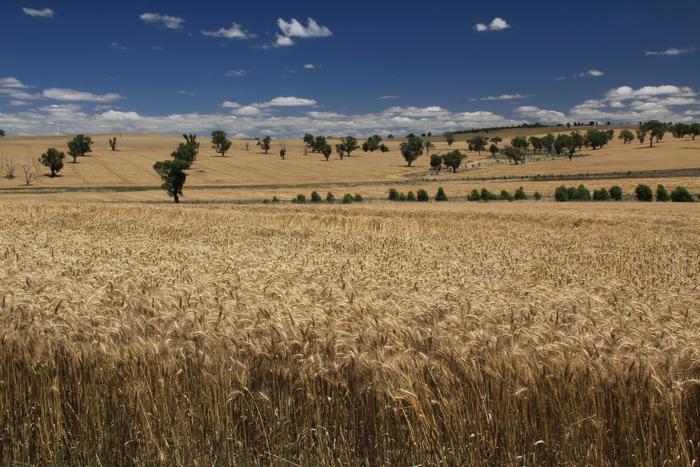
A genomic resource for the wild grass species Tausch’s goatgrass (Aegilops tauschii) has been developed by a team of international researchers led by KAUST. This new understanding will accelerate gene discovery research and shed new light on the story of wheat’s evolutionary genetics.[1].

Credit: © 2024 KAUST; Simon Krattinger.
A genomic resource for the wild grass species Tausch’s goatgrass (Aegilops tauschii) has been developed by a team of international researchers led by KAUST. This new understanding will accelerate gene discovery research and shed new light on the story of wheat’s evolutionary genetics.[1].
The modern bread wheat (Triticum aestivum) evolved from the hybridization of three wild grass species. One of these (Ae. tauschii) is known as the donor of the bread wheat D genome. Today, wild wheat relatives represent a genetic reservoir of potential beneficial genes that could be used to improve modern wheat varieties.
KAUST researchers, Brande Wulff and Simon Krattinger, have collaborated on many projects to clone genes from wheat and wild plant relatives, as well as identifying the role of various compounds in wheat disease resistance. Now, Ph.D. researchers in the two groups, Emile Cavalet-Giorsa and Andrea Gonzalez-Munoz, together with post doc, Naveenkumar Athiyannan, have led an international research project that establishes a comprehensive set of genomic resources for Ae. tauschii.
The Ae. tauschii pangenome
The Wulff lab has led the effort to generate a pangenome for the species as a genomics resource for resistance gene discovery.
From an initial 900 collection samples, or accessions, of Ae. tauschii, the researchers compiled 493 genetically distinct accessions. They then reached out to the Open Wild Wheat Consortium (OWWC) to select accessions with traits of interest to other researchers. This was critical to the project, which demanded a large investment of resources. The OWWC is a major international collaboration to improve wheat by exploring useful genetic diversity in wild crop relatives. The consortium brings together research groups and researchers from 15 countries.
“Many of the accessions we selected have disease resistance genes or agronomic traits of interest, such as stress tolerance,” explains Gonzalez-Munoz. “Other researchers in the OWWC are using these lines, so they benefit from having a high quality genome assembly.”
After this input and screening to ensure the genetic diversity of the species was represented, the team compiled 46 high-quality genome assemblies of Ae. tauschii.
Gene discovery
The value of these gene assemblies is their potential for gene discovery. Gonzalez-Munoz and Athiyannan next screened the assemblies to identify rust resistance genes.
A stem rust resistance gene that had transferred — a process called introgression — into bread wheat from one of the Ae. tauschii accessions was genetically mapped to the stem rust resistance locus Sr33.
“In the case of the stem rust gene (Sr66), until now we have lacked an assembly that had both Sr33 and Sr66 in the same accession,” says Athiyannan.
“Earlier work had led us to question whether they were two separate genes or alleles of the same gene.
“Now, thanks to finding this accession that contains both genes located in different positions, we can confirm that they are different genes,” he explains.
In another significant finding, the researchers also identified a leaf rust resistance gene which encodes the recently emerging resistance class wheat tandem kinase protein with unique integrated domains.
Gonzalez-Munoz is now using the resources to uncover a gene that has a trait associated with stress tolerance
Origin and evolution of the wheat D genome
Cavalet-Giorsa, meanwhile focused on analyzing the wheat genome. “Wheat has a lot of introgressions, i.e. hybridization that occurred naturally from wild relatives,” he says.
“Understanding the contribution from different wild relatives is important to explain the diversity and adaptability of wheat and perhaps also its evolutionary history.”
These introgressions were a major driver to bring back genetic diversity following a massive genetic bottleneck. Without these early introgressions, it is unlikely that bread wheat would have become such a widely cultivated crop.
“We have developed tools that have allowed us for the first time to trace and track the dynamics of a particular introgression (L3) in detail,” notes Cavalet-Giorsa.
This work launches new questions for wheat genomics and breeding, particularly with a focus on adaptation.
Journal
Nature
Article Title
Origin and evolution of the bread wheat D genome’
Article Publication Date
14-Aug-2024
Cite Scienmag News
Juliet Wilcox. (August 14, 2024). Unraveling modern bread wheat from the genes up. Scienmag. https://scienmag.com/unraveling-modern-bread-wheat-from-the-genes-up/
Juliet Wilcox. "Unraveling modern bread wheat from the genes up." Scienmag, 14 August 2024, https://scienmag.com/unraveling-modern-bread-wheat-from-the-genes-up/. Accessed 4 September 2026.
Juliet Wilcox. "Unraveling modern bread wheat from the genes up." Scienmag. August 14, 2024. https://scienmag.com/unraveling-modern-bread-wheat-from-the-genes-up/

