

Tuesday, May 5, 2026
Science
No Result
View All Result
  • Login
  • HOME
  • SCIENCE NEWS
  • CONTACT US
  • HOME
  • SCIENCE NEWS
  • CONTACT US
No Result
View All Result
Scienmag
No Result
View All Result
Home Science News Marine

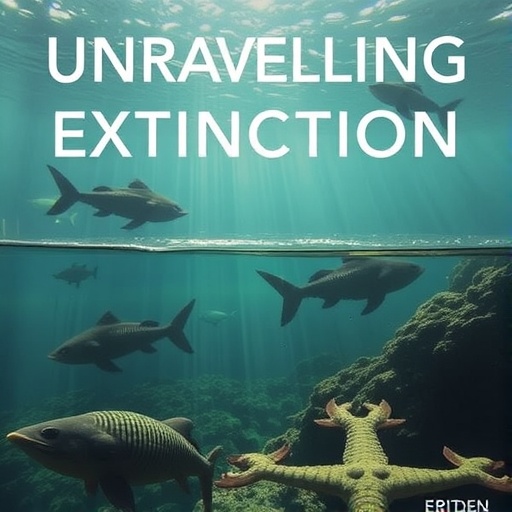
Unraveling Extinction: Why One Ancient Ocean Creature Thrived While Another Disappeared

May 5, 2026
in Marine
Reading Time: 1 min read
0
Unraveling Extinction: Why One Ancient Ocean Creature Thrived While Another Disappeared — Marine

Unraveling Extinction: Why One Ancient Ocean Creature Thrived While Another Disappeared

65
SHARES
588
VIEWS
Share on FacebookShare on Twitter
ADVERTISEMENT

Ammonites, the magnificent marine cephalopods that flourished for millions of years before their sudden extinction, remain one of paleontology’s most intriguing mysteries. Despite their extensive evolutionary history, spanning roughly 350 million years and surviving numerous catastrophic events including the devastating Permian-Triassic extinction, ammonites vanished at the close of the Cretaceous period, about 65.5 million years ago. This mass extinction event, famously associated with the demise of the non-avian dinosaurs, also saw the survival of a less diverse but related group of shelled cephalopods—the nautiloids—provoking questions about what factors shaped these divergent fates.

The longstanding question as to why ammonites, with their incredible diversity and adaptability, succumbed to extinction while nautiloids endured, has persisted as an evolutionary enigma. Michael Schmutzer, an evolutionary biologist at the University of Oxford, has dedicated efforts to unraveling this puzzle. His collaborative research, to be showcased at the upcoming European Geosciences Union (EGU) General Assembly, leverages an unprecedented compilation of data on Late Cretaceous shelled cephalopods, integrating previously overlooked fossils and so-called ‘dark data’—specimens hidden in museum collections worldwide.

This comprehensive dataset incorporates diverse parameters, including body size metrics, egg morphology, and geographic distribution patterns. Previous speculation had suggested that differences in geographic ranges were responsible: nautiloids purportedly enjoyed broader or more advantageous habitats, allowing them to weather global ecological upheavals. However, Schmutzer’s analysis challenges this notion, finding little support that spatial distribution significantly influenced survival outcomes. Instead, the evidence points towards reproductive strategies, particularly egg size and development patterns, as critical determinants of resilience through the end-Cretaceous extinction.

Ammonites produced an extraordinary number of minuscule eggs, releasing countless microscopic hatchlings into the marine environment. This reproductive strategy, while providing an evolutionary advantage under stable conditions by increasing

Tags: ammonite extinction causescephalopod fossil analysisCretaceous-Paleogene extinction eventdark data in fossil researchegg morphology in extinct speciesevolutionary biology of cephalopodsgeographic distribution of ancient cephalopodsLate Cretaceous marine lifenautiloid survival factorspaleontology of marine invertebratesPermian-Triassic extinction survivalshelled cephalopod evolution
Share26Tweet16
Previous Post

AI Model Analyzes Body Composition to Forecast Health Risks

Next Post

How Cutting-Edge AI Assistants from Big Tech Are Transforming Healthcare

Related Posts

Improving Irrigation in Crop–Climate Models Under Warming — Marine
Marine

Improving Irrigation in Crop–Climate Models Under Warming

May 5, 2026
Study Reveals Seaweed Integration Enhances Aquaculture Efficiency and Reduces Waste — Marine
Marine

Study Reveals Seaweed Integration Enhances Aquaculture Efficiency and Reduces Waste

May 5, 2026
Rare and Elusive Giant Squid Spotted Off the Coast of Western Australia — Marine
Marine

Rare and Elusive Giant Squid Spotted Off the Coast of Western Australia

May 5, 2026
Innovative Filter Swap Could Revolutionize Marine eDNA Biomonitoring — Marine
Marine

Innovative Filter Swap Could Revolutionize Marine eDNA Biomonitoring

May 4, 2026
Unseen Benefits of Inactivating Resistance Genes — Marine
Marine

Unseen Benefits of Inactivating Resistance Genes

May 1, 2026
Urbanization Drives Microbial Homogenization in Wastewater — Marine
Marine

Urbanization Drives Microbial Homogenization in Wastewater

May 1, 2026
Next Post
How Cutting-Edge AI Assistants from Big Tech Are Transforming Healthcare — Policy

How Cutting-Edge AI Assistants from Big Tech Are Transforming Healthcare

  • Mothers who receive childcare support from maternal grandparents show more parental warmth, finds NTU Singapore study

    Mothers who receive childcare support from maternal grandparents show more parental warmth, finds NTU Singapore study

    27640 shares
    Share 11052 Tweet 6908
  • University of Seville Breaks 120-Year-Old Mystery, Revises a Key Einstein Concept

    1043 shares
    Share 417 Tweet 261
  • Bee body mass, pathogens and local climate influence heat tolerance

    677 shares
    Share 271 Tweet 169
  • Researchers record first-ever images and data of a shark experiencing a boat strike

    540 shares
    Share 216 Tweet 135
  • Groundbreaking Clinical Trial Reveals Lubiprostone Enhances Kidney Function

    527 shares
    Share 211 Tweet 132
Science

Embark on a thrilling journey of discovery with Scienmag.com—your ultimate source for cutting-edge breakthroughs. Immerse yourself in a world where curiosity knows no limits and tomorrow’s possibilities become today’s reality!

RECENT NEWS

  • Multi-Trait Scores Boost Atrial Fibrillation Prediction
  • Microbes Behind Ammonium Build-Up in Pearl River Sediments
  • CityUHK Physicist Uncovers How Magnetic Fields Reactivate Superconductivity in Nickelates
  • FAU Review Highlights Metabolic Pathways Linking Obesity and Alzheimer’s Disease

Categories

  • Agriculture
  • Anthropology
  • Archaeology
  • Athmospheric
  • Biology
  • Biotechnology
  • Blog
  • Bussines
  • Cancer
  • Chemistry
  • Climate
  • Earth Science
  • Editorial Policy
  • Marine
  • Mathematics
  • Medicine
  • Pediatry
  • Policy
  • Psychology & Psychiatry
  • Science Education
  • Social Science
  • Space
  • Technology and Engineering

Subscribe to Blog via Email

Enter your email address to subscribe to this blog and receive notifications of new posts by email.

Join 5,146 other subscribers

© 2025 Scienmag - Science Magazine

Welcome Back!

Login to your account below

Forgotten Password?

Retrieve your password

Please enter your username or email address to reset your password.

Log In
No Result
View All Result
  • HOME
  • SCIENCE NEWS
  • CONTACT US

© 2025 Scienmag - Science Magazine

Discover more from Science

Subscribe now to keep reading and get access to the full archive.

Continue reading
