


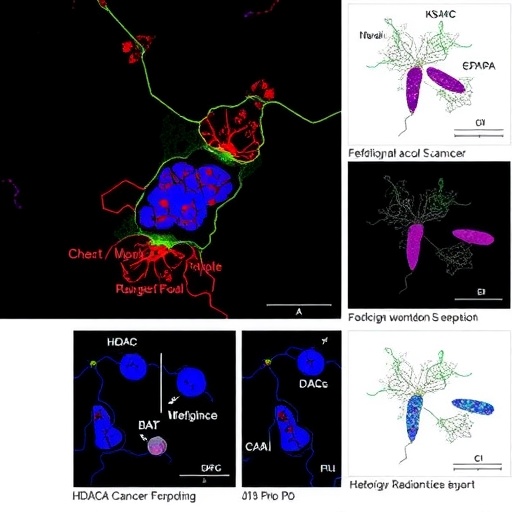
In a groundbreaking advancement that may redefine therapeutic strategies against lung cancer, a team of researchers has unveiled a novel approach to enhancing radiation therapy’s effectiveness through targeted protein degradation. The focus of this innovative work centers on the development of an HDAC4-specific PROTAC degrader, a molecular tool that promotes the selective destruction of histone deacetylase 4 (HDAC4). This strategy not only sensitizes lung cancer cells to radiation but critically augments a form of regulated cell death known as ferroptosis. This discovery marks a significant leap in understanding and manipulating cancer cell susceptibility to established treatments.
Histone deacetylases (HDACs) have long been recognized as pivotal regulators of chromatin remodeling and gene expression, with aberrations in their activity implicated across numerous cancers. Among these, HDAC4 has emerged as a particularly promising target due to its multifaceted role in modulating cellular survival and stress responses. Traditional HDAC inhibitors, while effective to some extent, often suffer from a lack of isoform specificity and associated toxicities. The advent of PROTAC (Proteolysis Targeting Chimera) technology offers a transformative avenue by harnessing the cell’s own ubiquitin-proteasome system to selectively degrade target proteins, thereby overcoming limitations observed with mere enzymatic inhibition.
The research team engineered a sophisticated PROTAC molecule designed to recognize and bind HDAC4 selectively, recruiting E3 ubiquitin ligases to tag HDAC4 for proteasomal degradation. This precision targeting eliminates HDAC4 protein function more completely than traditional inhibitors. Detailed biophysical and biochemical assays confirmed the degrader’s specificity and potency, setting the stage for subsequent cellular and in vivo studies. These investigations demonstrated that HDAC4 depletion precipitates significant biological effects in lung cancer cells, reshaping their response to external stimuli such as radiation.
Central to this study is the previously underappreciated interaction between HDAC4 activity and ferroptosis—a unique form of regulated cell death characterized by iron-dependent lipid peroxidation. Ferroptosis has garnered intense research interest due to its distinct biochemical pathways and potential to overcome apoptosis resistance in cancer cells. By delineating the molecular crosstalk by which HDAC4 influences ferroptotic machinery, the researchers revealed that HDAC4 acts as a suppressor of ferroptosis, thereby facilitating cancer cell survival under genotoxic stress, including radiation exposure.
The application of the HDAC4-specific PROTAC degrader in lung cancer models precipitated a dramatic increase in ferroptotic cell death upon radiation treatment. Mechanistic dissections elucidated that proteolytic removal of HDAC4 disrupts key antioxidant defenses and lipid metabolic pathways, culminating in the accumulation of lethal lipid peroxides. This biochemical vulnerability acts synergistically with radiation-induced reactive oxygen species, culminating in enhanced cancer cell eradication. Importantly, this ferroptosis-driven radiosensitization occurs without compromising normal tissue integrity, highlighting the degrader’s therapeutic index.
Beyond mono-therapeutic efficacy, combinatorial strategies integrating the HDAC4 degrader and radiation therapy exhibited profound tumor growth inhibition in murine lung cancer xenografts. These preclinical models substantiated the molecular findings, demonstrating reduced tumor burden and prolonged survival. The targeted depletion of HDAC4 rendered even radioresistant tumor subsets markedly more susceptible, suggesting broad applicability of this approach across heterogeneous lung cancer phenotypes.
This study also navigated the complex interplay between epigenetic regulation and ferroptosis, shedding light on how chromatin state and transcriptional programs governed by HDAC4 orchestrate ferroptotic sensitivity. Chromatin immunoprecipitation coupled with transcriptomic analyses revealed that HDAC4 modulates expression of key ferroptosis regulators, antioxidant enzymes, and iron metabolism genes. The PROTAC-mediated degradation precipitated epigenetic shifts favoring an oxidative stress-prone environment, thereby tipping the cellular equilibrium towards ferroptotic demise.
At a molecular level, the researchers scrutinized the downstream signaling cascades impacted by HDAC4 loss. Notably, enhanced lipid peroxidation was attributable to impaired expression of glutathione peroxidase 4 (GPX4), a central ferroptosis inhibitor. In tandem, disrupted iron homeostasis further exacerbated redox imbalance, fostering the inception of ferroptosis. These insights underscore the multi-tiered regulatory role of HDAC4 at metabolic and transcriptional fronts, providing a compelling rationale for its selective targeting.
The innovation of employing a PROTAC modality for HDAC4 stands as a testament to the emerging paradigm in drug discovery that transcends mere inhibition. By eliciting degradation, PROTACs redefine target modulation, offering durable and tunable effects with potential for reduced resistance. This approach exemplifies how precision chemical biology can interrogate and manipulate complex oncogenic machineries with unprecedented specificity and effectiveness.
From a clinical perspective, the implications are profound. Lung cancer remains among the deadliest malignancies worldwide, with resistance to standard therapies posing a major challenge. Radiation therapy, though widely used, often encounters limitations due to tumor cell resilience. The integration of HDAC4-specific PROTAC degraders could revolutionize radiotherapy protocols, transforming resistant tumors into vulnerable targets through ferroptosis induction. Prospective clinical trials informed by these findings may unlock new therapeutic windows and improve patient outcomes markedly.
Furthermore, the study catalyzes broader exploration of ferroptosis as an exploitable vulnerability in cancer therapeutics. The identification of epigenetic regulators as ferroptosis gatekeepers invites investigation into other HDAC family members and associated chromatin modulators. Expanding the arsenal of PROTACs against such targets might yield a new class of radiosensitizers and combinatorial cancer treatments with wider applicability beyond lung cancer.
The research also foregrounds potential biomarkers for patient stratification and monitoring treatment response. The expression levels and functional status of HDAC4, along with ferroptosis-related gene signatures, could guide precision medicine strategies, ensuring that PROTAC-based interventions are deployed where they hold maximal efficacy. Such personalized approaches embody the evolving landscape of oncology, where molecular insights converge with therapeutic innovation.
Nevertheless, challenges remain before clinical translation. The optimization of PROTAC pharmacokinetics, delivery, and potential off-target effects requires thorough evaluation. Long-term safety profiles in relevant models will determine feasibility, particularly given the critical roles of HDACs in normal physiology. Collaborative efforts spanning chemical biology, oncology, pharmacology, and clinical research will be essential to navigate these complexities.
In summary, the pioneering work developing an HDAC4-specific PROTAC degrader unveils a powerful mechanism to sensitize lung cancer cells to radiation via ferroptosis enhancement. This strategy exemplifies the confluence of targeted protein degradation technology with an emerging cell death paradigm, forging a path towards next-generation cancer therapies. As the molecular underpinnings of ferroptosis and epigenetic regulation continue to unravel, such interventions promise to transform the therapeutic landscape and extend hope to patients facing formidable malignancies.
Cheng, C., Sun, L., Yang, J. et al. An HDAC4-specific PROTAC degrader achieves radiation sensitization by enhancing ferroptosis in lung cancer. Nat Commun (2026). https://doi.org/10.1038/s41467-026-73682-0
Cite Scienmag News
Nathaniel Bowman. (May 25, 2026). HDAC4 PROTAC Boosts Lung Cancer Ferroptosis, Sensitizes Radiation. Scienmag. https://scienmag.com/hdac4-protac-boosts-lung-cancer-ferroptosis-sensitizes-radiation/
Nathaniel Bowman. "HDAC4 PROTAC Boosts Lung Cancer Ferroptosis, Sensitizes Radiation." Scienmag, 25 May 2026, https://scienmag.com/hdac4-protac-boosts-lung-cancer-ferroptosis-sensitizes-radiation/. Accessed 5 September 2026.
Nathaniel Bowman. "HDAC4 PROTAC Boosts Lung Cancer Ferroptosis, Sensitizes Radiation." Scienmag. May 25, 2026. https://scienmag.com/hdac4-protac-boosts-lung-cancer-ferroptosis-sensitizes-radiation/


