


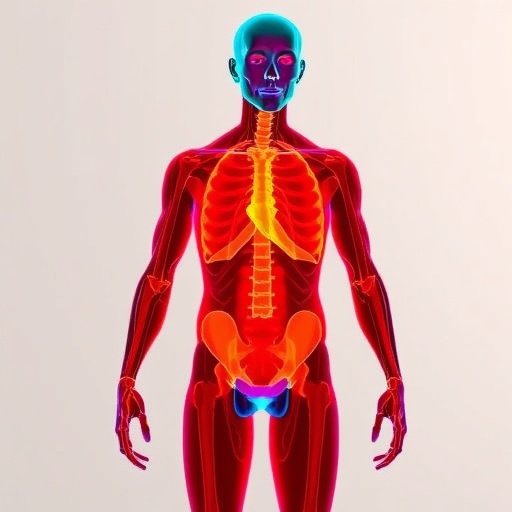
In a groundbreaking study that leverages artificial intelligence and advanced imaging technologies, researchers have unveiled an unprecedentedly detailed atlas of human body composition across age, sex, and height. By analyzing whole-body MRI scans from over 66,000 individuals, this work profoundly advances our understanding of how fat and muscle are distributed in the body, challenging the traditional reliance on body mass index (BMI) and opening new pathways for predicting and managing cardiometabolic diseases.
Traditionally, BMI and simple body weight measurements have served as the cornerstone metrics for estimating health risks related to cardiovascular and metabolic disorders. However, BMI’s inherent limitations—primarily its failure to differentiate between muscle mass and fat or their respective anatomical distributions—have prompted a search for better indicators. This new research confronts that gap head-on by employing deep learning algorithms capable of dissecting complex MRI data to precisely quantify subcutaneous fat, visceral adipose tissue, skeletal muscle volume, intramuscular fat, and muscle quality.
The study cohort, drawing from the extensive UK Biobank and German National Cohort, encompasses 66,608 participants with a mean age approaching 58 years. Their body composition metrics were normalized for age, sex, and height, yielding z-scores that represent individual deviation from population-adjusted norms. This normalization is crucial to accurately gauge risk, as muscle and fat distribution naturally fluctuate throughout the lifespan and differ markedly between sexes and body sizes.
One of the critical revelations from this research highlights that visceral fat—fat stored around internal organs—is associated with a 2.26-fold increased risk of developing diabetes. This finding reaffirms the pathogenic role of visceral adiposity but importantly places it within a framework of nuanced risk assessment informed by personalized body composition profiles rather than crude BMI scores.
Equally transformative is the insight into muscle quality and quantity. High levels of intramuscular fat, indicative of poor muscle quality, correlated with a 1.54-fold increased risk of major cardiovascular events. Meanwhile, a low skeletal muscle mass independently predicted a 1.44-fold higher risk of all-cause mortality, underscoring muscle not just as a mechanical structure but as a vital metabolic organ whose integrity impacts survival beyond traditional cardiometabolic risk factors.
These findings challenge the medical community to rethink how patient risk profiles are constructed and suggest that future clinical protocols might incorporate automated AI-driven imaging tools to routinely assess muscle and fat parameters during standard imaging exams. The AI framework developed for this study is open-source and fully automated, able to extract precise body composition metrics from whole-body MRI scans with minimal human intervention, enhancing reproducibility and clinical scalability.
From a technical perspective, the research team leveraged convolutional neural networks trained on massive annotated datasets to segment and quantify multiple tissue compartments. This approach surpasses older techniques like dual-energy X-ray absorptiometry (DEXA) and bioelectrical impedance analysis (BIA), which cannot discern intramuscular fat fractions or provide detailed anatomical fat distributions with high accuracy.
The study also generated reference curves that map body composition trajectories throughout the aging process, stratified by sex and height. Such standardized references are invaluable not only for risk stratification but also for monitoring therapeutic interventions, enabling clinicians to differentiate between beneficial fat loss and detrimental muscle wasting, particularly relevant in contexts like weight-loss treatments utilizing GLP-1 receptor agonists.
Importantly, this novel AI-powered analytical framework can apply to a range of existing imaging modalities beyond dedicated whole-body MRI scans. Routine chest or abdominal CTs and MRIs, commonly acquired in clinical practice, harbor untapped data on muscle and fat composition that, with this technology, can be extracted and harnessed for improved patient care without additional imaging burden.
The implications extend beyond metabolic and cardiovascular medicine. The capability to finely characterize body composition holds promise for oncology, where muscle loss (sarcopenia) and fat distribution influence treatment toxicity, survival outcomes, and cancer recurrence. Validating these reference standards in clinical populations forms the next frontier of this research, fine-tuning diagnostic tools tailored for diverse disease contexts.
This research signifies a pivotal shift toward precision medicine driven by data-rich, AI-enabled imaging analytics. It propels the medical field toward a future where personalized body composition metrics will be seamlessly integrated into routine diagnostics, facilitating earlier detection of risk, more informed treatment decisions, and personalized monitoring of disease progression and therapy response.
By turning the hidden layers of everyday imaging data into actionable clinical insights, the study paves the way for a new paradigm in health care—one that recognizes the multifaceted nature of body composition as a critical determinant of overall health and disease risk, beyond the simplistic measures of weight and height.
News Publication Date:
5-May-2026
Web References:
– Radiology Journal: https://pubs.rsna.org/journal/radiology
– Radiological Society of North America: https://www.rsna.org/
– Patient Information on MRI: http://www.radiologyinfo.org
Cite Scienmag News
Denise Maddox. (May 5, 2026). AI Model Analyzes Body Composition to Forecast Health Risks. Scienmag. https://scienmag.com/ai-model-analyzes-body-composition-to-forecast-health-risks/
Denise Maddox. "AI Model Analyzes Body Composition to Forecast Health Risks." Scienmag, 5 May 2026, https://scienmag.com/ai-model-analyzes-body-composition-to-forecast-health-risks/. Accessed 3 September 2026.
Denise Maddox. "AI Model Analyzes Body Composition to Forecast Health Risks." Scienmag. May 5, 2026. https://scienmag.com/ai-model-analyzes-body-composition-to-forecast-health-risks/


