



view more
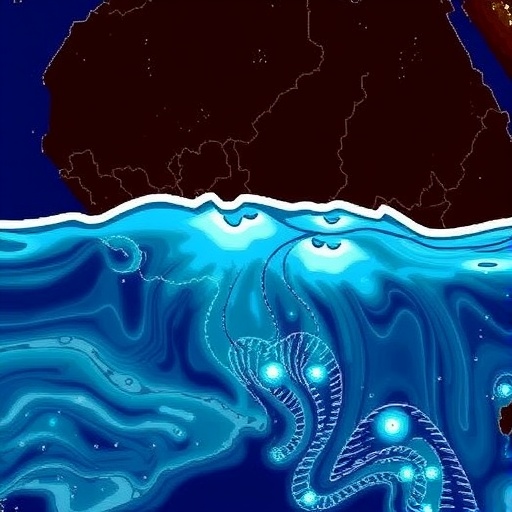
Credit: Ghomsi et al., Communications Earth & Environment (2026). Licensed under CC BY 4.0.
“African coastlines face unprecedented sea level surge crisis
A groundbreaking study led by researchers at the University of Cape Town’s (UCT) Department of Oceanography has revealed that Africa’s coastlines are facing a rapidly accelerating crisis. It found that the 2023-2024 El Niño event triggered the most significant sea level surge ever recorded in the region, exceeding even the historically powerful 1997-1998 event and highlighting a dangerous new reality for the continent’s coastal nations.
The study, published in Communications Earth & Environment, analysed over three decades of satellite data spanning from 1993 to 2024 across the Atlantic Ocean, Indian Ocean, Mediterranean Sea, Red Sea and adjacent waters surrounding Africa. Regional sea levels have risen by 11.26 centimeters since 1993, outpacing the global average and accelerating at a rate of 0.14 millimeters per year squared, faster than previously documented.
A record-breaking climate event
When the long-term trend of rising seas is removed to isolate the effect of natural climate cycles, the 2023-2024 El Niño produced a sea level anomaly of 27 millimeters, the largest on record. This dwarfs the 1997-1998 El Niño, considered one of the most powerful climate events of the 20th century, which produced a smaller anomaly of roughly 19 millimeters.
What made this event extraordinary was not the El Niño alone. Multiple climate patterns aligned simultaneously beforehand. The Indian Ocean Dipole, the Atlantic Niño and the Tropical North Atlantic index all reached record-positive levels, preconditioning the ocean to respond with unusual intensity. This rare convergence amplified the El Niño’s impact far beyond what its strength alone would predict.
“”We are witnessing a fundamental shift in how the ocean responds to climate variability. The 2023-2024 event interacted with an ocean already preconditioned by multiple climate forces and excessive heat, creating a compound effect that pushed sea levels to heights we have never seen in the satellite record,”” said Dr Franck Ghomsi, the study’s lead researcher and a postdoctoral fellow at the Nansen-Tutu Centre for Marine Environmental Research in the Department of Oceanography at UCT.
Trapped heat, rising seas
Thermal expansion, the physical swelling of water as it heats up, accounted for over 70% of the total rise during the event. In simple terms, the ocean was experiencing a fever.
Typical wind patterns that usually bring cold, nutrient-rich water up from the deep ocean along Africa’s coasts effectively shut down. This meant hot surface water piled up along the coastline. Simultaneously, the ocean became highly stratified or layered. This stratification acted like a lid, trapping heat near the surface and preventing it from mixing into deeper, cooler waters. The result was a quadrupling of ocean heat content compared to previous events, creating a feedback loop that locked ever more warmth near the surface and drove sea levels higher.
A continent at a crossroads
The study identified a critical turning point around 2009, when sea level rise accelerated by 73%, jumping from 2.72 to 4.70 millimeters per year. The 2023-2024 period alone contributed roughly one-fifth of all rise recorded since 1993.
This acceleration threatens over 15 million people across Africa’s 38 coastal nations. Cities including Lagos, Douala, Accra and Dar es Salaam face growing risks from flooding, land subsidence and extreme weather, while Small Island Developing States such as the Seychelles and Comoros face threats to infrastructure and fresh water supplies. The suppression of nutrient-rich deep water also devastates fisheries that millions depend on for food and income.
“”This research closes a critical knowledge gap regarding African sea levels,”” said Dr Ghomsi. “”We must use this information to drive policy, build resilient infrastructure and protect the vulnerable communities that define our continent’s coastline.”””
Journal
Communications Earth & Environment
Method of Research
Data/statistical analysis
Subject of Research
Not applicable
Article Title
2023-2024 El Niño amplifies record sea level surges in African marine domains
Article Publication Date
17-Feb-2026
COI Statement
The authors declare no competing interests.
Hishamodien Hoosain
University of Cape Town – Faculty of Science
science-marketing@uct.ac.za
Journal
Communications Earth & Environment
Method of Research
Data/statistical analysis
Subject of Research
Not applicable
Article Title
2023-2024 El Niño amplifies record sea level surges in African marine domains
Article Publication Date
17-Feb-2026
COI Statement
The authors declare no competing interests.
Cite Scienmag News
Violet Maxwell. (March 25, 2026). Unprecedented Sea Level Rise Threatens African Coastlines: A Scientific Urgency. Scienmag. https://scienmag.com/unprecedented-sea-level-rise-threatens-african-coastlines-a-scientific-urgency/
Violet Maxwell. "Unprecedented Sea Level Rise Threatens African Coastlines: A Scientific Urgency." Scienmag, 25 March 2026, https://scienmag.com/unprecedented-sea-level-rise-threatens-african-coastlines-a-scientific-urgency/. Accessed 3 September 2026.
Violet Maxwell. "Unprecedented Sea Level Rise Threatens African Coastlines: A Scientific Urgency." Scienmag. March 25, 2026. https://scienmag.com/unprecedented-sea-level-rise-threatens-african-coastlines-a-scientific-urgency/

