


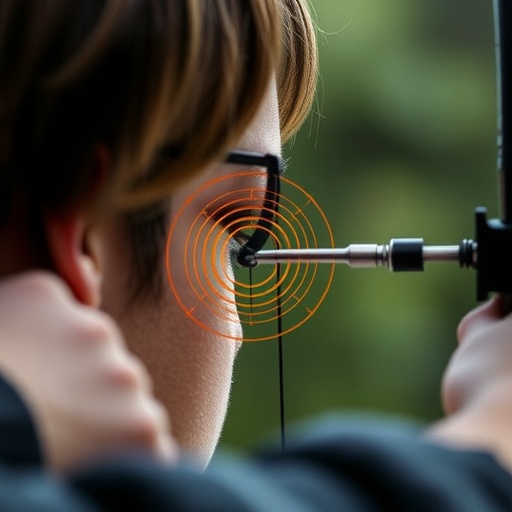
Research in the realm of sports science continuously evolves, yielding novel insights into the multifaceted factors that contribute to athletic performance. A recent study by Söğüt, Şimşek, and Kesilmiş dives deep into a lesser-discussed yet fundamentally vital aspect of archery – the role of the “quite eye duration” parameter in predicting high-potential archers. This innovative approach promises to not only enhance training methodologies but also refine scouting techniques for discovering emerging talent in the discipline of archery.
The study hinges on the premise that visual acuity, specifically the ability to maintain a steady gaze under pressure, plays a crucial role in executing precise shots in archery. Archers are often subjected to intense stress and distractions that can severely undermine their performance. The research builds a compelling case for measuring “quite eye duration,” a term that denotes the length of time an archer can maintain a steady visual focus on their target before making a shot. This ability is significant because it directly correlates to the archer’s likelihood of scoring well, especially in high-pressure tournament settings.
Technologically advanced tools were employed in the research to precisely measure the duration of an archer’s eye fixation on the target. Using eye-tracking devices, the researchers gathered extensive data on various archers, capturing insights into their unique visual patterns leading up to each shot. The data was meticulously analyzed to identify trends and correlations between eye fixation duration and shooting accuracy, revealing that archers with longer fixation durations tended to outperform their peers consistently. This finding opens avenues for tailored training programs focused on improving visual attention and concentration skills among aspiring archers.
Furthermore, Söğüt et al. identified distinct variations in quite eye duration across different skill levels. Novice archers displayed greatly fluctuating fixation durations, often losing focus leading up to the shot, which contributed to their inconsistent scores. In contrast, high-performing archers exhibited remarkable steadiness in their fixation durations, suggesting a robust level of mental discipline and practice that effectively minimizes distractions. This critical differentiation highlights the potential for the development of training modules explicitly aimed at enhancing mental fortitude and visual focus in competitive archery.
Moreover, the implications of this research extend beyond mere performance enhancement. The findings signal a paradigm shift in how talent identification in archery occurs. Traditionally, coaches and scouts have relied on physical skills and past performance records to identify promising archers. However, incorporating the quite eye duration parameter into this analysis allows for a more holistic appraisal of talent potential. Coaches can now utilize a data-driven approach to assess young archers, prioritizing those who demonstrate superior visual focus, thus optimizing their recruitment strategies.
The cognitive dimensions of sports performance underscore the critical interplay between physical training and mental readiness. This research contributes to a growing body of literature that underscores the necessity of integrating psychological factors into physical training regimens. Archers who exhibit the ability to sustain concentration through prolonged eye fixation tend to experience greater confidence during competitions, which translates into improved performance outcomes. By fostering an awareness of the psychological aspect of hitting a target, coaches and athletes alike can cultivate a more rounded skill set.
Collaboration among researchers from various disciplines further enriches the findings of this study. By combining expertise from sports psychology, biomechanics, and data analysis, the authors crafted a comprehensive study that resonates with contemporary approaches to sports science. This interdisciplinary angle not only broadens the research framework but also enhances the relevance of the findings to practitioners within the field. Importantly, as sports science continues to evolve, it is imperative that researchers remain committed to fostering collaborations that help unveil new insights into performance enhancement.
The potential applications of the “quite eye duration” findings are staggering. The research suggests that these insights could benefit not only archers but also athletes across a variety of sports requiring precision and focus. For example, athletes in disciplines such as shooting, golf, and even tennis could benefit from pinpointing and enhancing their focusing abilities. Implementing a unified training model that incorporates visual attention skills could strengthen the performance outcomes across these sporting arenas.
Furthermore, this innovative research opens the door for future explorations that investigate the physiological and psychological responses of archers during their sport. Delving into how fatigue impacts quite eye duration and performance could provide valuable information on optimal training cycles and recovery strategies. A nuanced understanding of these variables could subsequently inform the development of advanced performance analytics that helps athletes attain peak performance, ultimately altering the landscape of competitive archery.
In summary, the study conducted by Söğüt, Şimşek, and Kesilmiş presents a compelling argument for the incorporation of the “quite eye duration” parameter in both training and talent identification. By reframing the focus on visual acuity and concentration, this research offers fresh insights into the mental dimensions of archery performance. As coaches and athletes begin to recognize the importance of mastering mental alertness in addition to physical skills, a new era of training and performance enhancement awaits in the archery community. The results not only serve the immediate needs of athletes competing today but also lay strong groundwork for the future of the sport.
As the understanding of the interplay between visual focus and athletic performance deepens, we can anticipate further empirical studies emerging from this foundation, potentially revolutionizing how athletes train and compete. This research emphasizes the importance of viewing archery—and indeed all sports—as a complex interplay of mental and physical training, each indispensable for achieving excellence. Such holistic perspectives are paramount for elevating not just archery, but all sports disciplines to new heights of performance and achievement.
Söğüt, F., Şimşek, M. & Kesilmiş, İ. Predicting high potential archers by the quite eye duration parameter.
Sports Eng 28, 9 (2025). https://doi.org/10.1007/s12283-025-00492-w
Cite Scienmag News
Denise Maddox. (September 1, 2025). Unlocking Archer Potential Through Eye Duration Analysis. Scienmag. https://scienmag.com/unlocking-archer-potential-through-eye-duration-analysis/
Denise Maddox. "Unlocking Archer Potential Through Eye Duration Analysis." Scienmag, 1 September 2025, https://scienmag.com/unlocking-archer-potential-through-eye-duration-analysis/. Accessed 7 September 2026.
Denise Maddox. "Unlocking Archer Potential Through Eye Duration Analysis." Scienmag. September 1, 2025. https://scienmag.com/unlocking-archer-potential-through-eye-duration-analysis/


