


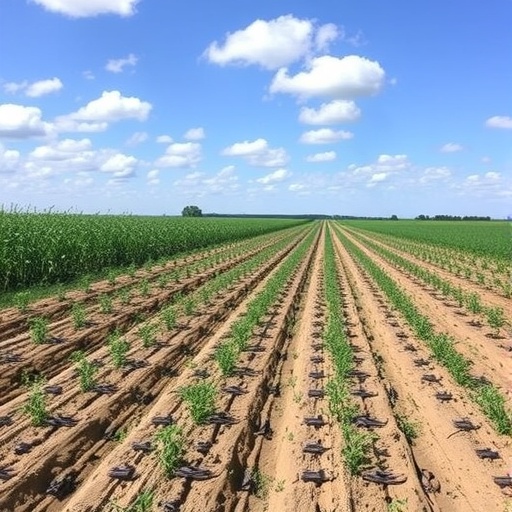
In the rolling fields across the US Midwest, a quiet revolution in sustainable agriculture is underway—one driven not by tractors or plows, but by satellites orbiting high above the earth and sophisticated machine learning algorithms decoding their signals. Researchers at the University of Illinois Urbana-Champaign have unveiled an innovative, dynamic framework capable of detecting tillage practices across vast landscapes and extended time horizons. This breakthrough transforms the way scientists, policymakers, and farmers understand soil management, offering unprecedented insights into conservation tillage’s role in promoting soil health and environmental resilience.
Conservation tillage, encompassing techniques such as no-till and reduced tillage, has long been recognized as a cornerstone of sustainable farming. By minimizing soil disturbance, these practices preserve organic matter, enhance moisture retention, and combat erosion — factors essential to maintaining fertile land amid growing climate concerns. Yet despite their importance, accurate and timely data on tillage adoption has remained elusive, traditionally reliant on self-reported farmer surveys that lack fine spatial resolution or the capacity to reflect rapid changes in practices over time.
Addressing this critical knowledge gap, the Illinois research team harnessed the power of satellite remote sensing, leveraging crop residue indices derived from spectral data to detect the presence and intensity of different tillage methods. Unlike previous efforts limited to snapshot assessments or small locales, their approach incorporates a comprehensive array of environmental variables — including soil type, moisture conditions, and prevailing weather patterns — accounting for the myriad factors that modulate spectral signatures. This environmental context is integrated alongside machine learning models trained to discern subtle patterns, allowing for remarkably accurate, scalable mapping of tillage practices.
The resulting framework was applied over an expansive study area covering key agricultural states in the Midwest, tracking changes from the year 2000 through 2022. This extensive temporal window affords an unprecedented view of how conservation tillage adoption has evolved, illuminating regional and crop-specific dynamics. Corn and soybeans, the backbone of Midwestern agriculture, exhibited distinct trends: soybean fields more frequently embraced no-till methods, while cornfields showed a preference for reduced tillage approaches. Additionally, spatial disparities emerged, reflecting how local climate and soil conditions influence farmers’ management choices.
One fascinating revelation is the greater prevalence of no-till in the drier Great Plains regions. In these areas, retaining crop residues on the soil surface plays a pivotal role in conserving moisture, a critical resource during dry spells. Moreover, no-till’s slower soil warming effect is less constraining in warmer zones, ensuring planting schedules remain intact. Such nuanced understanding underscores the essential need to tailor conservation strategies to the specific ecological and climatic context, rather than adopting blanket prescriptions.
Lead author Xiaocui Wu emphasized how this methodology bridges a major scientific divide. “Current datasets, heavily reliant on surveys, have lacked the spatial and temporal resolution needed to fully understand tillage practices’ impacts,” Wu stated. “Our framework fills this void, offering detailed, regionally sensitive maps of tillage that can inform soil carbon modeling and resource conservation efforts.” Principal investigator Kaiyu Guan further highlighted the policy implications: “These data empower agencies to refine conservation programs, ensuring they effectively promote practices that safeguard soil and water quality.”
This advancement holds substantial promise beyond academic curiosity. Effective management of tillage touches on critical issues like reducing nutrient runoff that contributes to water pollution, enhancing soil carbon sequestration that combats climate change, and boosting the resilience of agroecosystems facing increasingly erratic weather patterns. By providing high-resolution, long-term data, the new framework equips stakeholders with a powerful tool for monitoring progress toward environmental and agricultural sustainability goals.
Earlier attempts to measure tillage relied heavily on hyperspectral and multispectral remote sensing technologies, which, while promising, struggled with confounding factors such as soil background effects and weather variability. These influences could obscure crop residue signals, limiting detection accuracy and consistency over large geographic extents. The Illinois team addressed these limitations through an integrated model that dynamically adjusts for environmental variability, reducing uncertainty and enhancing robustness.
Implementing this modeling framework required processing extensive satellite data archives, exploiting vegetation indices sensitive to residue cover, and applying machine learning algorithms capable of pattern recognition amidst complex datasets. The researchers blended domain expertise in agroecosystem science with advanced computational methods, illustrating the growing importance of interdisciplinary approaches in environmental monitoring.
As conservation tillage increasingly becomes a pillar of modern farming, the need for comprehensive monitoring grows. This framework sets a precedent for remote sensing applications in agriculture, demonstrating how technology can uncover hidden practices and trends once invisible at large scales. Policymakers and agronomists alike can leverage these insights to design smarter incentives, track adoption rates in real time, and predict the environmental outcomes of agricultural decisions.
The study’s findings reveal not only upward trends in conservation tillage adoption but also regional heterogeneity that calls for fine-tuned management strategies. For instance, targeted outreach and resources could be directed toward regions lagging in no-till adoption where it may offer significant environmental benefits. Furthermore, continuous monitoring enables rapid response to emerging challenges or shifts in farming practices prompted by socioeconomic or climatic factors.
For the scientific community, these detailed tillage maps open new research avenues. Incorporating accurate tillage data enhances simulations of soil erosion, nutrient cycling, and water dynamics, fostering better predictions and recommendations. This work exemplifies the crucial role of integrating remote sensing and machine learning to unlock the complexities of agricultural landscapes, advancing a data-driven approach to sustainable food production.
In conclusion, the University of Illinois Urbana-Champaign research team’s development of a satellite-based, machine learning-driven framework marks a significant leap forward in agricultural science. By illuminating nuanced patterns of conservation tillage across vast regions and over extended periods, they have provided a valuable compass for guiding sustainable land management. As agriculture faces mounting pressures from environmental change and resource constraints, such technological innovations will be key to ensuring productive, resilient, and environmentally sound food systems for the future.
News Publication Date:
28-Feb-2026
Web References:
- University of Illinois Urbana-Champaign: https://illinois.edu/
- Agroecosystem Sustainability Center: https://asc.illinois.edu/
- Institute for Sustainability, Energy, and Environment: https://sustainability.illinois.edu/
- Center for Advanced Bioenergy and Bioproducts Innovation (CABBI): https://cabbi.bio/
- Department of Natural Resources and Environmental Sciences: https://nres.illinois.edu/
- College of Agricultural, Consumer and Environmental Sciences: https://aces.illinois.edu/
- Published Paper: https://doi.org/10.1016/j.rse.2026.115323
References:
Wu, X., Guan, K., et al. (2026). A framework to detect tillage practices from space: a demonstration in the US Midwest. Remote Sensing of Environment. https://doi.org/10.1016/j.rse.2026.115323
Keywords
Conservation tillage, no-till farming, reduced tillage, remote sensing, satellite imagery, machine learning, soil health, crop residue, Midwest agriculture, sustainability, environmental monitoring, soil carbon sequestration
Cite Scienmag News
Alan Morgan. (April 21, 2026). University of Illinois Scientists Create Dynamic Space-Based System to Track Tillage Practices. Scienmag. https://scienmag.com/university-of-illinois-scientists-create-dynamic-space-based-system-to-track-tillage-practices/
Alan Morgan. "University of Illinois Scientists Create Dynamic Space-Based System to Track Tillage Practices." Scienmag, 21 April 2026, https://scienmag.com/university-of-illinois-scientists-create-dynamic-space-based-system-to-track-tillage-practices/. Accessed 3 September 2026.
Alan Morgan. "University of Illinois Scientists Create Dynamic Space-Based System to Track Tillage Practices." Scienmag. April 21, 2026. https://scienmag.com/university-of-illinois-scientists-create-dynamic-space-based-system-to-track-tillage-practices/


