


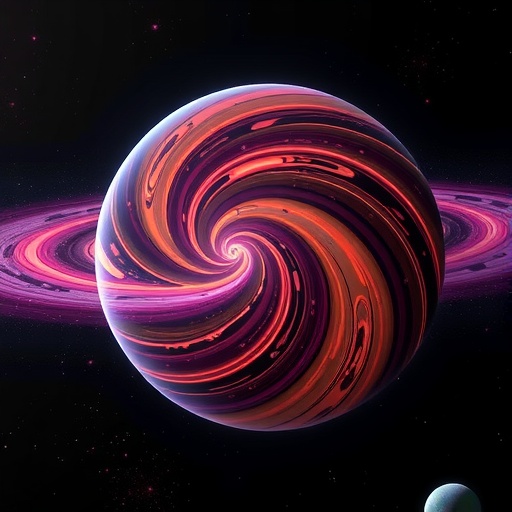
A groundbreaking discovery by an international team of astronomers has yielded the most compelling evidence to date that certain exoplanets—planets orbiting stars beyond our Solar System—possess intrinsic magnetic fields. Utilizing cutting-edge observational techniques with two of the world’s most powerful ground-based telescopes, the European Southern Observatory’s Very Large Telescope (ESO’s VLT) in Chile and the Gemini North telescope in Hawaiʻi, scientists meticulously measured atmospheric wind velocities on seven searingly hot, Jupiter-like exoplanets. These findings reveal that magnetic forces dominate the dynamics of the fierce winds raging across these distant worlds, enabling the first robust quantification of extraterrestrial planetary magnetism.
Magnetic fields on Earth play a crucial role in shaping the planet’s atmospheric behavior and safeguarding its habitability by deflecting charged solar particles and maintaining the planet’s atmosphere. Similarly, planets such as Jupiter and Saturn in our own Solar System demonstrate the presence of strong magnetic fields, which significantly influence their magnetospheres and atmospheric phenomena. However, despite extensive study over the past decade and a half, determining the magnetic field strengths of exoplanets has remained an elusive quest—until this recent milestone.
The research team originally embarked on measuring wind speeds rather than magnetic strengths. The subjects of this investigation are gas giants analogous to Jupiter but situated in extremely close orbits around their parent stars, rendering them tidally locked. This synchronous rotation ensures one hemisphere is perpetually scorched by stellar radiation while the opposite side remains in frigid darkness. The stark thermal gradient between their day and night hemispheres drives atmospheric winds at extraordinary speeds ranging from approximately 7,200 kilometers per hour up to over 25,000 kilometers per hour. For comparison, the strongest winds recorded on Jupiter reach a mere 1,500 kilometers per hour, highlighting just how extreme these exoplanetary conditions can be.
Upon comparing wind velocities with the planets’ thermal characteristics, the researchers unearthed an intriguing counterintuitive pattern: hotter planets exhibit slower wind speeds. This paradox arises because, theoretically, higher temperatures should inject greater energy into atmospheric circulation, accelerating winds rather than impeding them. Such unexpected behavior compelled the team to explore alternative mechanisms capable of mitigating wind velocities on these distant behemoths.
A leading hypothesis emerged that intrinsic planetary magnetic fields act as a braking force on these electrically conductive atmospheres. In essence, the magnetic fields interact with the ionized atmospheric particles, exerting Lorentz forces that resist and slow down wind motion. This magnetohydrodynamic damping effect offers a coherent explanation for the temperature-linked slowdown in wind speeds observed. By inverting this logic, the astronomers deduced magnetic field strengths for each exoplanet in their sample, revealing fields comparable to those found within our Solar System. Estimated strengths are roughly four times that of Saturn’s magnetic field and about half the intensity of Jupiter’s, underscoring these distant worlds as potent magnetic entities.
The implications of such formidable magnetic fields extend well beyond atmospheric wind dynamics. On Earth, our magnetic field enables spectacular auroral displays where charged solar particles collide with atmospheric gases near the poles, producing vibrant green, pink, and purple lights—the northern and southern lights. Applying this analogy to the studied exoplanets suggests their magnetically driven aurorae could be far more intense and visually striking, illuminated by the interplay of their strong magnetic fields and stellar wind interactions. These phenomena offer tantalizing prospects for future observations and atmospheric characterizations.
This breakthrough heralds a new era for exoplanet research, unlocking the ability to compare magnetic environments across a diverse array of worlds. Such understanding is indispensable for unraveling how planetary magnetism influences atmospheric retention, surface conditions, and ultimately, a planet’s potential to sustain water and perhaps even life. The study’s lead author emphasized that comprehending magnetic environments is “a key step toward ultimately understanding which planets can stay alive” in a cosmic sense.
Harnessing observations from ESO’s ESPRESSO instrument installed on the VLT—a high-resolution spectrograph equipped for precision radial velocity and atmospheric studies—was critical to this achievement. Alongside the Gemini North telescope, the collaboration leveraged sophisticated spectroscopy to track wind-induced Doppler shifts in exoplanet atmospheres. This methodology provides a unique window into the kinetic forces at play in these exotic climates, which are otherwise inaccessible in such detail.
The success of these measurements also underscores the vital role of international scientific collaboration. The combined resources of ESO and NSF’s Gemini Observatory facilitated this pioneering work, bridging continents and expertise. Looking ahead, the advent of next-generation observatories like ESO’s Extremely Large Telescope promises to revolutionize magnetic field studies further, extending these techniques to smaller Earth-like planets. Such advancements might one day enable the detection of auroral gases and magnetic signatures directly tied to planetary habitability.
Envisioning these alien skies, one can imagine vast luminous curtains rippling above planets locked in eternal day and night, painted by aurorae far more breathtaking than those on Earth. This blend of stellar physics, planetary science, and atmospheric dynamics enriches our understanding of the cosmic diversity and sets the stage for future discoveries regarding the magnetic hearts of distant worlds.
This research not only fills a longstanding gap in planetary astrophysics but also opens a novel observational frontier, empowering astronomers to probe the magnetic properties of exoplanets and their atmospheres with unprecedented precision. As instrumentation and analysis techniques advance, scientists anticipate unveiling the complex interactions shaping exoplanetary magnetospheres and their implications for planet formation and evolution.
Ultimately, this pioneering study lays the groundwork for a comprehensive framework to interpret how magnetic fields influence exoplanets, their climates, and the broader factors dictating their capacity to remain hospitable on astronomical timescales. It is a vital leap forward in the quest to understand our place in the universe and the conditions that make a planet truly alive.
News Publication Date: Not specified (refer to original Nature Astronomy release)
Web References:
- European Southern Observatory ESPRESSO Instrument: https://www.eso.org/public/teles-instr/paranal-observatory/vlt/vlt-instr/espresso/
- ESO Very Large Telescope (VLT): https://www.eso.org/public/teles-instr/paranal-observatory/vlt/
- Gemini Observatory: https://noirlab.edu/public/telescopes/gemini/
- ESO Extremely Large Telescope: https://elt.eso.org/
- DOI link to research paper: https://doi.org/10.1038/s41550-026-02870-1
References:
Seidel, J. V., Parmentier, V., Prinoth, B., et al. (2026). Measuring magnetic fields on hot Jupiter-like exoplanets via atmospheric wind speeds. Nature Astronomy. https://doi.org/10.1038/s41550-026-02870-1
Keywords
Exoplanets, magnetic fields, hot Jupiters, atmospheric dynamics, magnetohydrodynamics, planetary science, astronomy, Very Large Telescope, Gemini Observatory, aurorae, ESPRESSO instrument, tidal locking
Cite Scienmag News
Grant Pearson. (June 2, 2026). Mysterious Winds Offer Strongest Evidence Yet of Magnetic Activity on Exoplanets. Scienmag. https://scienmag.com/mysterious-winds-offer-strongest-evidence-yet-of-magnetic-activity-on-exoplanets/
Grant Pearson. "Mysterious Winds Offer Strongest Evidence Yet of Magnetic Activity on Exoplanets." Scienmag, 2 June 2026, https://scienmag.com/mysterious-winds-offer-strongest-evidence-yet-of-magnetic-activity-on-exoplanets/. Accessed 4 September 2026.
Grant Pearson. "Mysterious Winds Offer Strongest Evidence Yet of Magnetic Activity on Exoplanets." Scienmag. June 2, 2026. https://scienmag.com/mysterious-winds-offer-strongest-evidence-yet-of-magnetic-activity-on-exoplanets/


