


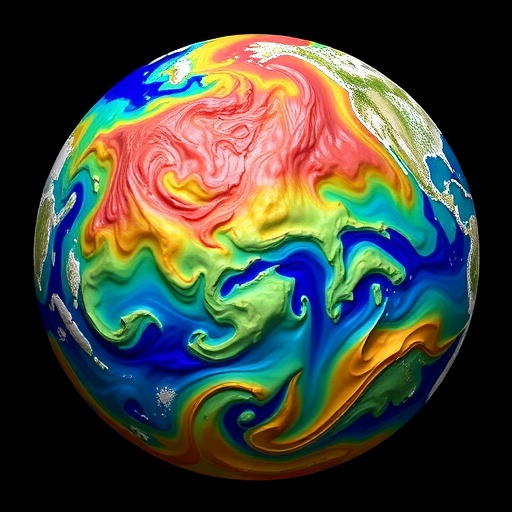
In a groundbreaking advancement in oceanographic research, a recent study has unveiled the intricate three-dimensional structure of fine-scale vertical velocities within the Southern Ocean, yielding unprecedented insights into the dynamic processes occurring beneath the waves. This pioneering work leverages cutting-edge satellite remote sensing technologies combined with innovative data processing techniques to illuminate aspects of ocean circulation that have long eluded scientists due to technological constraints. The findings, authored by Thompson, Dove, Tranchant, and colleagues, promise to revolutionize our understanding of oceanic vertical motions, which are crucial for global climate regulation and marine ecosystem dynamics.
The Southern Ocean, encircling Antarctica, plays a pivotal role in Earth’s climate system, acting as a massive conduit for heat and carbon exchange between the atmosphere and the deep ocean. Vertical water movements, although minute and challenging to detect, are fundamental drivers of nutrient transport, biological productivity, and carbon sequestration. Historically, measuring these minute vertical velocities has been fraught with difficulties given the vast scale of the ocean and the limitations of in-situ observational instruments. However, the novel approach harnessed in this study sidesteps these hurdles by exploiting space-borne sensors capable of detecting subtle signatures imprinted by vertical water movements on the ocean surface.
The research team utilized a sophisticated synthesis of satellite altimetry with high-resolution ocean circulation models to infer the fine-scale vertical motions embedded within the turbulent boundary layer of the Southern Ocean. By analyzing variations in sea surface height and temperature fluctuations in tandem with oceanographic simulations, they managed to reconstruct the three-dimensional velocity field with remarkable spatial and temporal resolution. This methodology marks a significant leap from traditional singularly focused measurements, opening a window into the complex interplays driving the vertical exchanges of water masses over tens to hundreds of kilometers and at resolutions below one kilometer.
One of the study’s key achievements is its demonstration of how fine-scale vertical velocities contribute to the vertical transport of heat and dissolved gases. These vertical currents help mediate the sequestration of atmospheric carbon dioxide into the deep ocean, a process essential for dampening the rise of global temperatures. Furthermore, the research highlights how such vertical motions facilitate the upward flux of nutrients, fostering regions of enhanced primary productivity that support the rich biodiversity characteristic of the Southern Ocean’s marine ecosystems. This revelation underscores the far-reaching implications of vertical velocity dynamics beyond mere physical oceanography, extending into ecological and biogeochemical realms.
The team observed that vertical velocity patterns are intricately linked to mesoscale and sub-mesoscale oceanic features such as eddies, filaments, and fronts. These dynamic structures generate localized upwelling and downwelling zones, inducing vertical water motion that contradicts previous simplistic assumptions of largely horizontal circulation. The study meticulously maps these structures in three dimensions, revealing a tapestry of interacting currents that shape the overall ocean circulation and impact global climate feedback mechanisms. This nuanced understanding could refine existing climate models by integrating these previously underrepresented vertical processes.
Moreover, the spatial heterogeneity elucidated by this research indicates that vertical velocities vary markedly across different regions of the Southern Ocean, influenced by factors such as wind forcing, buoyancy fluxes, and interactions with the Antarctic continental shelf. These findings suggest that the Southern Ocean’s vertical mixing processes are far more complex and spatially differentiated than previously recognized. This insight challenges conventional paradigms and calls for region-specific parameterizations in predictive climate and ocean models to capture the true scope of vertical exchanges.
Crucially, the use of satellite data enables continuous and global-scale monitoring of these fine-scale oceanic phenomena, overcoming the limitations inherent in sparse ship-based surveys or drifting instrument deployments. The remote sensing approach presented in the study unlocks the potential for real-time assessment of vertical velocity structures, facilitating an improved understanding of their temporal variability and responses to climatic anomalies. This capability is particularly vital in the context of a warming planet where rapid changes in ocean circulation can have profound and cascading impacts on climate and marine ecosystems.
The intricate data processing involved sophisticated machine learning algorithms and data assimilation techniques that optimized the fusion of satellite observations with numerical models. This interdisciplinary approach underscores the critical role that advances in computational science and artificial intelligence now play in enhancing Earth system sciences. By deciphering the complex signal embedded in the ocean surface data, the researchers could generate high-fidelity three-dimensional maps representing vertical velocity fields, previously unattainable at such fine spatial resolutions.
The implications of the study extend beyond the Southern Ocean. The methodology and findings set a precedent for investigating other major ocean basins, potentially transforming our comprehension of vertical mixing and exchange processes worldwide. Understanding the vertical dimension of ocean currents is vital for predicting the oceans’ capacity to buffer anthropogenic climate change, manage fisheries sustainably, and safeguard marine biodiversity. Therefore, this research represents a significant contribution not only to ocean science but also to policy-relevant fields related to climate adaptation and environmental stewardship.
Additionally, the research aids in unraveling the complex interplay between surface atmospheric forces, such as wind stress, and subsurface ocean processes. Vertical velocities serve as a key linkage in this coupled system, mediating momentum and scalar exchanges across the air-sea interface. The study’s detailed depiction of vertical flow structures reinforces theories about the vertical coupling mechanisms in the ocean, informing future studies aimed at quantifying energy dissipation and mixing in marine environments.
Future research inspired by these findings is expected to delve deeper into the seasonal and interannual variability of vertical velocities, examining their role in modulating climate anomalies such as the Southern Annular Mode and El Niño-Southern Oscillation teleconnections. Enhanced understanding of how vertical currents respond to environmental forcing will improve predictions about regional and global climate variability, potentially leading to better-informed climate resilience strategies.
The study also uncovers intriguing questions about the feedback loops between biological processes and physical ocean dynamics. For example, how do fine-scale vertical velocities influence phytoplankton blooms and subsequent carbon export to the deep ocean? By bridging physical and biological oceanography, future interdisciplinary efforts could build on this foundational work to chart holistic views of ocean-atmosphere-biosphere interactions in polar regions.
Critically, the insight gained into vertical velocity structure carries enormous practical significance for navigational safety and offshore engineering in the Southern Ocean, an area of increasing human activity despite its extreme conditions. Understanding vertical current patterns will aid in designing resilient marine infrastructure and in planning sustainable exploitation of marine resources, ensuring minimal ecological disturbance.
In sum, the meticulous research conducted by Thompson et al. draws from advanced space-based technologies and innovative analytical methods to reveal the Southern Ocean’s fine-scale vertical velocity landscape in three dimensions. This monumental achievement not only fills a crucial knowledge gap but sets the stage for transformative advances in marine sciences, climate research, and environmental policy formulation.
As humanity grapples with the multifaceted impacts of climate change, studies like this underscore the importance of pushing the frontiers of observational capability and interdisciplinary collaboration. The ocean’s vertical dimension, once a murky and inaccessible realm, now emerges with clarity and vivid detail, promising to reshape scientific understanding and practical management of our blue planet for generations to come.
Cite Scienmag News
Violet Maxwell. (June 2, 2026). 3D Fine-Scale Southern Ocean Currents Revealed from Space. Scienmag. https://scienmag.com/3d-fine-scale-southern-ocean-currents-revealed-from-space/
Violet Maxwell. "3D Fine-Scale Southern Ocean Currents Revealed from Space." Scienmag, 2 June 2026, https://scienmag.com/3d-fine-scale-southern-ocean-currents-revealed-from-space/. Accessed 3 September 2026.
Violet Maxwell. "3D Fine-Scale Southern Ocean Currents Revealed from Space." Scienmag. June 2, 2026. https://scienmag.com/3d-fine-scale-southern-ocean-currents-revealed-from-space/


