


In a groundbreaking study that reshapes our understanding of the early solar system and the origins of life-essential elements on Earth, scientists at Rice University have unveiled significant differences in the chemical composition of iron meteorites compared to younger asteroids. This research, recently published in Science Advances, highlights that the ratios of phosphorus to nitrogen in asteroidal bodies associated with iron meteorites diverge markedly from those found in chondrites, shedding new light on the distribution and delivery of these vital nutrients during planet formation.
Phosphorus and nitrogen, two elements fundamental to terrestrial life, play crucial roles in biological molecules and processes. The presence and relative abundance of these elements in nascent planetary bodies can provide key insights into the evolutionary pathways that led to habitable worlds. The Rice University team, led by Professor Rajdeep Dasgupta, embarked on a detailed investigation into the early chemical environment of planetesimals—the small bodies that coalesced to form planets—and how these environments influenced the availability of life-essential elements.
Central to this research was the recreation of iron meteorite formation conditions within the laboratory. Utilizing a high-pressure, high-temperature apparatus, the scientists simulated the crystallization processes that occurred within the metallic cores of these early planetesimals. Iron meteorites, which are fragments from these cores, provide an invaluable record of the primordial chemical environment, allowing researchers to reverse-engineer the elemental makeup of their parent bodies. Graduate student Debjeet Pathak, the study’s corresponding author, explained that their method involved correlating known meteorite chemical compositions with experimental results to deduce the nitrogen and phosphorus content in early planetesimals.
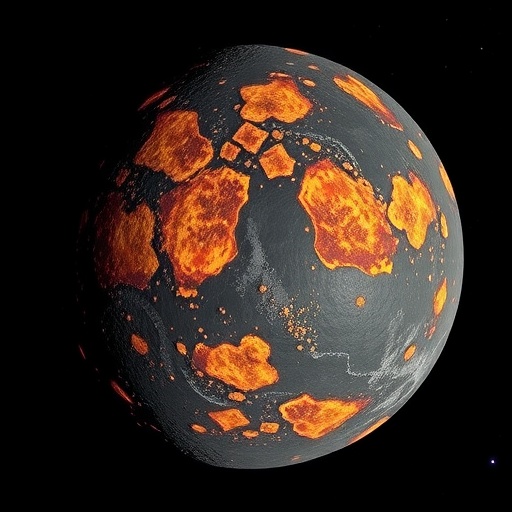
The solar system’s infancy, more than 4.5 billion years ago, was a dynamic milieu in which gases and dust laden with volatile compounds, including nitrogen and phosphorus, gradually coalesced into solid bodies. These small planetary embryos formed differentiated interiors, including metallic cores from which iron meteorites originated when disrupted by collisions or other cataclysmic events. The current repository of these iron meteorites largely resides in the asteroid belt, nestled between Mars and Jupiter, which acts as a dynamic boundary separating the inner terrestrial planets from the more distant gas giants.
The Rice team’s experimental approach offered unprecedented insight into the inner versus outer solar system’s chemical evolution. By simulating conditions of planetesimal formation across this spatial gradient, they observed a distinct variation in the phosphorus-to-nitrogen ratio. Inner solar system iron meteorites exhibited lower phosphorus to nitrogen ratios compared to their outer solar system counterparts. This spatial heterogeneity underscores the role of localized environmental conditions and processes in establishing the elemental inventory accessible to forming planets.
Interestingly, when the team compared these findings to the chemical signatures of chondrites—primitive, undifferentiated asteroids that formed slightly later—they found notable differences. Chondrites from the inner solar system possessed higher phosphorus-to-nitrogen ratios, which decreased progressively moving outward toward the outer solar system. This trend contrasts with the pattern found in iron meteorite-related planetesimals, suggesting distinct evolutionary timelines and mechanisms controlled element distribution during different formation epochs.
A pivotal factor influencing these disparities appears to be the massive gas giant, Jupiter. As it accrued mass and gravitational influence early in solar history, Jupiter likely acted as a formidable barrier, modulating the migration of volatile-rich materials across the nebula. This barrier would have curtailed the inward flow of nitrogen and phosphorus-bearing compounds from the outer to the inner solar system, leading to the decreasing elemental ratios observed in later chondritic bodies forming 2–3 million years after the iron meteorite parent planetesimals.
Crucially, both generations of planetesimals—those that spawned iron meteorites and those that formed chondrites—exhibited phosphorus-to-nitrogen ratios most closely aligned with the balance supporting life on Earth in the inner solar system. This convergence suggests that Earth’s life-essential elemental inventory may have predominantly originated from indigenous inner solar system sources rather than being imported from the more volatile-rich outer regions, challenging existing paradigms about planetary element delivery.
Professor Dasgupta emphasized the broader implications of these findings, stating that they offer a refined narrative on how early dust and planetesimal composition evolved under the combined influences of giant planetary growth and nebular cooling dynamics. The interplay between disk chemistry and planetary processes within the first few million years was integral to establishing the elemental framework that would foster habitable environments.
These discoveries advance our understanding of the cosmochemical processes governing planetary formation and evolution. By elucidating the distinct chemical reservoirs and transport mechanisms in the nascent solar system, this work provides foundational knowledge relevant not only to Earth’s history but also to the search for life-supporting conditions on exoplanets orbiting other stars.
The study’s fusion of experimental petrology, meteorite chemistry, and planetary formation models showcases how interdisciplinary approaches can unravel complex astrophysical phenomena. It affirms the idea that the early solar system was chemically and dynamically diverse, with primordial planetary building blocks exhibiting distinct evolutionary paths driven by both environmental and gravitational forces.
Sponsored by NASA grants 80NSSC18K0828 and 80NSSC22K0635, this research continues to position Rice University at the forefront of planetary origins and habitability studies. As the scientific community further explores these findings, the nuanced understanding of element delivery mechanisms will enrich our grasp of how indispensable ingredients for life were distributed, setting the stage for the emergence of life on Earth.
This work opens new avenues for future investigation into the timing, location, and processes that governed life-essential element synthesis and transport in the solar nebula. It also strengthens the conceptual framework guiding astrobiological exploration and the interpretation of meteoritic evidence in the context of planetary sciences. As humanity presses forward in unraveling the origins of life, studies like this illuminate the deep interconnections between cosmic evolution and biological potential.
News Publication Date: 3-Jun-2026
Web References:
https://www.science.org/doi/10.1126/sciadv.aed8749
http://dx.doi.org/10.1126/sciadv.aed8749
Cite Scienmag News
Grant Pearson. (June 3, 2026). Iron Meteorite Studies Reveal New Insights into Early Solar System and Earth’s Formation. Scienmag. https://scienmag.com/iron-meteorite-studies-reveal-new-insights-into-early-solar-system-and-earths-formation/
Grant Pearson. "Iron Meteorite Studies Reveal New Insights into Early Solar System and Earth’s Formation." Scienmag, 3 June 2026, https://scienmag.com/iron-meteorite-studies-reveal-new-insights-into-early-solar-system-and-earths-formation/. Accessed 3 September 2026.
Grant Pearson. "Iron Meteorite Studies Reveal New Insights into Early Solar System and Earth’s Formation." Scienmag. June 3, 2026. https://scienmag.com/iron-meteorite-studies-reveal-new-insights-into-early-solar-system-and-earths-formation/


