


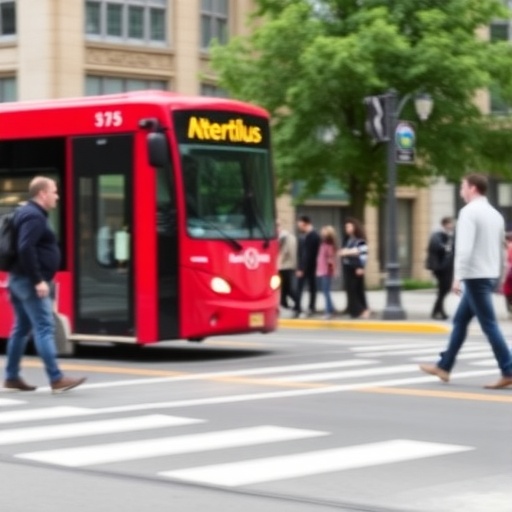
In the quest to bridge the persistent mobility gaps faced by individuals with compromised health, demand-responsive transport (DRT) has emerged as a promising inclusive solution, tailoring urban transit to meet first- and last-mile challenges. Despite its touted potential, the adoption hurdles for this vulnerable segment remain inadequately explored, presenting a critical frontier for transportation equity and innovation. The recent comprehensive study led by Dr. Haruka Kato, a junior associate professor at Osaka Metropolitan University, delves into these adoption dynamics within the unique context of Senboku New Town, Osaka, unraveling nuanced behavioral and infrastructural factors influencing DRT use.
At the heart of this investigation lies the application of the Unified Theory of Acceptance and Use of Technology-3 (UTAUT-3)—an advanced framework synthesizing user expectations, social influence, and facilitating conditions—to dissect the multifaceted determinants behind DRT acceptance among residents experiencing health limitations. By integrating this sophisticated theoretical lens, Dr. Kato’s research extends beyond rudimentary user surveys, leveraging psychometric analyses to quantify intention versus actual usage discrepancies within this demographic.
One of the study’s most striking revelations is the paramount role of community involvement in shaping individuals’ willingness to embrace DRT services. Unlike conventional transport paradigms, demand-responsive systems appear uniquely sensitive to social engagement cues, with residents’ propensity to adopt being significantly amplified by local citizen participation initiatives. Such findings underscore the critical intersection of social ecology and technology uptake, illustrating that infrastructural solutions alone cannot drive accessibility without fostering robust community ecosystems.
However, a compelling paradox emerges when examining behavioral outcomes: high willingness to use DRT does not seamlessly translate into frequent or sustained utilization among those in poor health. This gap signals latent practical barriers that undermine the potential benefits of DRT, especially for individuals who might rely on such systems as lifelines for independence and mobility. Dr. Kato identifies two pivotal obstacles within the lived realities of these users.
Foremost among these challenges is the spatial distribution of mobility points—or rather, their scarcity—proximate to the homes of potential users. Unlike fixed-route transit hubs, DRT relies heavily on strategically placed pick-up and drop-off nodes to maintain operational feasibility and user convenience. The research highlights that inadequate stop density in residential zones critically impairs service accessibility, disproportionately disadvantaging those with reduced physical capacity who cannot traverse long distances to reach mobility points.
Equally impactful is the technological barrier posed by smartphone-based booking interfaces integral to many DRT platforms. While digitization promises streamlined service management, it inadvertently erects a steep learning curve for older or health-impaired users who may struggle with touchscreens, app navigation, or intermittent connectivity. This underlines a crucial design consideration: inclusivity in user interface development must accommodate diverse abilities and technological fluency to mitigate digital exclusion in public transport innovation.
Senboku New Town presents a pioneering model wherein a cross-sector partnership approach underpins DRT deployment, integrating 15 local commercial, amenity, and healthcare stakeholders to anchor mobility points directly on familiar community grounds. This collaborative blueprint amplifies citizen engagement and incentivizes usage through localized discounts, thereby weaving transport accessibility into the socio-economic fabric of the town. Dr. Kato emphasizes that such integrative frameworks markedly bolster intention to use by cultivating trust, familiarity, and tangible value among elderly or health-compromised residents.
Beyond immediate findings, this research carries significant implications for urban planners and policymakers globally, who are grappling with aging populations and the imperative for more adaptable, person-centered transit systems. It challenges conventional wisdom that technology acceptance naturally leads to behavioral adoption, demanding a more holistic approach that simultaneously addresses physical infrastructure, digital literacy, and community empowerment.
Moreover, the study advocates for a recalibration of DRT operational design, urging increased uniformity and penetration of mobility points within residential vicinities to lower physical access thresholds. The implication extends to service scheduling and routing algorithms that must reconcile efficiency with equitable reach, ensuring that the promise of demand-responsiveness translates into actual mobility gains rather than symbolic acceptance.
The fusion of detailed data analysis with rigorous theoretical application enhances the credibility of these insights, positioning them as indispensable knowledge for advancing transportation equity. Dr. Kato’s work not only illuminates the barriers to DRT adoption but also paves the way for targeted interventions programmed to surmount these obstacles effectively, thereby enhancing quality of life for those whose health predicates their mobility needs.
Published in Transportation Research Interdisciplinary Perspectives, the study enriches scholarly discourse on accessible urban mobility and sets a benchmark for subsequent explorations into the intersection of technology, health, and transport. It signals a call to action for integrating human-centered design principles with collaborative governance to realize truly inclusive mobility futures.
As demand-responsive transport systems become increasingly integral to smart city infrastructures worldwide, ensuring their accessibility and usability for all populations—especially the health-vulnerable—will be essential to fulfilling promises of sustainable and equitable urban living. Dr. Kato’s pioneering research provides an empirical roadmap and theoretical foundation to guide these endeavors with precision and compassion.
This investigation reaffirms that addressing mobility disparities demands more than innovation alone; it requires the synergy of technology, community, policy, and design to unlock the transformative potential of demand-responsive transport systems for society’s most fragile members.
News Publication Date: 16-Sep-2025
Web References: None provided.
References: Published in Transportation Research Interdisciplinary Perspectives, DOI: 10.1016/j.trip.2025.101632
Cite Scienmag News
Courtney Benton. (October 1, 2025). United We Move: How Community Engagement Drives Adoption of New Transport Technologies. Scienmag. https://scienmag.com/united-we-move-how-community-engagement-drives-adoption-of-new-transport-technologies/
Courtney Benton. "United We Move: How Community Engagement Drives Adoption of New Transport Technologies." Scienmag, 1 October 2025, https://scienmag.com/united-we-move-how-community-engagement-drives-adoption-of-new-transport-technologies/. Accessed 6 September 2026.
Courtney Benton. "United We Move: How Community Engagement Drives Adoption of New Transport Technologies." Scienmag. October 1, 2025. https://scienmag.com/united-we-move-how-community-engagement-drives-adoption-of-new-transport-technologies/


