


Beneath every healthy plant lies a hidden economy of trade, and few partnerships are as ancient or as consequential as the one between plant roots and arbuscular mycorrhizal fungi. These microscopic soil dwellers colonize root systems, extending a fungal network far beyond the reach of the root itself, and in exchange for plant sugars they deliver water and mineral nutrients that the host would otherwise struggle to obtain. A new field study published in Plant Biosystems has now quantified just how powerful this partnership can be for one of the world’s most valued medicinal crops, milk thistle (Silybum marianum), showing that fungal inoculation can simultaneously raise seed yields, enrich the seeds with the liver-protective compound silymarin, and boost the biological activity of seed extracts in ways that vary strikingly between plant varieties.
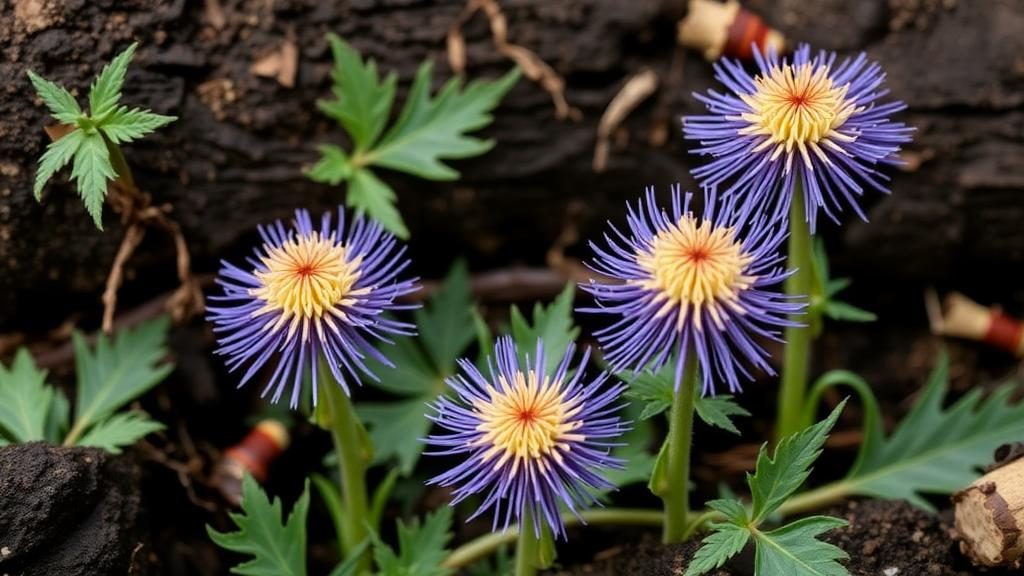
The research team, led by Hussein S. Mohamed of Beni-Suef University in Egypt together with collaborators across Egypt, Iraq and Saudi Arabia, conducted the work under genuine semiarid field conditions rather than in the more forgiving environment of a greenhouse. They compared two botanical varieties of milk thistle: the purple-flowered Silybum marianum var. marianum, abbreviated Sm-mar, and the white-flowered Silybum marianum var. albiflorum, or Sm-alb. Half of the plants were inoculated with arbuscular mycorrhizal fungi while the other half grew uninoculated as controls, allowing the researchers to isolate the effect of the symbiosis on everything from flower head counts to the molecular composition of the harvested seeds.
The yield results were unambiguous. Inoculated plants of the white-flowered variety produced roughly 13 percent more capitula, the spiny flower heads that contain the seeds, compared with about 8 percent more in the purple-flowered variety. More dramatic still were the changes in seed size and weight: thousand-seed weight rose by approximately 20 percent in Sm-mar and by 36 percent in Sm-alb. Taken together, these effects translated into overall seed yield gains of around 9 percent for the purple-flowered variety and a remarkable 27 percent for the white-flowered one. For a medicinal crop grown under water-limited conditions, yield improvements of this magnitude achieved without synthetic fertilizers represent a meaningful agronomic advance.
What makes the study particularly valuable is that the researchers did not stop at yield. They carried out a detailed metabolic audit of the seeds, examining primary metabolites such as sugars, organic acids and amino acids, as well as the secondary metabolites responsible for the plant’s pharmacological reputation. The carbon and nitrogen profiles of the seeds shifted in a clearly variety-dependent manner. In the white-flowered Sm-alb, glucose and fructose levels surged by up to about 136 percent and sucrose climbed by 37 percent relative to uninoculated controls. In the purple-flowered Sm-mar, the increases in individual sugars were more moderate and were instead accompanied by a shift toward higher starch accumulation, suggesting the two genotypes channel fungal-derived carbon into different storage forms.
The amino acid pools of the seeds also responded to the fungal partnership. Lysine, an essential amino acid that human and animal diets must supply externally, rose by roughly 50 percent in Sm-mar and 46 percent in Sm-alb under inoculation. The white-flowered variety additionally showed smaller but consistent increases in several other free amino acids. The authors are careful to frame these findings as evidence of improved seed amino acid pools rather than a direct demonstration of enhanced nitrogen nutrition status, a distinction that reflects the complexity of tracing nitrogen flows through a living symbiosis. Even so, the enrichment of essential amino acids has obvious implications for the nutritional value of milk thistle seed meal, which is already used in animal feed applications.
The headline result for pharmacology concerns silymarin, the signature complex of flavonolignans concentrated in milk thistle seeds that has been studied for decades for its hepatoprotective, antioxidant and anti-inflammatory properties. Here the two varieties diverged in an intriguing way. In the purple-flowered Sm-mar, total silymarin increased by about 36 percent, driven largely by rises in silybin, the most pharmacologically prominent component, along with a doubling of minor flavonolignans such as silydianin and silychristin. The white-flowered Sm-alb showed a more modest 12 percent increase in total silymarin with smaller changes in individual components. In other words, the purple variety proved the stronger silymarin responder, while the white variety excelled elsewhere.
Bulk phenolic chemistry told a similarly split story. Total phenolics and total flavonoids actually decreased slightly, by 15 to 16 percent, in the purple-flowered variety under mycorrhizal treatment, yet they increased by 11 percent and 34 percent respectively in the white-flowered one. This divergence underscores a principle that is increasingly recognized in plant-microbe research: mycorrhizal fungi do not simply push secondary metabolism in one direction. Instead, they reconfigure metabolic priorities in ways that depend on the genotype, the environment and the specific biosynthetic pathways involved. A decline in total phenolics can coexist with an increase in a targeted, high-value compound class such as the silymarin flavonolignans, as the Sm-mar results demonstrate.
Crucially, these compositional shifts translated into measurable changes in bioactivity. Ferric reducing antioxidant power, a standard assay of a sample’s capacity to neutralize oxidizing agents, increased by 26 percent in Sm-mar and by 65 percent in Sm-alb. Extracts from inoculated plants also inhibited the oxidation of low-density lipoprotein, the lipoprotein particle central to cardiovascular disease pathology, and reduced red blood cell hemolysis more effectively than extracts from control plants in both varieties. The antimicrobial results were perhaps the most eye-catching of all: activity against the most responsive bacterial strains rose by up to 160 percent in the white-flowered variety, while antifungal activity against Aspergillus flavus, a notorious food-contaminating fungus and producer of aflatoxins, increased by 41 percent in Sm-mar and 119 percent in Sm-alb.
The broader significance of the work lies in its demonstration that a single, low-input intervention can upgrade a medicinal crop on multiple axes at once. Arbuscular mycorrhizal fungi are increasingly promoted as biofertilizers for sustainable agriculture because they improve nutrient uptake, enhance drought tolerance and reduce the need for chemical inputs, but evidence that they can also raise the therapeutic quality of a crop’s harvest is far scarcer than evidence for yield effects alone. By documenting simultaneous gains in yield, amino acid nutrition, silymarin content, antioxidant capacity and antimicrobial potency under real field conditions, the study strengthens the case for integrating mycorrhizal inoculation into the cultivation protocols of medicinal plants, particularly in semiarid regions where conventional fertilization is both costly and environmentally risky.
There is also a practical lesson for growers and breeders in the variety-specific responses. The white-flowered Sm-alb generally exhibited larger relative improvements in yield and in several bioactivity parameters, making it an attractive candidate for farmers seeking maximum output from inoculated fields, whereas the purple-flowered Sm-mar showed the stronger relative enrichment in silymarin flavonolignans, the compounds most directly associated with liver-supportive supplements. Matching fungal inoculation to the right genotype, and choosing the genotype according to whether the goal is biomass, seed quantity or pharmaceutical concentration, could allow producers to tailor milk thistle cultivation to specific market demands. As demand for plant-derived hepatoprotective compounds continues to grow, the humble fungi threading through the soil may prove to be among the most important partners the medicinal crop industry has.
Subject of Research: Effects of arbuscular mycorrhizal fungal inoculation on seed yield, silymarin content and bioactivity in two varieties of milk thistle under semiarid field conditions
Article Title: Arbuscular mycorrhizal fungi improve seed yield, silymarin content and bioactivity in two varieties of milk thistle (Silybum marianum)
Article References: S. Mohamed, H., A. Abdelrheem, D., Z. Al-Saffar, A., Sonbol, H., Magdy Korany, S., A. Alsherif, E., M. Almutairi, M., M. Mahmoud, A., & Yousry A. Mohamed, M. (2026). Arbuscular mycorrhizal fungi improve seed yield, silymarin content and bioactivity in two varieties of milk thistle (Silybum marianum). Plant Biosystems, 160(5), Article 278. https://doi.org/10.1007/s44473-026-00275-6
Image Credits: AI Generated
DOI: 10.1007/s44473-026-00275-6
Keywords: arbuscular mycorrhizal fungi, milk thistle, Silybum marianum, silymarin, seed yield, flavonolignans, antioxidant activity, antimicrobial activity, biofertilizer, medicinal plants, secondary metabolism, sustainable agriculture
Cite Scienmag News
Alan Morgan. (October 6, 2026). Underground Fungal Allies Supercharge Milk Thistle Yields and Healing Compounds. Scienmag. https://scienmag.com/underground-fungal-allies-supercharge-milk-thistle-yields-and-healing-compounds/
Alan Morgan. "Underground Fungal Allies Supercharge Milk Thistle Yields and Healing Compounds." Scienmag, 6 October 2026, https://scienmag.com/underground-fungal-allies-supercharge-milk-thistle-yields-and-healing-compounds/. Accessed 6 October 2026.
Alan Morgan. "Underground Fungal Allies Supercharge Milk Thistle Yields and Healing Compounds." Scienmag. October 6, 2026. https://scienmag.com/underground-fungal-allies-supercharge-milk-thistle-yields-and-healing-compounds/


