


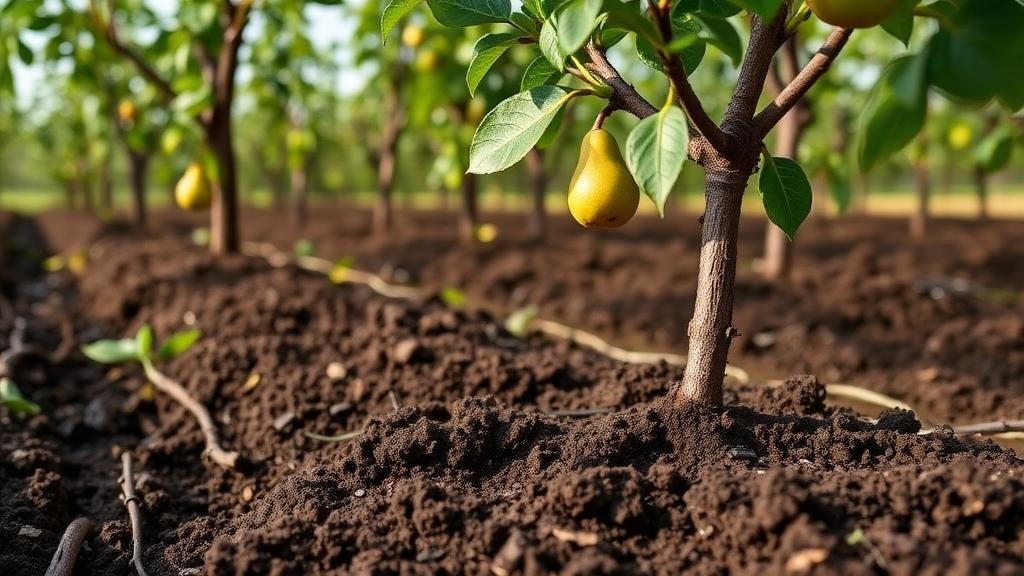
When an old pear orchard is torn out and replanted, the new trees often refuse to thrive. Growth stalls, canopies stay cramped, and yields collapse in a syndrome growers call replant disease, a problem that has haunted orchard renovation for generations. A new study published in BMC Plant Biology by researchers at Hebei Agricultural University offers a strikingly concrete explanation of what is happening underground, and a practical fix. By digging out the old soil and replacing it before replanting, the team showed that young pear trees can escape the chemical and microbial trap left behind by their predecessors, with yield per tree more than doubling compared with trees planted into renovated but unreplaced soil.
The research team, led by Yiran Huang and corresponding author Shugang Zhao, worked at an experimental orchard in Zhoujiazhuang village, Jinzhou city, in Hebei Province, China. They compared pear trees growing in three settings: an unrenovated old orchard, a renovated orchard where trees were replanted directly into the existing soil, and renovated orchards where the soil around the planting sites had been replaced. Rhizosphere soil, the thin layer of earth hugging the roots where biology is most intense, was collected from each setting for analysis. The goal was to disentangle how soil nutrients, microbial communities, and small-molecule metabolites jointly shape the fate of newly planted trees.
The growth differences were dramatic. Trees planted with replaced soil showed a trunk cross-sectional area 69.20 percent larger than trees in the non-replacement orchard, along with an east-west crown diameter 86.29 percent wider and a north-south crown diameter 63.64 percent greater. Branch number per plant rose by 69.05 percent, average branch number per 667 square meters increased by 24.11 percent, and yield per plant surged by 131.37 percent. In other words, simply swapping the soil transformed stunted saplings into vigorous, productive trees, providing one of the clearest field-scale demonstrations that replant disorder is driven by something in the ground rather than by the genetics of the planting stock.
To understand what the replacement soil changed, the researchers deployed a battery of analytical techniques. Soil nutrient elements were quantified using inductively coupled plasma-optical emission spectrometry alongside an Auto Analyzer 3, which revealed that soil replacement reduced zinc content in the rhizosphere. High-throughput sequencing of the rhizosphere soil showed that replacing the soil increased bacterial diversity, a shift generally associated with healthier, more resilient soil ecosystems. Meanwhile, ultra-high-performance liquid chromatography-tandem mass spectrometry was used to profile the metabolites dissolved in the rhizosphere, capturing the chemical conversation between roots, microbes, and decaying residues from the previous orchard.
The sequencing data pointed to a specific fungal signature of the unhealthy soil. The genus Acaulium, and especially the species Acaulium retardatum, was significantly enriched in the renovated orchard without soil replacement, reaching relative abundances of 14.79 percent and 2.88 percent respectively. Soil replacement sharply reduced these organisms. While the study stops short of proving that Acaulium directly harms pear trees, its dominance in the sick orchards marks it as a compelling suspect in the replant disease mystery, and a potential bioindicator that growers could monitor when deciding whether a site is ready for replanting.
The metabolomic results were equally revealing. In the non-replacement orchard, the alkaloid finaconitine accumulated to levels significantly higher than those measured in both the soil-replacement orchard and the old orchard. Alkaloids are nitrogen-containing plant defense compounds, and many, including the well-known toxin aconitine from monkshood plants, are potently bioactive. Finaconitine belongs to that same chemical family, and its buildup in soil that had hosted pears for years suggested a possible mechanism: a legacy of phytotoxic compounds leaching from old roots and residues, poisoning the next generation of trees before they could establish.
To test that idea, the team turned to a seed germination assay using Pyrus betulifolia, a common pear rootstock. When seeds were exposed to aconitine, a structural analog of finaconitine, germination and seedling growth were significantly inhibited. Because aconitine is chemically similar to the finaconitine found enriched in the unreplaced orchard soil, the result provides strong circumstantial evidence that diterpenoid alkaloids accumulating in old pear orchard soil can suppress the establishment of new pear seedlings. It is a textbook example of allelopathy, the phenomenon in which one plant’s chemical residues sabotage another’s growth, here compounded across successive orchard generations.
The soil-replacement orchard told the opposite story. Among its rhizosphere metabolites, amino acids, including threonine and proline, were abundant. When the researchers applied a mixture of these two amino acids to Pyrus betulifolia seeds in the assay, germination was significantly promoted, along with epicotyl and radicle growth. The replaced soil, in effect, had swapped a chemical environment dominated by a growth-inhibiting alkaloid for one enriched in growth-promoting nitrogen compounds, a shift that aligns neatly with the doubled yields observed in the field.
Correlation analysis added a microbial thread to the story. The contents of finaconitine, amino acids, and their derivatives were all significantly positively correlated with the abundance of Gemmatimonadota, a bacterial phylum common in soils. This suggests that specific bacterial groups may track, and possibly influence, the pool of small molecules that determine whether young trees flourish or fail. Disentangling whether Gemmatimonadota helps degrade or produce these compounds will be a task for future work, but the correlation provides a starting point for designing microbial interventions that could complement or even replace the labor-intensive practice of soil replacement.
For orchardists, the practical message is that replant disorder is not an inevitable tax on renewal. Removing and replacing the soil in planting sites reshaped the rhizosphere microbiome, lowered zinc levels, suppressed Acaulium, and purged finaconitine, all while enriching beneficial amino acids. The study, published open access on 28 September 2026, connects field agronomy with molecular ecology in a way that few replant studies have, identifying candidate chemical culprits and microbial markers in the same system. As old pear orchards across China and beyond come up for renovation, the humble act of moving soil may prove to be one of the most powerful tools for giving the next planting a clean start.
Subject of Research: Soil replacement as a mitigation strategy for pear replant disorder through rhizosphere microbial and metabolite changes
Article Title: Soil replacement mitigates pear replant disorder by reshaping rhizosphere microbial communities and reducing putatively phytotoxic alkaloids
Article References: Huang, Y., Xie, J., Liu, P., Xu, Z., Sun, Y., Li, Z., & Zhao, S. (2026). Soil replacement mitigates pear replant disorder by reshaping rhizosphere microbial communities and reducing putatively phytotoxic alkaloids. BMC Plant Biology. https://doi.org/10.1186/s12870-026-10032-8
Image Credits: AI Generated
DOI: 10.1186/s12870-026-10032-8
Keywords: pear, replant disease, soil replacement, rhizosphere, soil microbiome, alkaloids, finaconitine, aconitine, amino acids, Acaulium, Gemmatimonadota, orchard renovation
Cite Scienmag News
Alan Morgan. (October 6, 2026). Swapping Orchard Soil Revives Stunted Pear Trees by Purging Toxic Alkaloids. Scienmag. https://scienmag.com/swapping-orchard-soil-revives-stunted-pear-trees-by-purging-toxic-alkaloids/
Alan Morgan. "Swapping Orchard Soil Revives Stunted Pear Trees by Purging Toxic Alkaloids." Scienmag, 6 October 2026, https://scienmag.com/swapping-orchard-soil-revives-stunted-pear-trees-by-purging-toxic-alkaloids/. Accessed 6 October 2026.
Alan Morgan. "Swapping Orchard Soil Revives Stunted Pear Trees by Purging Toxic Alkaloids." Scienmag. October 6, 2026. https://scienmag.com/swapping-orchard-soil-revives-stunted-pear-trees-by-purging-toxic-alkaloids/


