


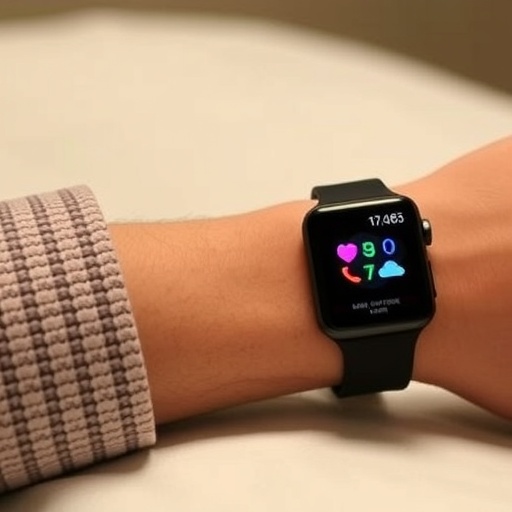
In a groundbreaking advance poised to reshape sleep health research, a team of scientists at the University of Massachusetts Amherst has developed an innovative application harnessing the power of consumer wearable technology to unlock previously inaccessible depths of sleep analysis. Under the leadership of Professor Joyita Dutta from the Biomedical Imaging and Data Science Lab, this novel app transforms the ubiquitous Apple Watch into a formidable tool for monitoring and categorizing sleep stages with remarkable sophistication. Published in the prestigious IEEE Transactions on Biomedical Engineering, their work promotes accessibility, affordability, and extended sleep monitoring capabilities that challenge the conventional paradigms dominated by clinical polysomnography.
Sleep studies have traditionally relied on complex, expensive systems housed within specialized laboratories that require attaching cumbersome electrodes to patients’ heads. These methods, while regarded as the gold standard, impose significant limitations on the duration and ecological validity of sleep monitoring. Most studies constrict data collection to a single night due to practical and financial constraints, failing to capture the naturally occurring variability in sleep patterns over time or the often-overlooked episodic naps critical to understanding diseases such as Alzheimer’s. Recognizing these shortcomings, Professor Dutta’s team sought a creative yet pragmatic solution that leverages the wide adoption and continuous wearability of smartwatches.
The result of their efforts is BIDSleep, an application designed to gather instantaneous heart rate data—a physiological parameter intimately linked to sleep stage transitions—from the Apple Watch’s photoplethysmography sensors. The app capitalizes on the distinctive heart rate signatures associated with different phases of sleep: a deceleration during deep, slow-wave sleep and increased variability during REM and lighter sleep stages. This cardiac data is then fed into an advanced artificial intelligence model developed by the researchers, which utilizes machine learning techniques to classify sleep stages with a reported accuracy level surpassing 71 percent in comparison to the traditional EEG-based approaches.
This AI-driven model marks a significant leap forward in computational sleep staging, achieving higher fidelity in detecting deep sleep—a critical metric given its decline with age and its purported link to neurodegenerative processes. By integrating multi-night data uploads, BIDSleep can provide comprehensive longitudinal profiles unattainable through short lab visits or single-night assessments. Such depth of analysis could unveil subtle patterns in sleep architecture that are predictive of, or consequential to, pathologies like Alzheimer’s disease, which Professor Dutta is actively investigating through this technology.
The technology’s capacity to perform with an accuracy that rivals clinical measurements hinges on its sophisticated handling of physiological signals amid real-world variability. Unlike previous wearable-based approaches that relied on less granular data or proprietary algorithms with limited transparency, this method processes heart rate signals at a dense temporal resolution. As a result, it offers a richer dataset that improves the AI’s classification capabilities, reducing mislabeling errors and supporting robust clinical metrics such as sleep efficiency, latency to sleep onset, and total sleep duration.
Critically, the team underscores that their work does not directly compare to the native sleep-staging features later integrated into Apple’s own Health ecosystem, as those tools were unavailable during their trials. However, they anticipate their open-access AI model and data handling methods will outperform or complement these proprietary solutions, offering researchers and clinicians a more precise and customizable platform for sleep monitoring studies. This transparency aims to foster broader adoption and iterative improvements in wearable-based sleep research.
Furthermore, BIDSleep’s design caters specifically to the pragmatics of research deployment. It facilitates straightforward data export, allowing investigators to incorporate sleep metrics seamlessly into larger studies that track cognitive symptoms and disease progression over time. The app’s compatibility with a widely used consumer device democratizes access to advanced sleep analytics, making longitudinal sleep health studies feasible beyond traditional clinical environments, which can impose travel burdens and participant dropouts.
The implications of this technology extend beyond Alzheimer’s disease research into the wider realm of sleep medicine, neurology, and public health. Accurate, scalable sleep monitoring could revolutionize diagnostics for sleep disorders such as insomnia, sleep apnea, and narcolepsy, enabling early interventions and personalized treatment plans derived from comprehensive temporal sleep profiles. Such developments may also illuminate the intricate associations between sleep disturbances and cardiovascular or psychiatric conditions, areas ripe for future investigation using wearable-derived data.
Alongside its scientific impact, BIDSleep exemplifies the convergence of engineering, computer science, and medicine, showcasing how interdisciplinary collaboration fuels novel solutions addressing complex health challenges. The team’s work received support from the Massachusetts AI and Technology Center for Connected Care in Aging & Alzheimer’s Disease and the National Institutes of Health, highlighting contemporary investment in technologies aimed at integrating artificial intelligence with human health monitoring.
While BIDSleep’s success signals a new frontier for consumer wearable applications in medicine, the researchers acknowledge ongoing questions regarding data privacy, device variability, and user adherence that must be addressed as the field advances. Future directions include a planned head-to-head evaluation against Apple’s native algorithms and expansions to other wearable platforms to broaden applicability.
In sum, the creation of BIDSleep heralds a transformative approach to sleep research, one that exploits the accessibility of wearable devices enriched by sophisticated AI analytics to democratize, deepen, and extend sleep health understanding. By breaking free from the constraints of lab-based sleep studies, this technology opens the door to long-term, high-resolution monitoring capable of informing clinical practice and accelerating research into devastating conditions like Alzheimer’s disease.
News Publication Date: Oct. 30, 2025
Web References:
- IEEE Transactions on Biomedical Engineering: http://dx.doi.org/10.1109/TBME.2025.3612158
- UMass Amherst Biomedical Engineering Faculty Directory: https://www.umass.edu/engineering/about/directory/joyita-dutta
- Massachusetts AI and Technology Center for Connected Care: https://www.umass.edu/news/article/massachusetts-ai-and-technology-center-connected-care-aging-and-alzheimers-disease-0
References:
Dutta J., Song T.-A., et al. (2025). AI-Driven Sleep Staging Using Instantaneous Heart Rate and Accelerometry: Insights from an Apple Watch Study. IEEE Transactions on Biomedical Engineering. DOI: 10.1109/TBME.2025.3612158
Cite Scienmag News
Ophelia Keating. (October 30, 2025). UMass Amherst Develops Innovative Sleep Health Research Tool Combining App, Apple Watch, and AI. Scienmag. https://scienmag.com/umass-amherst-develops-innovative-sleep-health-research-tool-combining-app-apple-watch-and-ai/
Ophelia Keating. "UMass Amherst Develops Innovative Sleep Health Research Tool Combining App, Apple Watch, and AI." Scienmag, 30 October 2025, https://scienmag.com/umass-amherst-develops-innovative-sleep-health-research-tool-combining-app-apple-watch-and-ai/. Accessed 3 September 2026.
Ophelia Keating. "UMass Amherst Develops Innovative Sleep Health Research Tool Combining App, Apple Watch, and AI." Scienmag. October 30, 2025. https://scienmag.com/umass-amherst-develops-innovative-sleep-health-research-tool-combining-app-apple-watch-and-ai/


