


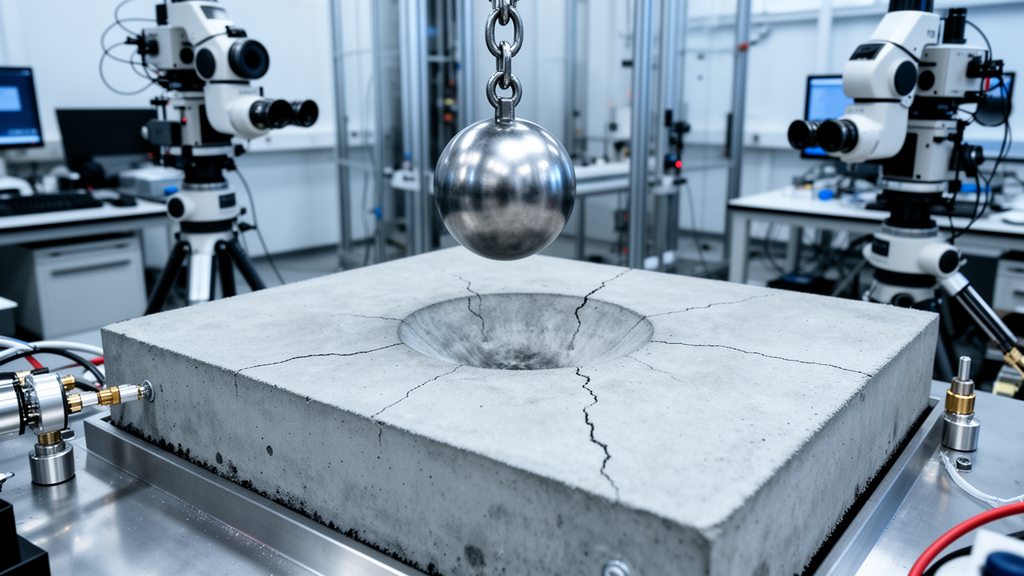
Reinforced concrete slabs in buildings and bridges can face sudden, severe dynamic loads during their service life, from vehicular collisions and falling heavy objects to explosive events. A new experimental and numerical study published in Scientific Reports examines how two-way simply supported reinforced concrete slabs behave under high-mass, low-velocity impact, with particular attention to how concrete compressive strength and reinforcement ratio shape the outcome. The work, led by Shamsoon Fareed and colleagues, combines physical drop-weight style testing with detailed finite element simulation to build a framework for predicting impact response.
The experimental program evaluated ten reinforced slabs cast from normal strength concrete and high strength concrete. Researchers varied the compressive strength of the concrete and the amount of reinforcement to see how these variables affected the peak impact force, the failure patterns that developed, and the displacements the slabs experienced. Two-way simply supported slabs of this kind are common structural elements, and understanding their behavior under impact forces that exceed typical static design loads is a long-standing concern in structural engineering.
Alongside the physical tests, the team developed a non-linear finite element model in the commercial software ABAQUS. The model was validated against the measured contact force–time histories from the experiments, meaning its simulated force traces matched the laboratory records well enough to serve as a trustworthy predictive tool. Once validated, the framework was extended beyond the tested materials to numerically predict how ultra-high strength concrete slabs, which were not part of the physical specimen set, would respond to the same class of impact loading.
Ultra-high strength concrete offers exceptional compressive strength and load-carrying capacity along with strong durability, but its response under low-velocity impact had remained underexplored. The numerical results indicated that ultra-high strength concrete slabs exhibit greater impact resistance than their lower-strength counterparts. To translate the simulation findings into practical tools, the researchers derived an Equivalent Static Factor from the finite element parametric results.
This factor is intended to predict the maximum load-carrying capacity of two-way simply supported ultra-high strength reinforced concrete slabs subjected to low-velocity impact loading at velocities up to 6 meters per second. In addition, the team developed multi-regression analysis equations to estimate two key response quantities: the maximum impact force and the maximum mid-span deflection for this slab type under the same velocity range. The authors are explicit about the limits of these predictive tools.
Both the Equivalent Static Factor and the regression equations were developed using a limited dataset and are not intended for design use. They offer simplified approximations for assessing the impact resistance of two-way simply supported reinforced concrete slabs under the low-velocity, up-to-6-m/s impact conditions evaluated in the study, and the researchers state that further experimental validation is required before any broader application. The study's scope is defined by its specimen set and loading regime.
The physical tests covered normal and high strength concrete only, so the ultra-high strength conclusions rest on the validated numerical model rather than direct laboratory testing of UHSC slabs. The impact velocities considered are low, characteristic of dropped masses and slow collisions rather than high-velocity projectiles or blast fragments. Boundary conditions were held to the simply supported, two-way configuration, so the findings do not directly extend to slabs with fixed or other edge restraints.
Within those boundaries, the research adds a quantified picture of which parameters matter most when a heavy mass strikes a slab at low speed: slab geometry, boundary condition, reinforcement ratio, concrete compressive strength, and the properties of the impactor itself all influence the maximum dynamic contact force and mid-span deflection. By tying these variables together in a validated simulation framework, and by offering provisional closed-form estimates for peak force and deflection, the study gives structural engineers a starting point for evaluating impact demand on this common slab type, while leaving the final validation work that would support design adoption to future research.
Subject of Research: Impact behavior of reinforced high and ultra-high strength concrete two-way slabs under low-velocity loading
Article Title: Behavior of reinforced high and ultra-high strength concrete slabs under high mass low-velocity impact loading
Article References: Fareed, S., Dar, N. M., Khalid, F., & Khan, A.-U.-R. (2026). Behavior of reinforced high and ultra-high strength concrete slabs under high mass low-velocity impact loading. Scientific Reports. https://doi.org/10.1038/s41598-026-76961-4
Image Credits: AI Generated
DOI: 10.1038/s41598-026-76961-4
Keywords: reinforced concrete, ultra-high strength concrete, low-velocity impact, finite element analysis, ABAQUS, mid-span deflection, contact force, scabbing, Equivalent Static Factor, regression analysis, structural engineering, slab testing
Cite Scienmag News
Denise Maddox. (October 27, 2026). Ultra-High Strength Concrete Slabs Show Stronger Resistance to Low-Velocity Impact. Scienmag. https://scienmag.com/ultra-high-strength-concrete-slabs-show-stronger-resistance-to-low-velocity-impact/
Denise Maddox. "Ultra-High Strength Concrete Slabs Show Stronger Resistance to Low-Velocity Impact." Scienmag, 27 October 2026, https://scienmag.com/ultra-high-strength-concrete-slabs-show-stronger-resistance-to-low-velocity-impact/. Accessed 27 October 2026.
Denise Maddox. "Ultra-High Strength Concrete Slabs Show Stronger Resistance to Low-Velocity Impact." Scienmag. October 27, 2026. https://scienmag.com/ultra-high-strength-concrete-slabs-show-stronger-resistance-to-low-velocity-impact/


