


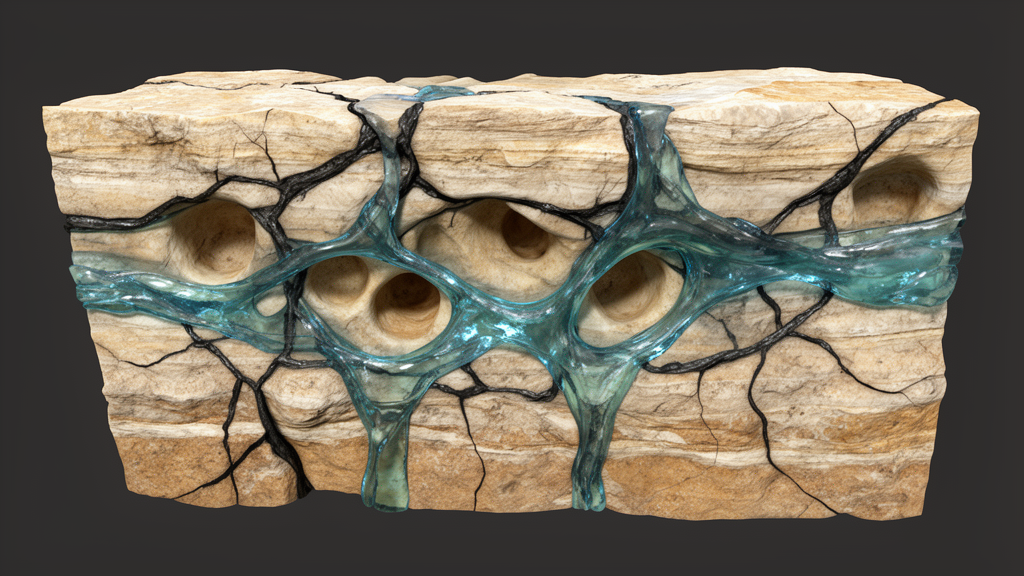
A new study of a deep fractured-vuggy carbonate reservoir, published as an open-access article in Scientific Reports, shows how stress sensitivity—the decline of rock permeability as effective stress rises during production—controls the pressure response measured at the bottom of a well. Combining laboratory experiments with theoretical derivation, the researchers built a well test model tailored to the X deep carbonate reservoir and traced how the reservoir's inherent heterogeneity produces distinctive pressure behavior that generic models miss. The analysis identified eight distinct flow stages for a vertical well in the fractured-vuggy system: wellbore storage, skin effects, a first radial flow stage, a transition stage, vug storage, a second radial flow stage, vug-fracture crossflow, and finally boundary-controlled flow.
The laboratory and modeling results linked stress sensitivity directly to permeability loss. Stronger stress sensitivity produced a greater decline in permeability as effective stress increased, and the higher the stress sensitivity, the greater the attenuation of permeability caused by changes in effective stress, with the stress sensitivity effect itself increasing accordingly. The authors note that although stress sensitivity and bottom-hole pressure analysis have been studied extensively, reservoir heterogeneity causes variability in both stress sensitivity behavior and pressure response across different reservoirs, which motivated a characterization method specific to the X reservoir.
The findings, presented as a case study of one deep carbonate fractured-vuggy reservoir, are offered as a theoretical basis for the efficient development of such reservoirs. As with any single-reservoir case study, the conclusions describe the X reservoir's characterized behavior and its modeled pressure response rather than outcomes from field-wide production trials.
Subject of Research: Stress sensitivity and bottom-hole pressure response in a deep fractured-vuggy carbonate reservoir
Article Title: Reservoir stress sensitivity and its influence on pressure response characteristics in deep fractured-vuggy reservoirs: a case study of the X deep fractured-vuggy reservoir
Article References: Guan, Y., Dai, M., Wu, H., & Wu, Z. (2026). Reservoir stress sensitivity and its influence on pressure response characteristics in deep fractured-vuggy reservoirs: a case study of the X deep fractured-vuggy reservoir. Scientific Reports. https://doi.org/10.1038/s41598-026-76285-3
Image Credits: AI Generated
DOI: 10.1038/s41598-026-76285-3
Keywords: stress sensitivity, fractured-vuggy reservoir, carbonate reservoir, well test model, bottom-hole pressure, permeability decline, effective stress, pressure derivative, vug-fracture crossflow, reservoir heterogeneity, deep reservoir development, Reservoir
Cite Scienmag News
Violet Maxwell. (October 27, 2026). Stress Sensitivity Shapes Pressure Behavior in Deep Fractured-Vuggy Carbonate Reservoirs. Scienmag. https://scienmag.com/stress-sensitivity-shapes-pressure-behavior-in-deep-fractured-vuggy-carbonate-reservoirs/
Violet Maxwell. "Stress Sensitivity Shapes Pressure Behavior in Deep Fractured-Vuggy Carbonate Reservoirs." Scienmag, 27 October 2026, https://scienmag.com/stress-sensitivity-shapes-pressure-behavior-in-deep-fractured-vuggy-carbonate-reservoirs/. Accessed 27 October 2026.
Violet Maxwell. "Stress Sensitivity Shapes Pressure Behavior in Deep Fractured-Vuggy Carbonate Reservoirs." Scienmag. October 27, 2026. https://scienmag.com/stress-sensitivity-shapes-pressure-behavior-in-deep-fractured-vuggy-carbonate-reservoirs/


