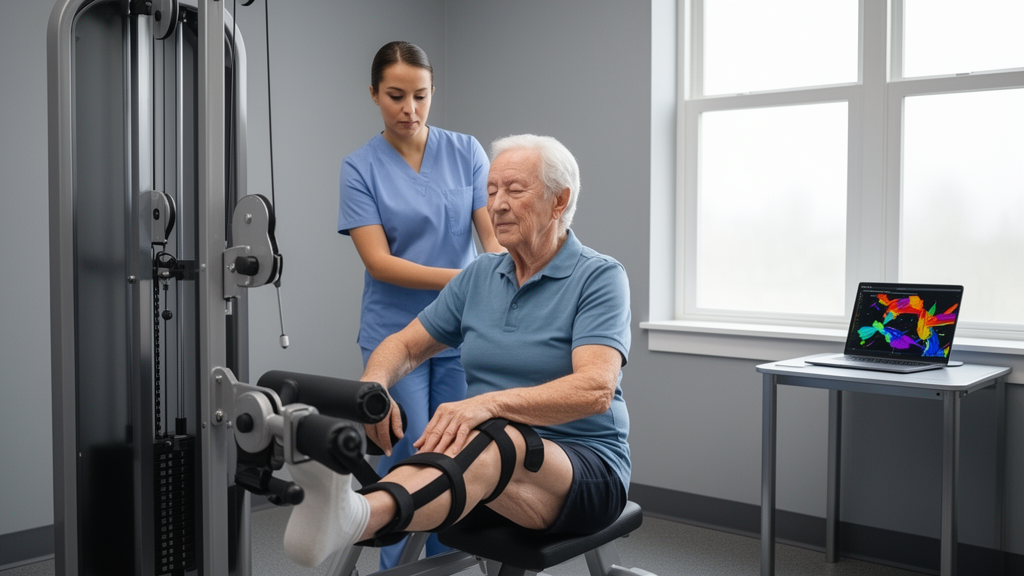
Machine learning models built from routine preoperative measurements can predict how patients will fare one year after anterior cruciate ligament reconstruction, according to an exploratory retrospective study published in Scientific Reports. Researchers analyzed 75 patients who underwent primary ACL reconstruction between 2016 and 2023, using demographic characteristics, treatment-related variables, isokinetic muscle performance, and patient-reported outcome measures collected before surgery. The one-year outcomes they sought to predict were return to pivoting sports, defined as a Tegner activity level of at least 6, and achievement of the patient acceptable symptom state, defined as an International Knee Documentation Committee score of 75.9 or higher.
The team first screened candidate variables with univariable logistic regression, then trained multiple machine learning algorithms on the surviving features and evaluated them with 3-fold cross-validation. Performance was judged using the area under the receiver operating characteristic curve, calibration plots, and Brier scores. Among the algorithms tested, the random forest model performed best, reaching an AUC of 0.832 for predicting return to pivoting sports and 0.815 for predicting the patient acceptable symptom state.
An AUC in this range indicates moderate discriminative ability, meaning the models ranked patients meaningfully better than chance but were far from perfect. Two factors stood out: younger age and greater preoperative flexor strength of the uninvolved limb emerged as the most important predictors of one-year outcomes. The study's authors are explicit that these results should be interpreted cautiously.
With only 75 patients, the dataset is small, and the models were not tested on any external cohort, so there is no evidence yet that they generalize beyond this single retrospective sample. The researchers describe the models as exploratory and hypothesis-generating rather than ready for clinical implementation, and they call for validation in larger, independent cohorts before any practical use could be considered. For now, the finding remains a promising statistical signal from a small exploratory study, not a validated clinical tool.
Subject of Research: Machine learning prediction of one-year outcomes after ACL reconstruction from preoperative physical performance measures
Article Title: Predicting 1-year outcomes after anterior cruciate ligament reconstruction from preoperative physical performance using machine learning: an exploratory study
Article References: Boo, S., Lee, J. H., & Jang, K.-M. (2026). Predicting 1-year outcomes after anterior cruciate ligament reconstruction from preoperative physical performance using machine learning: an exploratory study. Scientific Reports. https://doi.org/10.1038/s41598-026-77775-0
Image Credits: AI Generated
DOI: 10.1038/s41598-026-77775-0
Keywords: ACL reconstruction, machine learning, random forest, return to sport, patient acceptable symptom state, isokinetic strength, knee surgery, predictive modeling, SHAP, rehabilitation, orthopedics, retrospective cohort
Cite Scienmag News
Teresa Odom. (October 27, 2026). Machine Learning Hints at Knee Surgery Recovery Using Preoperative Strength Tests. Scienmag. https://scienmag.com/machine-learning-hints-at-knee-surgery-recovery-using-preoperative-strength-tests/
Teresa Odom. "Machine Learning Hints at Knee Surgery Recovery Using Preoperative Strength Tests." Scienmag, 27 October 2026, https://scienmag.com/machine-learning-hints-at-knee-surgery-recovery-using-preoperative-strength-tests/. Accessed 28 October 2026.
Teresa Odom. "Machine Learning Hints at Knee Surgery Recovery Using Preoperative Strength Tests." Scienmag. October 27, 2026. https://scienmag.com/machine-learning-hints-at-knee-surgery-recovery-using-preoperative-strength-tests/