
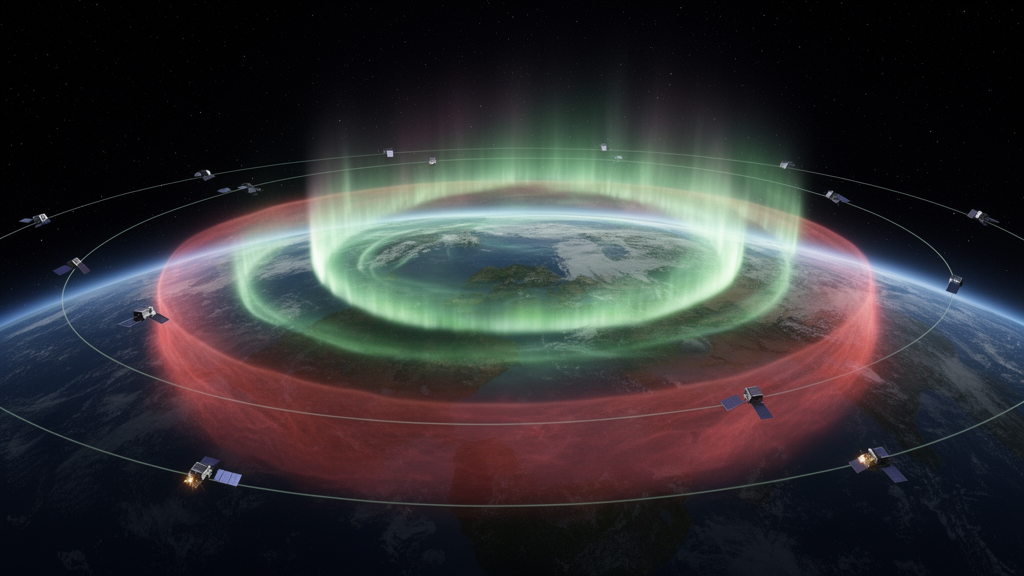
Geomagnetic storms thicken the upper atmosphere, and that extra density can drag low-Earth-orbit satellites toward an early reentry. A new per-event analysis of 22 storms ranging from minor G1 to extreme G5, published in Scientific Reports, now quantifies just how much each storm class speeds up orbital decay, using data from the GRACE and GRACE-Follow On missions between 2003 and 2024, including the May 2024 Gannon storm. Unlike earlier studies that averaged many storms together with superposed epoch techniques, the researchers compared each storm's peak-time orbit against a matched quiet-time reference orbit for the same satellite.
This event-by-event approach revealed a clear but noisy pattern: the mean enhancement in orbital decay rate climbed with storm intensity, reaching 77.2 percent for G1 storms, 98.5 percent for G2, 138.1 percent for G3, 149.6 percent for G4, and 166.5 percent for G5 events. Those averages, however, hide enormous scatter within each category. Some weak storms produced drag responses as strong as those from more intense ones, a reminder that per-event variability can be as operationally important as the category average.
Altitude emerged as a second decisive factor. To turn these observations into a predictive tool, the team built an empirical multiple linear regression model using three inputs: the quiet-time decay rate, the maximum Kp index reached during the storm, and the satellite's operating altitude. The model reproduced storm-time decay rates with an R-squared of 0.91 and a root mean square error of 12.3 meters per day, and a leave-one-out validation yielded an RMSE of 15.1 meters per day, indicating the fit is not simply overfitting the sample.
Substituting the open-ended Hp30 index for Kp produced similar performance, suggesting the results do not depend on one particular measure of geomagnetic activity. The practical stakes are high. In February 2022, a moderate geomagnetic storm increased drag enough that 38 newly launched Starlink satellites failed to reach their intended orbits, a loss that highlighted how quickly storm-time density changes can catch operators off guard.
The authors position the work as a complement to superposed epoch analyses rather than a replacement. By providing per-event benchmarks across the full G1 to G5 range, the dataset offers a reference point for empirical thermospheric density models and a foundation for storm-time orbit prediction. Its main limitations are the sample size of 22 events and its reliance on a single satellite pair, so extending the analysis to more spacecraft and storms remains an obvious next step for the field.
Subject of Research: Effect of geomagnetic storm intensity on thermospheric density and orbital decay of low-Earth-orbit satellites
Article Title: Impact of geomagnetic storm intensity on thermospheric density and orbital decay of LEO satellites: a G1–G5 per-event analysis
Article References: Kim, J.-H., Eom, G., Kwak, Y.-S., Yang, T.-Y., & Huh, H. (2026). Impact of geomagnetic storm intensity on thermospheric density and orbital decay of LEO satellites: a G1–G5 per-event analysis. Scientific Reports. https://doi.org/10.1038/s41598-026-78052-w
Image Credits: AI Generated
DOI: 10.1038/s41598-026-78052-w
Keywords: geomagnetic storms, thermospheric density, orbital decay, LEO satellites, GRACE, space weather, Kp index, Hp30 index, atmospheric drag, Starlink, Gannon storm, orbit prediction
Cite Scienmag News
Cameron Wolfe. (October 27, 2026). Research report: Impact of geomagnetic storm intensity on thermospheric density and orbital decay of LEO satellites: a G1–G5 per-event analysis. Scienmag. https://scienmag.com/research-report-impact-of-geomagnetic-storm-intensity-on-thermospheric-density-and-orbital-decay-of-leo-satellites-a-g1-g5-per-event-analysis/
Cameron Wolfe. "Research report: Impact of geomagnetic storm intensity on thermospheric density and orbital decay of LEO satellites: a G1–G5 per-event analysis." Scienmag, 27 October 2026, https://scienmag.com/research-report-impact-of-geomagnetic-storm-intensity-on-thermospheric-density-and-orbital-decay-of-leo-satellites-a-g1-g5-per-event-analysis/. Accessed 28 October 2026.
Cameron Wolfe. "Research report: Impact of geomagnetic storm intensity on thermospheric density and orbital decay of LEO satellites: a G1–G5 per-event analysis." Scienmag. October 27, 2026. https://scienmag.com/research-report-impact-of-geomagnetic-storm-intensity-on-thermospheric-density-and-orbital-decay-of-leo-satellites-a-g1-g5-per-event-analysis/