


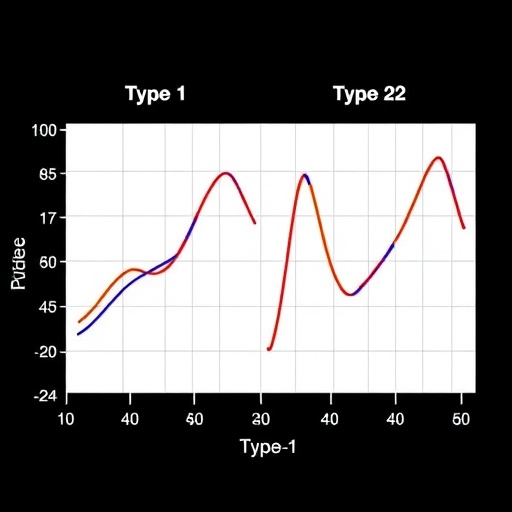
In the intricate realm of human cognition, decision-making remains one of the most fascinating and complex processes studied by scientists. A groundbreaking study soon to be published in Communications Psychology by Zheng, Y., Xue, K., Shekhar, M., and colleagues offers a revolutionary perspective on the nature of decision-making noise, providing compelling evidence that both type-1 and type-2 decisions share computational noise of similar magnitude. This finding challenges prevailing assumptions in cognitive science and paves the way for a deeper understanding of how the brain processes uncertainty and makes choices in complex environments.
Decision-making has long been categorized into two distinct types in psychological and neuroscientific literature. Type-1 decisions are those that occur on a perceptual level—such as distinguishing whether a faint sound is present or identifying the direction of an ambiguous visual stimulus. Conversely, type-2 decisions pertain to metacognitive processes, where an individual evaluates their own confidence or uncertainty regarding a previous type-1 choice. While these layers of decision-making have historically been studied separately, Zheng and colleagues’ research reveals a unifying computational property that underlies both.
Central to the study is the notion of “computational noise,” a term referring to the variability and imperfections in the brain’s internal algorithm during decision processing. Previous theories speculated that type-2 decisions, given their higher-level introspective nature, might involve differing noise characteristics, potentially greater in magnitude due to their complexity. However, the researchers found empirical and modeling evidence indicating that the noise influencing both decision types operates at comparable levels, suggesting a shared computational architecture or constraints.
The implications of this finding ripple through various fields that rely on understanding human cognition, from psychology and neuroscience to artificial intelligence and even economics. If the brain applies similar noise constraints at multiple decision-making layers, it could mean that our mental processes are more integrated than previously envisioned, governed by unified computational principles rather than distinct modules with separate noise profiles.
Methodologically, the researchers combined rigorous behavioral experiments with sophisticated computational modeling. Participants engaged in tasks designed to provoke both type-1 and type-2 decisions under controlled conditions, allowing measurement of accuracy and confidence. Sophisticated statistical techniques and Bayesian inference models were employed to quantify the computational noise underlying their choices, disentangling it from other behavioral variability factors such as lapses in attention or motor errors.
The magnitude of noise in both decision types was surprisingly consistent. This uniformity suggests that the brain’s mechanisms for representing uncertainty and processing evidence before a decision are fundamentally constrained by similar functional limitations. Such limitations may arise from the biophysical properties of neural circuits or from the inherent need to balance speed, accuracy, and energy consumption during cognition.
This discovery also rekindles debates about the neural substrates of metacognition. While previous studies have identified prefrontal regions as key actors in type-2 decisions or confidence judgments, the equivalence in noise magnitude indicates that early sensory and decision-processing regions could be subject to similar noise characteristics. This raises questions about the multilevel interactions within the brain’s decision systems and how they collaboratively shape cognition.
Moreover, the findings illuminate why subjective confidence judgments are sometimes unreliable. If both the initial perceptual decisions and the subsequent confidence evaluations are hampered by comparable computational noise, it suggests that the uncertainty inherent in our confidence reports is not merely a byproduct of introspective inefficiency but a direct consequence of fundamental neural processing constraints.
The study’s modeling framework is particularly innovative, integrating signal detection theories with hierarchical Bayesian models that represent decisions at multiple cognitive stages. This approach allows quantification not only of decision accuracy but also the internal noise distributions, providing nuanced insights into how information is encoded, transformed, and ultimately used for making subjective judgments.
Further fascinating is the study’s potential impact on artificial intelligence, particularly in the design of systems that mimic human decision-making and metacognition. Understanding that noise signatures are consistent across decision types might inspire algorithms that replicate this property, leading to machines capable of more human-like uncertainty representation and confidence estimation, which are crucial for robust and adaptable AI systems.
Beyond theoretical and applied domains, the results hold promise for clinical psychology. Disorders such as obsessive-compulsive disorder, anxiety, and schizophrenia feature altered metacognitive abilities and decision-making anomalies. By establishing a normative baseline of noise equivalence, this research could help pinpoint whether pathological deviations occur at type-1, type-2, or both decision-processing stages, informing more precise diagnostic tools and therapeutic approaches.
Another important dimension this research touches on is the evolutionary aspect of cognition. The similarity in noise magnitude might reflect an evolutionary optimization where both perceptual and metacognitive systems co-evolved under shared constraints, maximizing the brain’s efficiency without sacrificing essential flexibility in decision-making.
Relatedly, these findings may influence how educational strategies and training protocols are designed. By recognizing that uncertainty affects multiple layers of decision-making similarly, interventions aimed at improving self-awareness and confidence calibration could be tailored more effectively, enhancing learning outcomes and decision quality in complex environments.
In conclusion, Zheng et al.’s study provides a paradigm-shifting insight into the architecture of human decision-making. By demonstrating that type-1 and type-2 decisions share computational noise of comparable magnitude, it challenges the clear dichotomy traditionally drawn between perceptual and metacognitive processes. This unified framework not only deepens our understanding of the computational constraints shaping cognition but also inspires new research directions across disciplines, from neural mechanisms to machine intelligence, clinical applications, and educational innovations.
Future research building on this foundation will likely delve deeper into the neural correlates of this noise equivalence, explore its manifestation across diverse populations and tasks, and expand computational models to incorporate dynamic adaptations over time. The journey toward unraveling the mysteries of human choice is far from over, but this study marks a significant milestone by spotlighting underlying computational consistencies that unite our basic perceptions with our nuanced self-reflection.
Cite Scienmag News
Glenn Wilkins. (April 16, 2026). Type-1 and Type-2 Decisions Share Similar Computational Noise. Scienmag. https://scienmag.com/type-1-and-type-2-decisions-share-similar-computational-noise/
Glenn Wilkins. "Type-1 and Type-2 Decisions Share Similar Computational Noise." Scienmag, 16 April 2026, https://scienmag.com/type-1-and-type-2-decisions-share-similar-computational-noise/. Accessed 4 September 2026.
Glenn Wilkins. "Type-1 and Type-2 Decisions Share Similar Computational Noise." Scienmag. April 16, 2026. https://scienmag.com/type-1-and-type-2-decisions-share-similar-computational-noise/


