


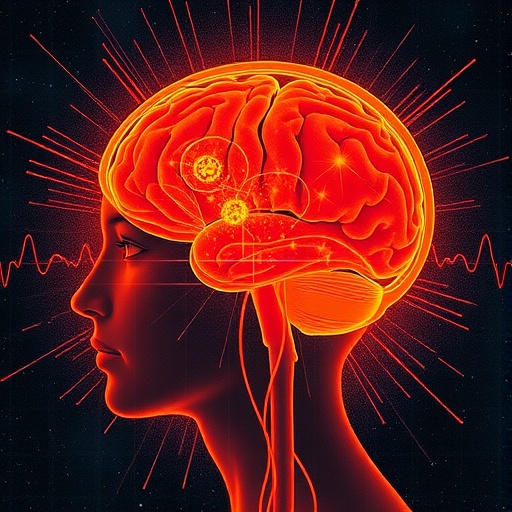
In a groundbreaking study that promises to reshape our understanding of human consciousness, researchers have uncovered a novel oscillatory phenomenon within the human thalamus that appears to be intricately linked to natural states of awareness. This discovery, achieved through direct intracranial recordings—an extraordinarily rare window into the human brain—illuminates how variations in thalamic activity distinguish wakefulness, rapid eye movement (REM) sleep, and non-REM sleep (NREM), thereby elucidating a long-sought electrophysiological signature associated with conscious states.
The thalamus has long been recognized as a critical deep brain hub involved in relaying sensory and motor signals and regulating consciousness, sleep, and alertness. However, due to its deep and complex anatomical location, direct recordings from the human thalamus have been exceptionally sparse. Leveraging a unique clinical setting that permitted intracranial electrode recordings, this study by Chowdhury and colleagues reveals compelling evidence for a brain-state-specific oscillation ranging between 19 and 45 Hz. This oscillation is conspicuously absent during NREM sleep but thrives during both REM sleep and wakefulness, states typically associated with heightened consciousness.
Electrophysiological oscillations in various frequency bands have long been studied for their role in brain function, yet most analyses have concentrated on cortical signals or peripheral proxies such as scalp electroencephalography (EEG). This investigation delves directly into the thalamus, a subcortical structure pivotal for integrating brain-wide neural communication. The identified 19–45 Hz oscillatory activity, occupying a frequency band overlapping high beta and low gamma rhythms, emerges uniquely during periods correlated with conscious experience, highlighting its potential as a biomarker for conscious brain states.
Intriguingly, the 19–45 Hz oscillation is not uniformly distributed throughout the thalamus. Rather, it localizes to the central thalamus, a region strategically positioned to coordinate widespread brain network dynamics. The central thalamic nucleus is implicated in transitions between global brain states, making the discovery that this oscillation specifically inhabits this region particularly consequential. The findings open new avenues to understand how thalamic microcircuits orchestrate the brain’s shift between wakefulness, the vivid dreaming characteristic of REM sleep, and the disconnected unconsciousness of NREM.
Moreover, the presence of this oscillation is temporally coupled to bursts of eye movements within REM sleep microstates. REM sleep, widely considered a paradoxical mix of deep unconsciousness and active, vivid dreaming, inherently involves characteristic rapid eye movements. The study demonstrates that the bursts of eye movement in REM are accompanied by synchronous oscillatory surges in the central thalamus between 19 and 45 Hz, suggesting these oscillations could be intertwined with mechanisms enabling the rich conscious experiences that define REM.
This discovery provides fresh insight into the electrophysiological underpinnings of consciousness, a subject that has eluded neuroscientists for decades. By pinpointing a distinct thalamic rhythm differentiating conscious and unconscious states, the research refines our conceptualization of consciousness beyond cortical phenomena and spotlights the thalamus as a key orchestrator that integrates and modulates brain-wide neuronal ensembles.
The implications extend far beyond fundamental neuroscience. Consciousness disorders, ranging from coma to vegetative states and minimally conscious states, remain poorly understood, with limited therapeutic options. The ability to identify signatures of conscious states electrophysiologically from within the thalamus could revolutionize diagnostics, prognostics, and eventually, interventions. For example, deep brain stimulation protocols targeting the central thalamus may be refined based on these oscillations to restore or enhance awareness in affected patients.
Methodologically, this study capitalized on the infrequency of intracranial access to the thalamus in humans, typically restricted to specific neurosurgical contexts such as the treatment of epilepsy or movement disorders. Researchers employed advanced signal processing algorithms to extract and analyze frequency-specific oscillatory activity, mapping temporal correlations between oscillations and behavioral states corroborated by polysomnographic data. This approach allowed the team to discern subtle yet robust electrophysiological distinctions amidst the rich complexity of human brain dynamics.
Importantly, the oscillation’s frequency range spanning high beta to low gamma bands aligns with previously characterized rhythms implicated in cognitive functions such as attention, sensory processing, and memory encoding. This overlap raises tantalizing possibilities that the 19–45 Hz oscillation forms a bridge between thalamic state regulation and cognitive operations, suggesting a unified framework for understanding how consciousness and cognition intertwine mechanistically.
Further research is warranted to investigate the causal role of this oscillatory activity. Does it merely reflect a state of consciousness, or could manipulation of this rhythm actively toggle brain states? Future studies employing stimulation paradigms, perhaps in conjunction with fMRI or other imaging methods, might elucidate how modulation of these thalamic oscillations influences subjective experience and cognitive performance.
The subtleties of how this oscillation fluctuates moment-to-moment during wakefulness and its relationship to attention, arousal, and sensory integration also demand exploration. Do fluctuations in the strength or coherence of the 19–45 Hz oscillation correspond to transitions in conscious awareness, or perhaps to varying depths of cognitive engagement? Understanding these dynamics could revolutionize mind-machine interfacing, neurofeedback techniques, and consciousness monitoring.
This work also challenges existing theoretical frameworks of consciousness that excessively emphasize cortical contributions while sidelining subcortical drivers. By shining a light on the thalamus—and specifically its central nucleus—this study presents a compelling argument for models incorporating deep brain oscillations as indispensable elements in the neural correlates of consciousness.
From a translational perspective, harnessing such oscillatory markers could inform adaptive neurostimulation devices that adjust parameters in real time depending on detected brain states. Such personalized neurotherapeutics could significantly improve outcomes for individuals with impairments in consciousness or cognitive dysfunctions linked to thalamocortical dysrhythmias.
Furthermore, the intersection of oscillations with eye movement bursts during REM sleep hints at mechanisms coupling sensory-motor phenomena with the internally generated experiences of dreaming. It invites further interdisciplinary research combining electrophysiology, behavioral neuroscience, and computational modeling to decode the neural fabric of subjective experience.
Overall, this landmark discovery sheds unprecedented light on the thalamic substrate of consciousness, using innovative direct human recordings to expose a signature oscillation that demarcates waking and REM states from unconscious non-REM sleep. The study charts new territory at the crossroads of neuroscience and philosophy, bringing us closer to unraveling one of humanity’s most profound enigmas: the nature and neural basis of conscious experience.
As research continues, the hope remains that understanding these deep brain dynamics will not only answer fundamental scientific questions but also catalyze practical breakthroughs in diagnosing and treating disorders of consciousness. By illuminating the beat of conscious life embedded within the central thalamus, this study announces a new chapter in neuroscience with reverberations across medicine, technology, and our very conception of the mind.
Cite Scienmag News
Cassandra Pierce. (May 27, 2026). Thalamic Oscillations Reveal Human Consciousness States. Scienmag. https://scienmag.com/thalamic-oscillations-reveal-human-consciousness-states/
Cassandra Pierce. "Thalamic Oscillations Reveal Human Consciousness States." Scienmag, 27 May 2026, https://scienmag.com/thalamic-oscillations-reveal-human-consciousness-states/. Accessed 3 September 2026.
Cassandra Pierce. "Thalamic Oscillations Reveal Human Consciousness States." Scienmag. May 27, 2026. https://scienmag.com/thalamic-oscillations-reveal-human-consciousness-states/


