


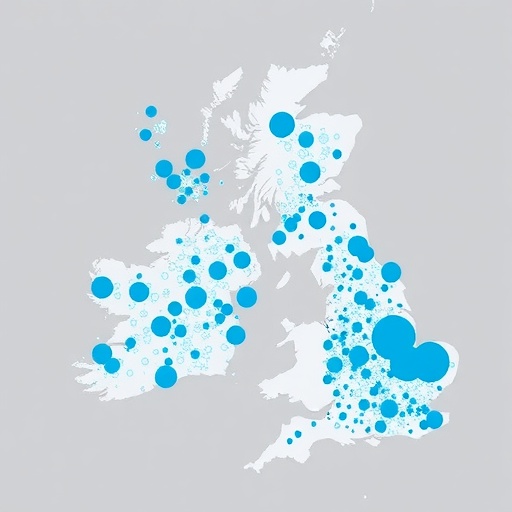
A new study of hundreds of thousands of people in the United Kingdom and Estonia is offering one of the most detailed views yet of how human partner choice can leave a measurable signature in the genome. Published in Nature Human Behaviour, the research reconstructs the parental origins of inherited DNA in as many as 440,209 individuals and uses that information to investigate recent patterns of assortative mating—the tendency for people to form partnerships with others who resemble them in particular traits, backgrounds, or social characteristics. The work provides a powerful genetic framework for studying how mating patterns influence the architecture of human populations across generations.
Every person inherits one copy of each chromosome from their mother and one from their father. By adulthood, however, those parental copies have been reshuffled through recombination, the biological process that exchanges DNA between paired chromosomes during the formation of eggs and sperm. As a result, an individual’s genome is a mosaic of segments inherited from both parents. Reconstructing which segments came from which parent is relatively straightforward in families where parental DNA is available, but it becomes far more challenging in large population datasets, where researchers often have genetic information only from the individual being studied.
Hofmeister, Marnetto, Cavinato and colleagues developed and applied methods to overcome that obstacle. Their approach uses patterns of genetic sharing, chromosomal recombination and relatedness to infer parental haplotypes—long stretches of DNA inherited together from a single parent. A haplotype can contain many genetic variants that remain physically linked on a chromosome. Recovering these inherited blocks allows researchers to distinguish the two parental contributions within an individual’s genome, even when the biological parents were not directly genotyped. This distinction is crucial because the effects of parental genomes are not fully captured by simply examining an individual’s total genetic profile.
The study draws on exceptionally large datasets from UK and Estonian populations, enabling the researchers to examine genetic inheritance at a scale that would be impossible in most conventional family studies. Large biobanks contain millions of genetic markers, but their value depends on sophisticated statistical models capable of separating genuine biological signals from technical artifacts, population structure and chance. By combining haplotype reconstruction with information about relationships and shared DNA, the researchers were able to examine how the genomes of parents may have been paired before being passed to their children. In effect, the method turns the genome of the offspring into a partial record of the mating patterns that produced it.
That record matters because assortative mating can change the genetic structure of a population without altering the frequency of individual genetic variants. If people who resemble one another in education, height, ancestry, socioeconomic position or other characteristics are more likely to pair, genetic variants associated with those traits may become correlated over time. This process is sometimes called indirect genetic assortment: the partners may not be choosing each other because of a specific DNA variant, but their shared trait or social environment can bring together genetic differences that would otherwise be more randomly distributed. Across generations, those correlations can influence estimates of heritability and the apparent effects of genes.
The researchers’ reconstruction makes it possible to study these dynamics more directly than analyses based only on unrelated individuals. Instead of asking whether a person’s genome contains variants associated with a trait, scientists can examine whether the two parental haplotypes entering the next generation show systematic similarities or differences. This helps separate genetic inheritance from the social and demographic processes that shape who meets, partners and has children. It also offers a way to investigate whether assortative mating is changing, weakening or becoming more pronounced in recent generations.
The findings reveal that mating patterns are not genetically invisible. The parental haplotypes reconstructed from the UK and Estonian data contain evidence consistent with recent assortative mating dynamics, showing that the genomes inherited by children reflect more than random combinations of population-wide variation. The scale of the study allows these patterns to be assessed across large numbers of individuals and in different national contexts, providing a stronger foundation for comparing how social structure, geography and demographic history influence partner choice. The researchers emphasize that such signals describe population-level tendencies, not fixed rules governing individual relationships.
One of the most important implications concerns genetic association studies. Many genome-wide association studies assume, either explicitly or implicitly, that parental genetic contributions are combined in ways that can be modeled using standard population-genetic expectations. Assortative mating can violate those assumptions by creating correlations between genetic variants that are associated with socially patterned traits. If those correlations are ignored, researchers may overestimate or underestimate genetic effects, misinterpret the relationship between genes and environment, or draw incorrect conclusions about the biological pathways underlying complex traits. Reconstructing parental haplotypes provides a route toward correcting or refining those analyses.
The method may also help clarify why genetic and social influences are so difficult to disentangle in traits such as educational attainment, health, behavior and reproductive outcomes. A child can inherit genetic variants from parents, grow up in an environment shaped by those same parents and experience social advantages or disadvantages linked to family background. When partners are similar in traits or circumstances, these pathways can reinforce one another across generations. The new framework does not reduce human behavior to DNA; instead, it offers a way to map how inherited genetic structure interacts with demographic and social processes. Its greatest value is therefore methodological as well as substantive: it gives population scientists a more precise lens for studying inheritance in the real world.
The researchers caution that reconstructed haplotypes are statistical inferences and that conclusions remain dependent on the quality, ancestry composition and representativeness of the biobank samples. Participants in large genomic databases are not perfect mirrors of their national populations, and differences between the UK and Estonia may reflect historical migration, sampling design, cultural context or social structure as well as mating preferences. Even so, the analysis demonstrates how the genomes of present-day individuals can preserve information about recent population dynamics. As genomic datasets continue to expand, parental haplotype reconstruction could become a standard tool for examining how partner choice, social inequality and biological inheritance combine to shape the next generation.
Cite Scienmag News
Juliet Wilcox. (August 17, 2026). Parental haplotypes in 440,209 UK and Estonian participants reveal assortative mating. Scienmag. https://scienmag.com/parental-haplotypes-in-440209-uk-and-estonian-participants-reveal-assortative-mating/
Juliet Wilcox. "Parental haplotypes in 440,209 UK and Estonian participants reveal assortative mating." Scienmag, 17 August 2026, https://scienmag.com/parental-haplotypes-in-440209-uk-and-estonian-participants-reveal-assortative-mating/. Accessed 4 September 2026.
Juliet Wilcox. "Parental haplotypes in 440,209 UK and Estonian participants reveal assortative mating." Scienmag. August 17, 2026. https://scienmag.com/parental-haplotypes-in-440209-uk-and-estonian-participants-reveal-assortative-mating/


