


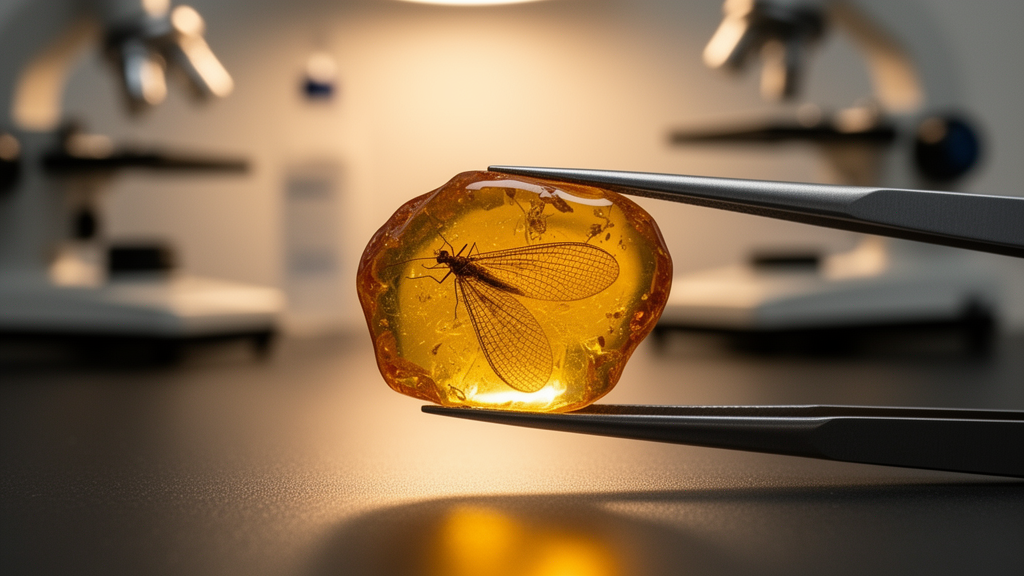
A fossil study describes a new genus and two new species of Babinskaiidae from mid-Cretaceous Kachin amber in Myanmar, expanding the known family record to 24 species in 17 genera. The specimens preserve differences in female reproductive anatomy and leg structure, although the precise functions of several features remain uncertain. The authors identify the new genus as Milubabinskaia , represented by the species Milubabinskaia zhiqiae .
Its holotype is a complete female with a body length of 10.9 mm and an estimated total forewing length of more than 12.0 mm. The second new species, Stenobabinskaia chenjieae , is based on another amber specimen with elongated wings and detailed preservation of the legs. The new genus is distinguished from other babinskaiid genera by a combination of wing and body characters, including the small body size, a simple MP vein, numerous presectoral crossveins and paired long processes on the female sixth sternum.
Both fossils came from the Hukawng Valley in Tanai Township, Myikyina District, Kachin State, Myanmar. Uranium-lead dating of zircons from the amber deposit’s volcanoclastic matrix places the deposit at 98.8 ± 0.6 million years. The authors confirmed that the amber specimen reported in the study was collected and purchased before June 2017.
The holotypes are deposited in the Xiachong Amber Museum in Beijing, China. Milubabinskaia zhiqiae combines wing characters most similar to those of Burmobabinskaia with a pair of long processes on the female sixth sternum, a feature also reported in Electrobabinskaia and Pseudobabinskaia . The generic name combines “Milu,” referring to Père David’s deer, with Babinskaia , reflecting the authors’ description of the fossil as having a mosaic-like combination of characters from other babinskaiid genera.
Stenobabinskaia chenjieae is characterized by medial fusion of the RP stem with RA in both fore- and hind wings, a straight oblique presectoral crossvein and marginally forked MP2 branches in the hind wing. The study distinguishes six morphotypes of female genitalia among babinskaiids from Kachin amber. They differ in features including the presence or absence of posterior projections on sternum 6, distinct gonocoxites 8, and additional lobes or digging setae on gonocoxites 9.
The female of Milubabinskaia zhiqiae has a sixth sternum extended into paired long lobes, a fused semilunar gonocoxite 8, lateral projections on tergum 9, and paired lobe-like gonocoxites 9. Long sternal projections in babinskaiids have previously been interpreted as possible courtship or mating adaptations, and the researchers suggest that the specialized sternum of Milubabinskaia might have had a similar function. They state that the function of its distinct gonocoxites 8, the additional lobes of gonocoxites 9 and the anteriorly projecting tergum 9 is difficult to determine.
The varied anatomy therefore provides evidence consistent with diversified reproductive behavior, rather than proof of a specific reproductive function. The presence of digging setae on the female gonocoxites 9 of Calobabinskaia xiai may be indicative of a fossorial larval lifestyle, although many babinskaiid species are considered arboreal. The legs of Stenobabinskaia chenjieae bear regularly spaced spinous setae, paired tibial spurs and a bilobed arolium.
The authors identify possible functions for the setae and spurs, including defense against small predators or parasites and improved grip on struggling prey, but frame these as functional hypotheses. A bilobed arolium is also present in Calobabinskaia xiai and is typical of Nymphidae, whose adults are generally arboreal. This shared feature suggests, but does not demonstrate, a similar arboreal lifestyle for S. chenjieae .
The authors also note that the presence of digging setae in C. xiai might indicate ecological divergence between its adults and larvae. The authors additionally reconsider the sex of the holotype of Burmobabinskaia tenuis , originally identified as a male. They argue that the prominent sclerite on abdominal segment 8 is more likely to be the gonocoxites 8 of a female, while the ventrally expanded tergum 9 and enclosed gonocoxites 9 resemble females of other babinskaiids.
The interpretation is based on comparisons of sclerite and genital morphology with other specimens. Before these additions, Babinskaiidae contained 22 species in 16 genera, all known from the Cretaceous across approximately 35 million years, from the Barremian to the Cenomanian. Its records came from three deposits: the Lower Cretaceous Zaza Formation in Russia, the Crato Formation in Brazil and the mid-Cretaceous Kachin amber in Myanmar.
Consequently, the ecology and behavior associated with many structures remain unresolved, and the paper does not establish a single lifestyle for the group.
Subject of Research: Fossil morphology and diversity of Cretaceous babinskaiid lacewings
Article Title: New Cretaceous fossils highlight the diverse reproductive behavior and life-styles of the extinct family Babinskaiidae ( Insecta , Neuroptera )
Article References: Lu, X., Wang, F., Zhuo, D., & Liu, X. (2026). New Cretaceous fossils highlight the diverse reproductive behavior and life-styles of the extinct family Babinskaiidae (Insecta, Neuroptera). Deutsche Entomologische Zeitschrift, 73(1), 95-104. https://doi.org/10.3897/dez.73.184533
Image Credits: AI Generated
Keywords: Babinskaiidae, Cretaceous fossils, Kachin amber, Neuroptera, lacewings, fossil classification, female genitalia, leg morphology, Myanmar, paleontology, Cretaceous, fossils
Cite Scienmag News
Gavin Prescott. (October 20, 2026). Two Cretaceous amber lacewings expand evidence of babinskaiid reproductive and leg diversity. Scienmag. https://scienmag.com/two-cretaceous-amber-lacewings-expand-evidence-of-babinskaiid-reproductive-and-leg-diversity/
Gavin Prescott. "Two Cretaceous amber lacewings expand evidence of babinskaiid reproductive and leg diversity." Scienmag, 20 October 2026, https://scienmag.com/two-cretaceous-amber-lacewings-expand-evidence-of-babinskaiid-reproductive-and-leg-diversity/. Accessed 20 October 2026.
Gavin Prescott. "Two Cretaceous amber lacewings expand evidence of babinskaiid reproductive and leg diversity." Scienmag. October 20, 2026. https://scienmag.com/two-cretaceous-amber-lacewings-expand-evidence-of-babinskaiid-reproductive-and-leg-diversity/


