


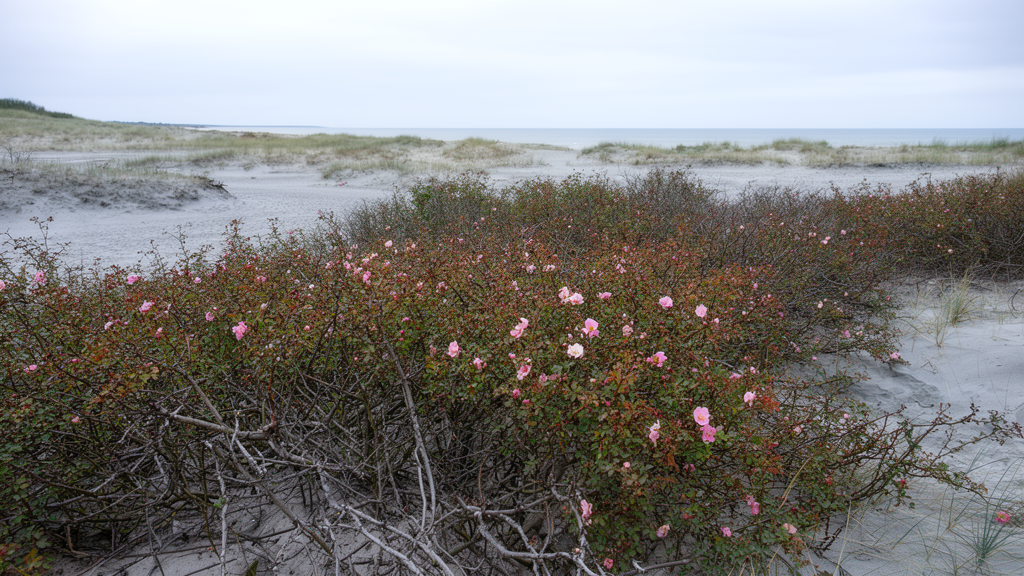
An observational field study in grey dune vegetation on Poland’s Baltic coast found that senescence-related canopy thinning in thickets of the invasive rugosa rose did not restore the adjacent open-habitat plant community. Older, central parts of the patches contained more dead or dying shoots and a thicker organic soil layer, but the vegetation there differed from that in adjacent uninvaded plots. Instead, the observed changes were associated with plant communities shifted toward species more commonly associated with closed, mesic conditions.
The study examined 11 sites in the grey dune zone of the eastern Hel Peninsula. At each site, researchers established four 1-square-metre plots: the centre of a rugosa rose patch, its edge, well-developed native grey dune vegetation adjacent to the patch, and a nearby bare-soil gap where total plant cover usually did not exceed a few percent. The centre and edge positions were used as spatial proxies for different stages of patch development. This space-for-time approach allowed the researchers to investigate how ecological conditions varied from newer margins toward ageing thicket interiors.
Measurements confirmed substantial morphological differences between the two invaded zones. Rugosa rose shrubs in central plots were taller than those at patch edges, but had lower densities of main and annual shoots. Approximately two-thirds of main shoots in central plots were dead or dying, compared with about one-third in edge plots. These observations were consistent with the study’s use of patch position as a proxy for demographic development, although the design did not directly track the age of individual plants.
Plant communities also varied among the four plot types. Total vegetation cover and species diversity were significantly lower in bare-soil plots than in the other three types. Species composition differed significantly overall, with edge plots and adjacent native vegetation showing considerable similarity. The principal differences were associated with Corynephorus canescens, which dominated the edge and native-vegetation plots, and Polypodium vulgare and Hieracium umbellatum var. dunense, which characterized central plots and also occurred frequently in edge and native-vegetation plots.
Canopy opening in the thicket interiors therefore did not produce a broad recovery of the vegetation observed beside the patches. Instead, the older centres contained more species associated with more closed and mesic habitats, including Polypodium vulgare and woody taxa such as Pinus sylvestris and Vaccinium vitis-idaea. At the same time, several typical early-successional dune species could persist in the opened microsites. The findings indicate a selective shift in community composition rather than restoration of the original community, with no corresponding decline in overall species diversity reported for the invaded zones.
A distinct soil organic horizon provided a likely environmental link to these vegetation differences. The horizon, composed largely of an interwoven root mat with surface litter, was several centimetres thick and occurred exclusively in the oldest central parts of the thickets. Its thickness and the dry masses of its litter and root fractions were significantly greater in central plots than at patch edges. The authors interpreted the association between this horizon and community changes as evidence that belowground conditions, including competition and altered resource availability, may matter more for resident plants than the reduction in canopy competition caused by shrub dieback.
Changes in mineral-soil physicochemical properties were more moderate than the structural change above ground. Water-holding capacity was significantly higher in central invaded plots than in non-invaded plots, while electrical conductivity was higher in the rugosa rose plots than in native vegetation. Total organic carbon and total nitrogen were higher in invaded plots than in bare soil, although differences among vegetation types were generally weak. Available phosphorus was highest at patch edges and in native vegetation but declined in the centres of older thickets. Except for electrical conductivity, the researchers observed no abrupt boundary between invaded and non-invaded soils, and many physicochemical values shifted gradually across plot types.
Microbial responses were variable but included clear contrasts. Basal respiration was significantly lower in native vegetation than in each of the other three plot types, while microbial biomass carbon and the metabolic quotient did not differ significantly among them. Enzyme activities were generally higher under rugosa rose than under non-invaded vegetation, although individual patterns varied. Arylsulphatase showed a sharp change between edge and native-vegetation plots, acid phosphatase declined gradually from the thicket centre toward bare soil, and urease activity reached its highest value in native vegetation. The authors associated elevated arylsulphatase and β-glucosidase activity with organic-matter processing and cellulose degradation in the root-litter environment, while suppression of urease was associated with altered nitrogen transformations. These functional patterns indicate rapid belowground responses, although they do not establish which processes caused the vegetation changes.
The study was spatial and observational rather than a manipulation of canopy age, soil horizons or plant establishment. Facilitation and belowground competition were inferred from the alignment of morphological, vegetation and soil patterns; the researchers did not directly test the effects of removing the organic layer or introducing native species. Within those limits, the results support the conclusion that natural senescence and thinning do not undo the ecological effects of rugosa rose in grey dunes. Instead, ageing thickets retain a root-litter layer and altered soil and microbial conditions that favor succession toward more mesic-tolerant assemblages. The authors concluded that control of rugosa rose requires removal of belowground roots and rhizomes; thinning the canopy alone is insufficient to create conditions for the re-establishment of species associated with open grey dune habitats.
Subject of Research: Effects of rugosa rose patch age on vegetation, soil properties and microbial activity in Polish grey dunes
Article Title: Senescence-driven canopy thinning in Rosa rugosa thickets does not mitigate negative effects on grey dune vegetation
Article References: Woch, M. W., Kapusta, P., Stefanowicz, A. M., Grześ, I. M., & Stanek, M. (2026). Senescence-driven canopy thinning in Rosa rugosa thickets does not mitigate negative effects on grey dune vegetation. NeoBiota, 108, 53-68. https://doi.org/10.3897/neobiota.108.181357
Image Credits: AI Generated
DOI: 10.3897/neobiota.108.181357
Keywords: Rosa rugosa, grey dunes, invasive shrub, canopy thinning, plant community composition, soil organic horizon, microbial activity, Baltic Sea coast, ecological succession, Senescence-driven, canopy, thinning
Cite Scienmag News
Beatrice Stafford. (October 20, 2026). Field study finds senescence-related canopy thinning does not restore grey dune vegetation under invasive rugosa rose. Scienmag. https://scienmag.com/field-study-finds-senescence-related-canopy-thinning-does-not-restore-grey-dune-vegetation-under-invasive-rugosa-rose/
Beatrice Stafford. "Field study finds senescence-related canopy thinning does not restore grey dune vegetation under invasive rugosa rose." Scienmag, 20 October 2026, https://scienmag.com/field-study-finds-senescence-related-canopy-thinning-does-not-restore-grey-dune-vegetation-under-invasive-rugosa-rose/. Accessed 20 October 2026.
Beatrice Stafford. "Field study finds senescence-related canopy thinning does not restore grey dune vegetation under invasive rugosa rose." Scienmag. October 20, 2026. https://scienmag.com/field-study-finds-senescence-related-canopy-thinning-does-not-restore-grey-dune-vegetation-under-invasive-rugosa-rose/


