


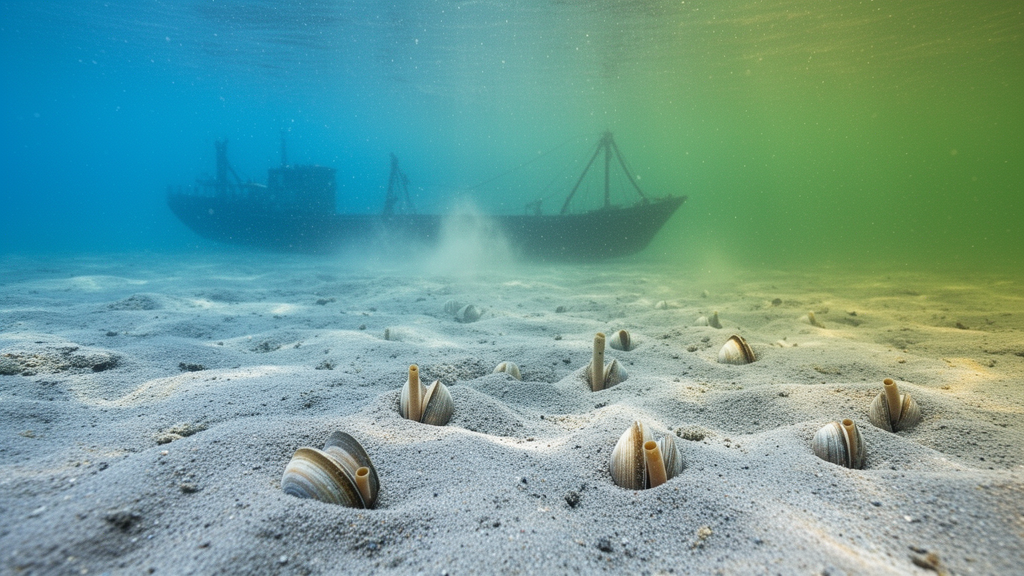
A three-year observational field study of the wedge clam Donax trunculus found no single, consistent microbial community across four Bulgarian Black Sea sites. Some bacteria recurred in every sampling year at particular locations, while many species appeared intermittently, supporting the authors’ conclusion that much of the clam microbiota was transient and influenced by local environmental conditions and anthropogenic inputs.
Researchers at the Department of Biology at the University of Shumen collected samples from January 2020 through December 2022 at four mussel-farm regions along the Bulgarian coast: Arkutino, Ahtopol, Obzor and Tsarevo. Wedge clams were collected monthly by trawling. Three subsamples of about 1 kg each were refrigerated at 4 °C and transported for immediate laboratory analysis without freezing.
The investigators selected clams of similar size, weight and shape to standardize the methods. Mean shell length was 2.2 ± 0.43 cm. After the shells were scrubbed, washed in 20 mg l⁻¹ hypochlorite solution and rinsed with sterile distilled water, the animals were opened with a sterile knife. About 100 g of whole soft tissue and associated liquor was homogenized for analysis.
The laboratory workflow combined culture-based enumeration with phenotypic identification. Faecal coliforms were measured using a five-tube most probable number series, with incubation at 37 °C for three hours followed by 44 °C for 21 hours. Escherichia coli was enumerated on MacConkey agar, Pseudomonas on Cetrimide agar, and lactic acid bacteria were isolated on de Man, Rogosa and Sharpe medium under limited-oxygen conditions.
Isolated strains were screened using the BIOLOG Microbial Identification System and its GEN III microplate, which profiles 94 biochemical reactions. Identification was based on the resulting phenotypic pattern and comparison with BIOLOG reference databases. The approach was intended to characterize cultivated aerobic bacteria from the clam tissue rather than the complete microbiota, including organisms that could not be recovered through the methods used.
Arkutino yielded recurring isolates of Enterococcus hirae, Escherichia vulneris and Acinetobacter gyllenbergii across all three years, which the authors classified as autochthonous microflora for that area. Enterococcus cancerogenus, found only in May 2020, and Citrobacter farmeri, detected only in September 2020, were treated as transitional species. At Ahtopol, E. hirae, E. vulneris, Enterobacter cloacae and A. gyllenbergii recurred in all three years. Other isolates, including Escherichia hermannii and several Pseudomonas species, were detected only in particular years or months.
Seasonal isolation did not establish that the bacteria were adapted to particular temperatures. For example, the Pseudomonas species recovered at Ahtopol were isolated in the colder months, while E. vulneris at Arkutino was chiefly detected from June through August. The investigators noted that the appearance of Pseudomonas might be associated with changes in currents, water temperature or pH, but the observations did not distinguish cold adaptation from other environmental or methodological influences.
Microbial composition differed markedly among the other sites. At Obzor, where the authors noted the absence of an active summer tourist season, no species was isolated regularly in all three years, and they classified the recovered organisms as transient. At Tsarevo, Vibrio cincinnatiensis, V. alginolyticus and V. parahaemolyticus were each isolated only in August samples across different years. The authors associated these occurrences with anthropogenic factors, but the field observations did not establish their source or demonstrate that the isolates caused disease in the clams.
Faecal-coliform measurements provided further evidence of seasonal contamination. The authors reported a July 2020 value in Arkutino that was 190 times the limit prescribed in Bulgarian Ordinance No. 4/20.10.2000 for inter-shell content. A high level persisted in 2022, when the reported amount increased by 50% and exceeded 250 times the sanitary limit. At Ahtopol, counts above the permitted level were also registered during summer through the end of September. The authors associated warmer-season increases with worsening seawater conditions related to human activity, including tourism and resort-related pollution.
Among the recurrent bacteria was E. vulneris, an opportunistic human pathogen that the source describes as capable of causing severe diarrhoea and sepsis in infants and invasive infection in vulnerable patients. The study’s isolation of the species in clams does not demonstrate transmission to consumers, but the authors considered its presence at high concentrations a potential health concern and a marker of anthropogenic contamination. Overall, they favoured the view that D. trunculus has predominantly transient microbiota affected by environmental conditions and pollution, while acknowledging that a stable bacterial symbiosis cannot be excluded without further investigation.
Subject of Research: Site- and season-dependent bacterial communities in Bulgarian Black Sea wedge clams
Article Title: Study of the dynamics of the microbial communities in the wedge clam Donax trunculus (Linnaeus, 1758) from the Bulgarian aquatory of the Black Sea
Article References: Ibryamova, S. F., Toschkova, S., Bachvarova, D. C., Stanachkova, E., Ivanov, R. I., Natchev, N. D., & Ignatova-Ivanova, T. V. (2023). Study of the dynamics of the microbial communities in the wedge clam Donax trunculus (Linnaeus, 1758) from the Bulgarian aquatory of the Black Sea. BioRisk, 21, 29-40. https://doi.org/10.3897/biorisk.21.111253
Image Credits: AI Generated
DOI: 10.3897/biorisk.21.111253
Keywords: Donax trunculus, Black Sea, wedge clams, microbial communities, bacterial isolation, faecal coliforms, seasonal variation, coastal pollution, Bulgaria, phenotypic identification, dynamics, microbial
Cite Scienmag News
Morgan Morrow. (October 20, 2026). Three-year field study finds transient, site-dependent microbiota in Black Sea wedge clams. Scienmag. https://scienmag.com/three-year-field-study-finds-transient-site-dependent-microbiota-in-black-sea-wedge-clams/
Morgan Morrow. "Three-year field study finds transient, site-dependent microbiota in Black Sea wedge clams." Scienmag, 20 October 2026, https://scienmag.com/three-year-field-study-finds-transient-site-dependent-microbiota-in-black-sea-wedge-clams/. Accessed 20 October 2026.
Morgan Morrow. "Three-year field study finds transient, site-dependent microbiota in Black Sea wedge clams." Scienmag. October 20, 2026. https://scienmag.com/three-year-field-study-finds-transient-site-dependent-microbiota-in-black-sea-wedge-clams/


