


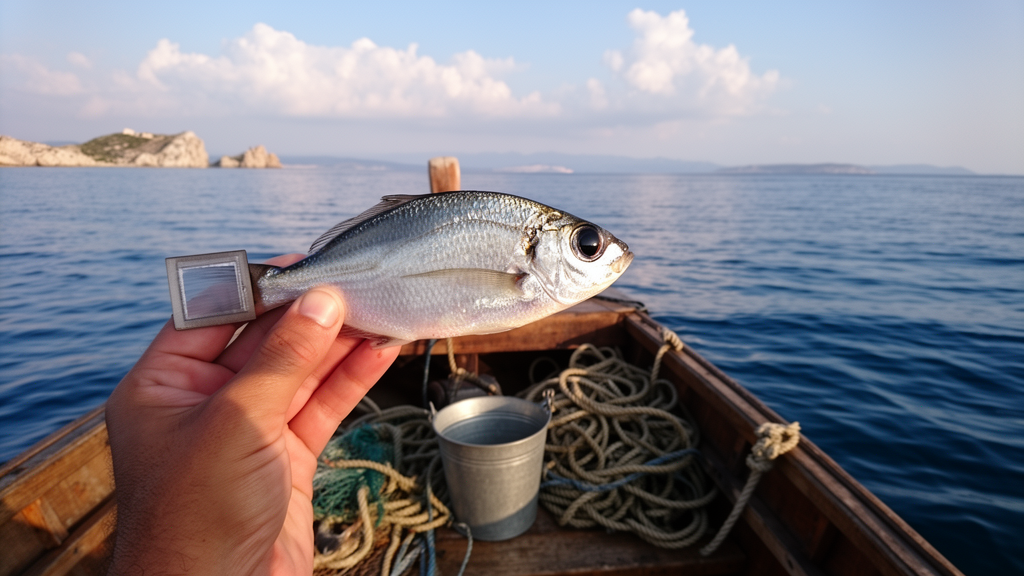
A single-specimen field record study confirms the presence of the smalleye squaretail, Tetragonurus cuvieri Risso, 1810, in the eastern Adriatic Sea. The fish was collected on 16 February 2024 at approximately 100 m depth in the Mljet Channel between the Croatian islands of Lopud and Šipan, and its identity was established through morphological examination and mitochondrial DNA analysis.
Researchers recovered the specimen with a bottom otter trawl, froze it within a couple of hours and transferred it to the Institute of Oceanography and Fisheries in Split, Croatia. They measured the fish with digital calipers to the nearest 0.01 mm, determined its weight with a digital scale to the nearest 0.1 g, and examined its morphometric and meristic characters against published descriptions. After dissection, the specimen was preserved in 70% ethyl alcohol and deposited in the institute’s Laboratory for Ichthyology and Coastal Fisheries under catalogue number TC2024.
The fish measured 37.2 cm in total length and weighed 277.56 g. Its internal organs were in poor condition, apparently because of a delay between capture and freezing or the collection process, so the researchers could not determine its sex. The stomach and gut contained traces of heavily digested material that could not be identified taxonomically. The gelatinous nature of the remains suggested that gelatinous organisms may have formed part of its diet, but the sample did not permit a specific dietary identification.
Diagnostic external characters supported the identification as T. cuvieri. The body was markedly elongated and covered with small, densely packed scales arranged in a spiral pattern, creating an armor-like appearance except on the anterior head. The fish was almost uniformly dark grey to black. Its robust lower jaw carried a single row of fan-shaped teeth, while the upper jaw had one row of small pointed teeth. The caudal peduncle was rectangular in cross-section and bore a lateral keel on each side, and the soft portions of the dorsal and anal fins were positioned posteriorly along the body.
Most measured proportions and meristic counts were generally consistent with records previously published for the Mediterranean. Differences from some earlier descriptions involved caudal-peduncle height, interdorsal-fin length, first dorsal-fin length and anal-fin length. The researchers said these discrepancies could reflect methodological differences rather than genuine morphological variation. The Adriatic specimen also had fewer pectoral-fin rays and more anal-fin rays than specimens reported elsewhere in the Mediterranean, which the authors attributed to possible measurement error or natural variation within the species. Because the study examined only one fish, it did not establish the extent of variation within T. cuvieri.
For molecular confirmation, the researchers extracted genomic DNA from fin clips and amplified a 631-base-pair fragment of the mitochondrial cytochrome c oxidase subunit I, or COI, gene. They aligned the resulting sequence with reference sequences from GenBank and constructed a maximum-likelihood phylogenetic tree using the HKY+I nucleotide substitution model with 1,000 bootstrap replicates. The sequence showed 100% similarity to available T. cuvieri sequences and clustered within a well-supported clade containing reference specimens of that species. Tetragonurus atlanticus and T. pacificus formed separate, well-resolved lineages.
The new COI sequence was deposited in GenBank under accession number PX970189, providing a regional reference sequence for comparisons with future records from the Adriatic and Mediterranean. The molecular result independently corroborated the morphology-based identification and excluded confusion with the two congeners included in the analysis. The study therefore documents a confirmed occurrence in the eastern Adriatic rather than merely listing the species in a checklist.
An earlier Adriatic listing had included T. cuvieri following a report of a 19.2 cm individual from Shëngjin, Albania, in 1995, but no description or supporting documentation of the material accompanied that entry. The species was also absent from a later evidence-based checklist of Adriatic fishes. By contrast, the present record is supported by a retained specimen, detailed morphological and biological measurements, a deposited DNA sequence and a phylogenetic comparison with reference material.
The capture expands the documented Mediterranean record of a species whose biology and ecology remain poorly understood. T. cuvieri is a meso-bathypelagic fish reported to occur down to 800 m and is known from the Pacific, Atlantic and Indian oceans. Its family, Tetragonuridae, contains the single genus Tetragonurus and three valid species: T. cuvieri, T. atlanticus and T. pacificus. Published Mediterranean records include the western and central basins and more recent reports from the Ionian Sea, Sicilian Channel, waters off Anzio, Tunisia and the Gulf of Cádiz.
The researchers described T. cuvieri as more likely to be elusive than genuinely rare because its deep-water habitat limits detection by conventional sampling. The single Adriatic specimen establishes a documented occurrence there, but it does not establish the species’ abundance, population structure or regional range. The authors concluded that the fish may be more widespread in the Mediterranean than earlier documentation indicated and called for further morphological and molecular studies to clarify its distribution and biology in the region.
Subject of Research: Documentation of the smalleye squaretail in the eastern Adriatic Sea using morphology and mitochondrial DNA analysis.
Article Title: First documented record of the smalleye squaretail, Tetragonurus cuvieri ( Actinopterygii , Scombriformes , Tetragonuridae ), in the Adriatic Sea
Article References: Ugrin, N., Pavičić, M., Žužul Vrgoč, I., & Dragičević, B. (2026). First documented record of the smalleye squaretail, Tetragonurus cuvieri (Actinopterygii, Scombriformes, Tetragonuridae), in the Adriatic Sea. Acta Ichthyologica et Piscatoria, 56, 159-166. https://doi.org/10.3897/aiep.56.187582
Image Credits: AI Generated
Keywords: Tetragonurus cuvieri, smalleye squaretail, eastern Adriatic, Croatia, species record, morphological identification, mitochondrial DNA, COI sequencing, deep-sea fish, single-specimen study, First, documented
Cite Scienmag News
Margaret Porter. (October 20, 2026). Single-specimen study confirms smalleye squaretail in Croatia’s eastern Adriatic. Scienmag. https://scienmag.com/single-specimen-study-confirms-smalleye-squaretail-in-croatias-eastern-adriatic/
Margaret Porter. "Single-specimen study confirms smalleye squaretail in Croatia’s eastern Adriatic." Scienmag, 20 October 2026, https://scienmag.com/single-specimen-study-confirms-smalleye-squaretail-in-croatias-eastern-adriatic/. Accessed 20 October 2026.
Margaret Porter. "Single-specimen study confirms smalleye squaretail in Croatia’s eastern Adriatic." Scienmag. October 20, 2026. https://scienmag.com/single-specimen-study-confirms-smalleye-squaretail-in-croatias-eastern-adriatic/


