


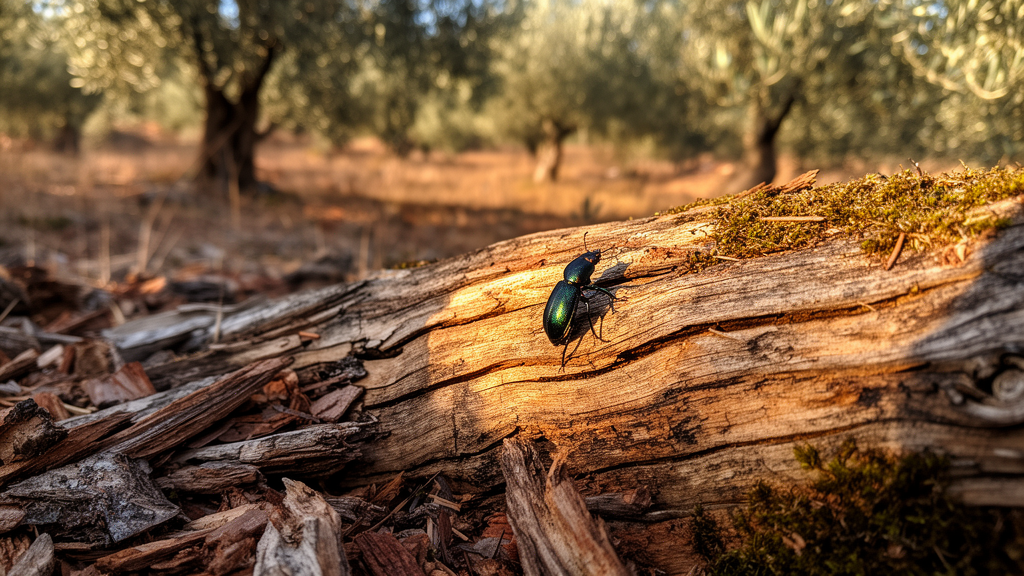
A review of historical literature, modern databases, museum collections and conservation assessments has produced the first consolidated checklist of saproxylic beetles recorded in Greece, documenting 1,548 species across 61 families and 606 genera. The catalogue includes 23 invasive species, one species considered extinct in Greece and 112 endemic species, while also showing that major gaps remain in knowledge of distribution, ecology and extinction risk.
The authors compiled records from published catalogues, Red Lists, other literature, Palaearctic catalogues, GBIF and additional online databases. They also examined arthropod holdings at the Natural History Museum of Crete, the Laboratory of Forest Entomology collection at the Forest Research Institute, and a private collection. Existing European and Mediterranean assessments guided the initial selection of species, after which the saproxylic status of Greek members of genera containing saproxylic species was checked separately. The synthesis was a review and national catalogue rather than a new field survey, so its totals reflect the evidence available to the authors across historical and modern sources.
Saproxylic beetles are defined here as species dependent on dead or dying wood, wood-rotting fungi or other organisms associated with decaying wood. The authors assigned broad trophic categories principally from the framework used in the Italian Red List, with some simplifications. Where published information was unavailable, a category was inferred from the typical ecology of the relevant genus, an approach that introduces uncertainty for some poorly studied species. Endemic species were assigned to nine broad Greek regions, with those restricted to one administrative division treated as local endemics and those recorded in two or more divisions treated as more widely distributed endemics.
Xylophagous species formed the largest trophic group, with 632 species, followed by saproxylophagous species with 254, mycetophagous species with 246 and predatory species with 231. Seventy species had no trophic assignment, while 84 were classified as having trophic flexibility across more than one category. The paper notes that trophic classification within saproxylic beetles is debated and that assignments for some species remain uncertain.
Endemism was concentrated in southern Greece. The checklist identifies 112 endemic species, representing 7.2% of the 1,548 recorded species, with Cerambycidae and Ptinidae containing the largest numbers, at 21 endemic species each. Crete contained 32 endemic species and the Peloponnese 36, including 26 endemics restricted to Crete and 22 to the Peloponnese. The authors associate Crete’s distinctive fauna with the island’s long-term isolation, dating back approximately 5.5 million years. They identify Pleistocene glacial refugia, mountain isolation and habitat specialisation as possible contributors to the Peloponnesian pattern, but the underlying ecological mechanisms remain uncertain.
Conservation assessments remain incomplete. Of the 1,548 species, 867 had not been assessed in either the European or Greek Red Lists. Among 681 assessed species, 42 were classified as threatened: one Critically Endangered species, 24 Endangered and 17 Vulnerable. Another 457 were Least Concern, 62 Near Threatened and 119 Data Deficient. After invasive and Data Deficient species were excluded, the threatened proportion was 7.5%, compared with 17.9% for Europe. The authors caution that the Greek assessment included many common, widespread and mobile species in families such as Buprestidae and Curculionidae, which can lower the overall proportion classified as threatened.
Endemic species had a less favourable assessed profile. Of 45 assessed endemics, 64%, after correction for Data Deficient species, were classified as threatened, compared with 36.6% in the European assessment and 53% in the Mediterranean assessment. The authors note that many endemics are known from only a few localities or their type locality, so assessments based heavily on distribution data may overestimate their risk. More broadly, the scarcity of taxonomic, distributional and ecological information limits interpretation for both endemic and unassessed species.
Land-use change was the main group of pressures identified in the Greek Red List assessments. These included housing and urban development, roads and railways, crop production, livestock farming, logging, tourism and recreational activities, fire, renewable-energy development, tree plantations, invasive organisms, climate change and pesticide or herbicide use. Species can be associated with more than one pressure, so totals for individual threat categories exceed the number of threatened species. The loss of old trees and dead wood was a particular concern, including the documented association between carob trees and the endangered endemic longhorn beetle Trichoferus bergeri. National data on dead-wood volume remain sparse.
The review identifies Crete, the Peloponnese, Pindos, Olympos and the Aegean as priorities for surveys, alongside work on less-studied beetle groups, species classified as Not Evaluated or Data Deficient, population genetics, species-distribution modelling and open databases. The authors also recommend measuring the effects of logging, wildfire, agricultural intensification and climate- or land-use-driven distribution shifts. Among 22 native species classified as threatened in the Greek Red List, 20 were reported within the Natura 2000 network, one was outside it and the distribution of the remaining species was insufficiently known.
Subject of Research: A review and first national checklist of saproxylic beetle diversity, endemism and conservation status in Greece
Article Title: Saproxylic beetles ( Insecta , Coleoptera ) of Greece: A synthesis of diversity, biogeography and conservation challenges, with the first national checklist
Article References: Bolanakis, G., Avtzis, D., Németh, T., Kundrata, R., Háva, J., Kaltsidis, A., Makris, C., Maroulis, L., & Trichas, A. (2026). Saproxylic beetles (Insecta, Coleoptera) of Greece: A synthesis of diversity, biogeography and conservation challenges, with the first national checklist. Frontiers of Biogeography, 19, Article e177299. https://doi.org/10.21425/fob.19.177299
Image Credits: AI Generated
Keywords: saproxylic beetles, Greece, species checklist, biodiversity, endemism, conservation status, Red List, dead wood, trophic guilds, Natura 2000, Saproxylic, beetles
Cite Scienmag News
Margaret Porter. (October 20, 2026). Review and first Greek checklist document 1,548 saproxylic beetle species. Scienmag. https://scienmag.com/review-and-first-greek-checklist-document-1548-saproxylic-beetle-species/
Margaret Porter. "Review and first Greek checklist document 1,548 saproxylic beetle species." Scienmag, 20 October 2026, https://scienmag.com/review-and-first-greek-checklist-document-1548-saproxylic-beetle-species/. Accessed 20 October 2026.
Margaret Porter. "Review and first Greek checklist document 1,548 saproxylic beetle species." Scienmag. October 20, 2026. https://scienmag.com/review-and-first-greek-checklist-document-1548-saproxylic-beetle-species/


