


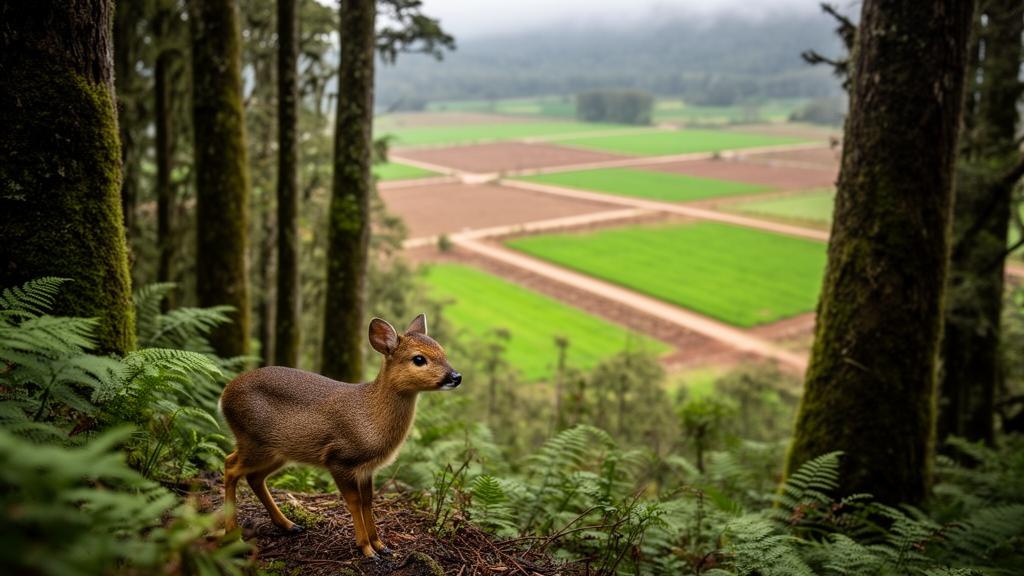
An observational landscape-genetics study of 20 pudu deer found that more fragmented native forest landscapes were associated with fewer alleles per microsatellite locus and lower observed heterozygosity. The finding comes from an individual-based analysis of deer sampled in the Chilean provinces of Osorno, Llanquihue and Chiloé between 2014 and 2019, with five microsatellite loci and land-cover data used to assess genetic variation and forest fragmentation.
Pudu deer, Pudu puda, are endemic to southern South America and strongly associated with temperate rainforest. Native forest loss and fragmentation are among the principal threats cited for the species, alongside predation by domestic dogs, competition with exotic species and poaching. The study focused on the provinces of Osorno, Llanquihue and Chiloé, where agricultural and forestry activity has contributed to increasingly fragmented native forest, particularly in the central valleys between the Andes and Coastal mountain ranges.
The researchers analyzed 20 georeferenced animals: five from Osorno, nine from Llanquihue and six from Chiloé. Most samples were skin and muscle from carcasses donated by institutions including the Museo de Historia Natural in Purranque, Parque Nacional Puyehue, the Sitio Paleontológico de Pilauco and the Centro de Reproducción del pudu in Osorno. Blood was also collected from captive animals at the Centro de Rehabilitación de Fauna Silvestre of the Universidad San Sebastián in Puerto Montt. Legal restrictions and the scarcity of carcasses with precise collection locations limited the sample size.
DNA was extracted from preserved tissue and individuals were genotyped at five polymorphic microsatellite loci: RT27, N, BM6506, BM203 and BBJ2. A sixth locus, Cervid14, was excluded because its amplification products could not be interpreted clearly. The researchers used the more polymorphic available markers because simulations cited in the study indicate that loci with greater allelic richness can monitor population genetic diversity more effectively when only a small number of loci is analyzed. Tests found no evidence of null alleles at the retained loci.
Mean numbers of alleles were 2.8 in Osorno, 3.2 in Chiloé and 4.2 in Llanquihue, while mean allelic richness was 2.5 in both Osorno and Chiloé and 3.1 in Llanquihue. Mean observed heterozygosity ranged from 0.423 in Chiloé to 0.547 in Llanquihue, with an overall mean of 0.473. All three populations showed significant heterozygote deficits, with mean inbreeding coefficients of 0.189 in Osorno, 0.131 in Chiloé and 0.091 in Llanquihue; the overall mean was 0.137, with P < 0.0001. The authors state that these measures indicate greater homozygosity than expected under Hardy–Weinberg equilibrium, although they do not by themselves establish the cause of the deficit.
The analysis did not detect significant differentiation among the three provincial samples. Mean FST was 0.0942, standardized FST was 0.2677 and the differentiation measure Dj was 0.3303; none showed a significant difference among populations. A STRUCTURE analysis favored two clusters under the ΔK criterion, but membership coefficients were nearly symmetric at 0.45–0.55 and the admixture parameter α ranged from 2.39 to 4.01. The authors therefore interpreted the results as showing no resolved population structure and as consistent with gene flow among the sampled populations. They cautioned that both the small sample and the small number of loci can affect STRUCTURE results.
Linkage-disequilibrium estimates gave an effective population size of 3 for Osorno under all three rare-allele thresholds, with a jackknife 95% confidence interval of 0.5 to infinity. For Chiloé and Llanquihue, the method found no evidence that genetic drift attributable to a finite number of parents explained the observations; the corresponding estimates were reported as infinite, with lower confidence limits of 3.0 and 0.6, respectively. The Osorno estimate was below the theoretical threshold of 50 cited by the authors, but it may be biased by the small sample and should be interpreted cautiously.
Fragmentation was measured within a 6.1 km radius around each sampling site, represented by a 12.2 × 12.2 km landscape rectangle. Land-cover data published in 2013 were derived from Landsat 8 imagery with a minimum mappable area of 0.24 hectares. FRAGSTATS was used to calculate class and patch metrics, including the proportion of landscape covered by native forest, patch density, division, splitting, patch number, patch area and patch proximity. Stepwise regression found that patch density and the proportion of forest cover were negatively associated with both the number of alleles per locus and observed heterozygosity. The adjusted R² was 0.3222, meaning that the model accounted for 32.22% of the variation in the response variables.
For the number of alleles per locus, the standardized coefficient was −0.6594 for patch density (P = 0.0123; bootstrap-corrected P = 0.028) and −0.8740 for forest cover (P = 0.0151; bootstrap-corrected P = 0.034). Similar associations were reported for observed heterozygosity. These cross-sectional relationships support an association between fragmentation and lower measured genetic variation, but they do not establish that contemporary forest loss caused the differences or that genetic variation is continuing to decline. The authors considered the possibility that small relict populations may have experienced variation loss over generations through drift, inbreeding or restricted gene flow, and proposed maintaining native-forest continuity, targeted reforestation and possible corridors as conservation strategies.
Subject of Research: Associations between native-forest fragmentation and microsatellite genetic variation in southern Chile pudu deer
Article Title: Genetic structure and microsatellite-based genetic variation influenced by habitat fragmentation in pudu deer ( Pudu puda ) from southern Chile
Article References: Colihueque, N., & Gantz, A. (2025). Genetic structure and microsatellite-based genetic variation influenced by habitat fragmentation in pudu deer (Pudu puda) from southern Chile. Neotropical Biology and Conservation, 20(3), 165-169. https://doi.org/10.3897/neotropical.20.e151162
Image Credits: AI Generated
DOI: 10.3897/neotropical.20.e151162
Keywords: pudu deer, landscape genetics, habitat fragmentation, microsatellites, genetic diversity, heterozygosity, effective population size, southern Chile, temperate rainforest, Genetic, structure, microsatellite-based
Cite Scienmag News
Juliet Wilcox. (October 20, 2026). Forest fragmentation associated with lower genetic variation in 20 pudu deer from three Chilean provinces. Scienmag. https://scienmag.com/forest-fragmentation-associated-with-lower-genetic-variation-in-20-pudu-deer-from-three-chilean-provinces/
Juliet Wilcox. "Forest fragmentation associated with lower genetic variation in 20 pudu deer from three Chilean provinces." Scienmag, 20 October 2026, https://scienmag.com/forest-fragmentation-associated-with-lower-genetic-variation-in-20-pudu-deer-from-three-chilean-provinces/. Accessed 20 October 2026.
Juliet Wilcox. "Forest fragmentation associated with lower genetic variation in 20 pudu deer from three Chilean provinces." Scienmag. October 20, 2026. https://scienmag.com/forest-fragmentation-associated-with-lower-genetic-variation-in-20-pudu-deer-from-three-chilean-provinces/


