


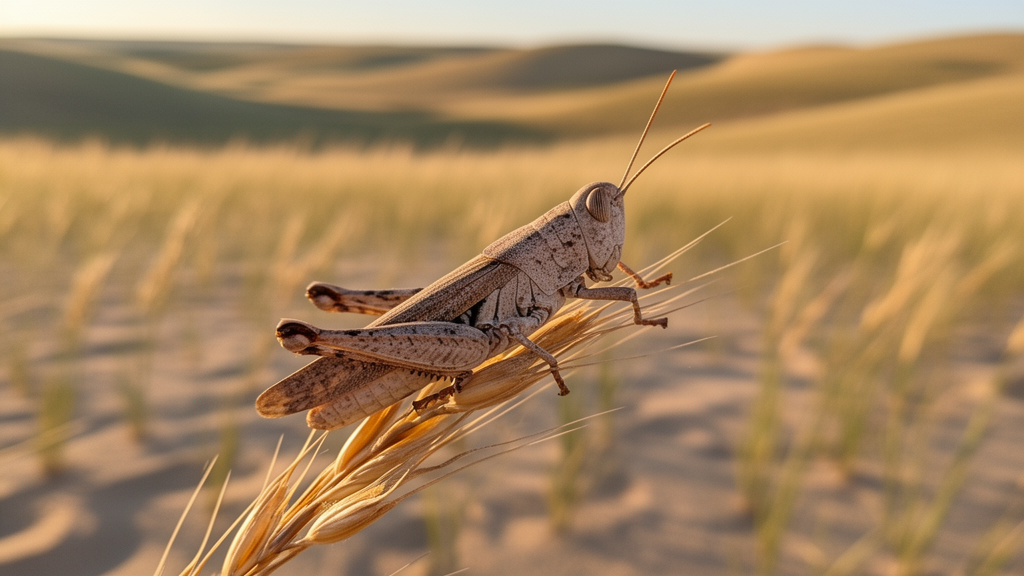
A field study of the grasshopper Melanoplus borealis documented the species in seven Nebraska counties between 2016 and 2024. The surveys recorded the insect at nine general sites, with multiple localities at two of those sites, and found it numerous at Cottonwood-Steverson Wildlife Management Area, Bowring Ranch State Historic Park and Whitehorse Creek.
The species has a broad North American distribution extending from Alaska across most of Canada and southward through Pennsylvania, northern Illinois, Nebraska and parts of the Rocky Mountains in Colorado and Washington. In the southern portion of this range, it is generally associated with cool, moist habitats such as bogs, wet meadows and other wetlands. Before 2007, Nebraska’s known records consisted of eight pre-1900 specimens held by the Academy of Natural Sciences at Drexel University: five from West Point in Cuming County, two from Sioux County and one from Broken Bow in Custer County.
Eight specimens were collected along Whitehorse Creek, about 10 km north of North Platte, in 2007. The creek is cold and spring-fed and likely creates a cool microclimate along its banks. Following that rediscovery, additional searches were conducted to locate other Nebraska populations. The study examined sites considered potentially suitable for the grasshopper, with some individuals collected incidentally during surveys for butterflies in public areas such as state parks, wildlife areas, recreation areas and historical parks. Other searches used satellite and topographic maps to identify promising public sites or roadsides. In 2023, the researchers contacted private landowners to request access to potentially suitable areas, although the reported occurrence results were not separated by land ownership.
The targeted 2023 survey examined 30 sites between June 19 and June 29, a period considered likely to coincide with peak adult abundance in Nebraska. Specimens were collected with aerial nets and sometimes photographed; collected material was deposited in the Chadron State College invertebrate collection. Across the full survey period, M. borealis was collected at nine general sites and found at three specific localities within Gilbert-Baker Wildlife Management Area and two localities at Whitehorse Creek. A single male was also seen at Schlagel Creek Wildlife Management Area but evaded capture.
Adults and nymphs were photographed during the surveys. Immature grasshoppers at Agate Fossil Beds National Monument were photographed but not collected. The targeted 2023 survey detected the species at four of the 30 sites surveyed in late June. The records included single adult specimens at several locations, while populations were described as numerous at Cottonwood-Steverson, Bowring Ranch and Whitehorse Creek. At two Whitehorse Creek localities, collectors reported 16 adult specimens at one site and six at another, with more than 100 grasshoppers likely seen at the first locality.
Most Nebraska collections came from fen wetlands or margins of small spring-fed streams and ditches. The main exception was Gilbert-Baker Wildlife Management Area, where three specimens occurred among openings in a canyon dominated by ponderosa pine. These individuals were among common snowberry or creeping Oregon grape and were 60–200 metres from a small spring-fed stream. At Cottonwood-Steverson, the grasshoppers were abundant among patches of pale smartweed, especially within 50 metres of a ditch west of Steverson Lake, although some occurred among giant goldenrod farther away.
At Bowring Ranch State Historic Park, the species was found almost exclusively among pale smartweed along a ditch about 300 metres east of the visitor centre. Similar spatial associations were recorded at other sites: two of three adults and one immature specimen at Fort Robinson State Park were among pale smartweed; a collected adult and observed nymphs at Smith Lake occurred among that plant; and pale smartweed was numerous at Gudmundsen Ranch. At Whitehorse Creek, the grasshopper was abundant among giant goldenrod, while nymphs at Agate Fossil Beds were also found among that vegetation. Investigators did not observe feeding, so these plant associations do not demonstrate which plants the grasshoppers consumed.
The authors interpret Nebraska’s populations, and possibly those in the Black Hills of South Dakota, as glacial relicts that may have been isolated from other populations for a substantial period. More than half of the recorded Nebraska locations for M. borealis fall within the general ranges of three fish considered glacial relicts: northern redbelly dace, finescale dace and northern pearl dace. The known grasshopper distribution also includes Nebraska’s two westernmost records of the broad-winged skipper, at Smith Lake and Whitehorse Creek. Earlier work has described the Niobrara River Valley as a postglacial refugium for plant and animal species, and several grasshopper collection sites were near that valley. Plant species considered glacial relicts have also been recorded in wetland fens in the Nebraska Sandhills, where some grasshopper locations overlap.
This observational study establishes occurrence and distribution through field collections, photographs and one uncaptured sighting, but it did not directly determine the age, origin or degree of isolation of the Nebraska populations. It also did not measure population trends, determine demographic connectivity or test the relict interpretation through genetic analysis. Nebraska specimens appeared morphologically indistinguishable from those in South Dakota’s Black Hills, while both populations appeared to differ morphologically from populations in Colorado and Canada. The study’s conclusion that Nebraska populations are glacial relicts therefore remains an interpretation based on distribution, habitat and morphological comparisons rather than a direct measurement of their evolutionary history.
Subject of Research: Field documentation and distribution of the Melanoplus borealis grasshopper in Nebraska
Article Title: Occurrence and distribution of Melanoplus borealis (Fieber) as a glacial relict in Nebraska
Article References: Brust, M. L., & Hill, J. (2026). Occurrence and distribution of Melanoplus borealis (Fieber) as a glacial relict in Nebraska. Journal of Orthoptera Research, 35(1), 83-86. https://doi.org/10.3897/jor.35.137718
Image Credits: AI Generated
Keywords: Melanoplus borealis, Nebraska, grasshoppers, field surveys, wetlands, glacial relicts, insect distribution, Chadron State College, Occurrence, distribution, Melanoplus, borealis
Cite Scienmag News
Margaret Porter. (October 20, 2026). Nebraska field surveys document Melanoplus borealis in seven counties. Scienmag. https://scienmag.com/nebraska-field-surveys-document-melanoplus-borealis-in-seven-counties/
Margaret Porter. "Nebraska field surveys document Melanoplus borealis in seven counties." Scienmag, 20 October 2026, https://scienmag.com/nebraska-field-surveys-document-melanoplus-borealis-in-seven-counties/. Accessed 20 October 2026.
Margaret Porter. "Nebraska field surveys document Melanoplus borealis in seven counties." Scienmag. October 20, 2026. https://scienmag.com/nebraska-field-surveys-document-melanoplus-borealis-in-seven-counties/


