The research team, led by Yi Guo and Shi Zuo with colleagues at several institutions, found that TRIM29 was upregulated in human hepatocellular carcinoma specimens compared with normal tissue, and that higher levels of the protein correlated with poor survival in patients with the disease. TRIM29 belongs to the tripartite motif family of E3 ubiquitin ligases, enzymes that attach ubiquitin tags to other proteins to control their fate inside cells.
In laboratory experiments using the hepatocellular carcinoma cell lines MHCC97H and Hep3B, TRIM29 acted as an oncogene: it enhanced cell proliferation and inhibited apoptosis, the programmed cell death process that normally eliminates damaged or abnormal cells. When researchers depleted TRIM29, cell survival dropped and apoptosis increased.
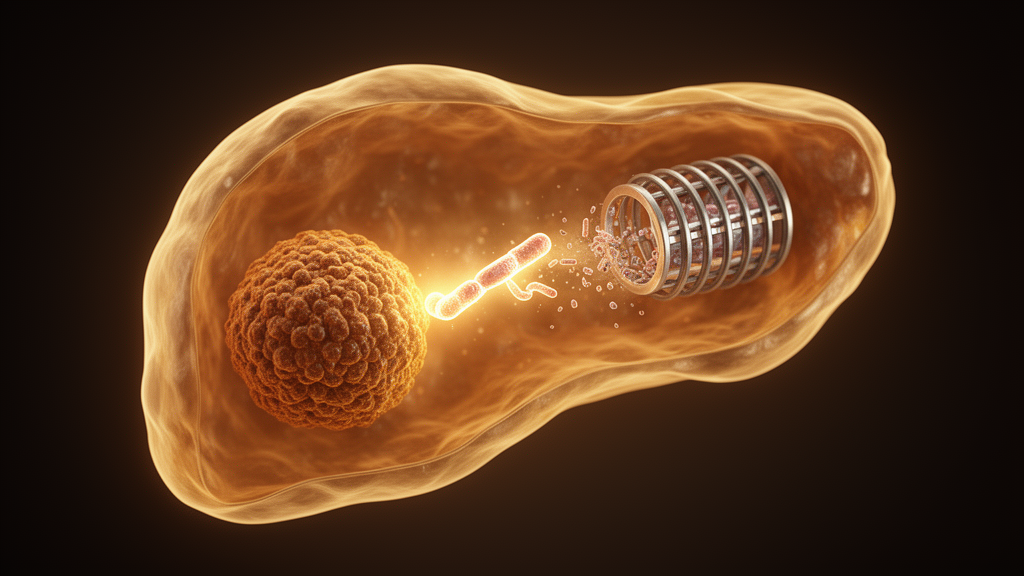
The study showed that TRIM29 directly interacts with DAPK3 and promotes its K48-linked ubiquitination, a specific molecular tag that directs proteins to the proteasome, the cell’s protein-degradation machinery, for destruction. The researchers identified lysine 261 on DAPK3 as the site through which this ubiquitination occurs, leading to proteasomal degradation of the kinase.
Crucially, the team demonstrated that the reduction in cell survival and the increase in apoptosis caused by TRIM29 depletion could be reversed by simultaneously downregulating DAPK3. This rescue experiment supports the conclusion that DAPK3 is a functional target of TRIM29 in the pathway driving tumour cell growth and survival.
The findings also have implications for hepatocellular carcinoma treatment. In cell line experiments, TRIM29 negatively regulated the apoptotic response induced by sorafenib, and its depletion promoted drug sensitization, suggesting that the protein contributes to treatment resistance through its suppression of apoptosis.
Overall, the authors conclude that TRIM29 promotes proliferation and inhibits apoptosis in hepatocellular carcinoma through ubiquitination-mediated degradation of DAPK3, positioning the protein both as a promising therapeutic target and as a candidate biomarker for prognosis. Because the work relies on human tissue comparisons, cell line experiments and mechanistic assays, further studies would be needed to establish clinical utility in patients.
Subject of Research: The role of the E3 ubiquitin ligase TRIM29 in promoting hepatocellular carcinoma progression through degradation of DAPK3.
Article Title: TRIM29 promotes hepatocellular carcinoma progression by inducing K48-linked ubiquitination and degradation of DAPK3
Article References: Guo, Y., Yuan, J., Hu, C., Xiao, B., Zhao, Q., Zhang, S., Wang, Z., Qiu, P., & Zuo, S. (2026). TRIM29 promotes hepatocellular carcinoma progression by inducing K48-linked ubiquitination and degradation of DAPK3. Cell Death Discovery. https://doi.org/10.1038/s41420-026-03346-x
Image Credits: AI Generated
DOI: 10.1038/s41420-026-03346-x
Keywords: TRIM29, DAPK3, hepatocellular carcinoma, ubiquitination, E3 ubiquitin ligase, proteasomal degradation, apoptosis, sorafenib, liver cancer, biomarker, cell proliferation, promotes
Cite Scienmag News
Nathaniel Bowman. (October 28, 2026). TRIM29 drives liver cancer growth by tagging DAPK3 for destruction. Scienmag. https://scienmag.com/trim29-drives-liver-cancer-growth-by-tagging-dapk3-for-destruction/
Nathaniel Bowman. "TRIM29 drives liver cancer growth by tagging DAPK3 for destruction." Scienmag, 28 October 2026, https://scienmag.com/trim29-drives-liver-cancer-growth-by-tagging-dapk3-for-destruction/. Accessed 28 October 2026.
Nathaniel Bowman. "TRIM29 drives liver cancer growth by tagging DAPK3 for destruction." Scienmag. October 28, 2026. https://scienmag.com/trim29-drives-liver-cancer-growth-by-tagging-dapk3-for-destruction/