Monday, October 26, 2026
Science
No Result
View All Result
  • Login
  • HOME
  • SCIENCE NEWS
  • CONTACT US
  • HOME
  • SCIENCE NEWS
  • CONTACT US
No Result
View All Result
Scienmag
No Result
View All Result
Home Science News Psychology & Psychiatry

Trial to Test Brief Family Therapy for Teens After Suicide Crisis

October 26, 2026
in Psychology & Psychiatry
Glenn Wilkins
By Glenn Wilkins Scienmag Editorial Profile - Clinical Psychology
Reading Time: 2 mins read
0
Trial to Test Brief Family Therapy for Teens After Suicide Crisis

Trial to Test Brief Family Therapy for Teens After Suicide Crisis

65
SHARES
587
VIEWS
Share on FacebookShare on Twitter
ADVERTISEMENT

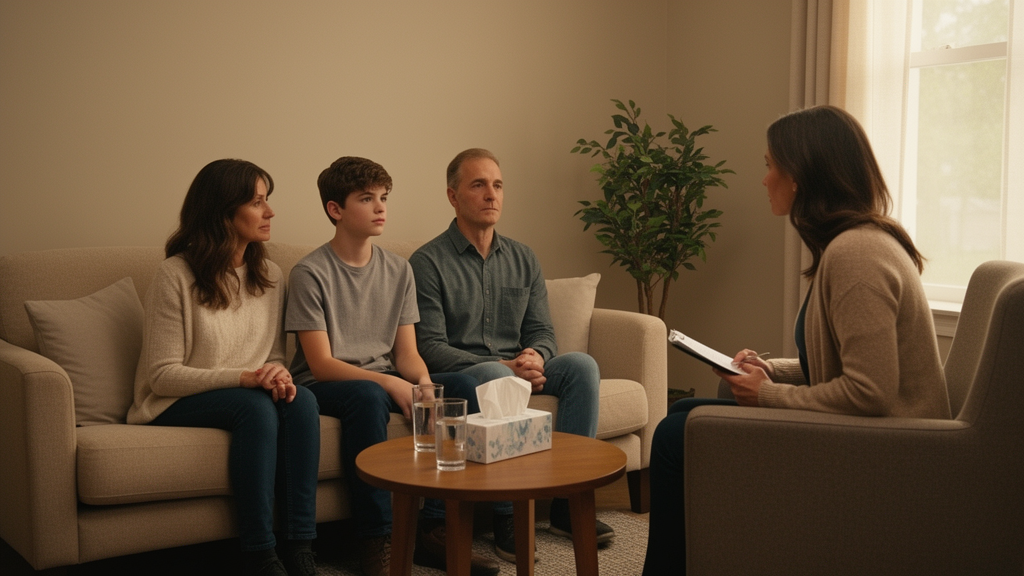
Researchers in China have designed a randomized controlled trial to test whether a brief, family-focused intervention can reduce the repetition of suicidal behavior among adolescents who present after a suicide crisis. The protocol, published in BMC Psychiatry as an open-access study protocol, describes a single-center, parallel-group trial that will enroll 824 adolescents together with their family caregivers. Participants will be randomly assigned in a 1:1 ratio to either a three-session family-based cognitive behavioral therapy program or an enhanced usual care control condition consisting of supportive contact and psychoeducation. The study was registered with the Chinese Clinical Trial Registry on February 24, 2025, under registration number ChiCTR2500097699.

The trial’s primary outcome is the time from randomization to a first repeated suicidal behavior within 90 days, assessed with the Columbia-Suicide Severity Rating Scale. Secondary outcomes include the occurrence of suicide attempts, the frequency of self-harm, participants’ self-efficacy in coping with self-harm, perceived family functioning, retention rate, and adherence to medical treatment. Follow-up assessments are scheduled at day 30, day 60, day 90, and again at six months, allowing the investigators to track outcomes over both the acute crisis period and the longer term. Data analysis will follow the intention-to-treat principle using Cox proportional hazards models.

The choice of a family-based format reflects the protocol’s framing of suicidal behavior in adolescents as a major global public health challenge for which evidence-based, scalable interventions remain limited, particularly in low- and middle-income countries. The intervention under study is deliberately brief, at three sessions, a feature the authors identify as relevant to scaling in resource-limited settings if the trial demonstrates effectiveness. The control condition is not a bare waitlist but enhanced usual care, combining supportive contact with psychoeducation, which gives the comparison a meaningful benchmark against routine clinical support.

As a protocol paper, the publication sets out planned methods rather than findings, and no outcome data are yet available from the trial. The registered design, with its 824-participant sample and predefined statistical models, will determine whether the brief family-based cognitive behavioral therapy service can reduce repetitions of suicidal behavior among adolescents in crisis. If the trial succeeds, the authors state that the intervention has the potential to be scaled in resource-limited settings, an aim tied directly to the service’s brevity and family-centered delivery. The protocol version listed is 1.0, dated December 27, 2024.

Subject of Research: Study protocol for a randomized controlled trial of a family-focused suicide risk management service for adolescents

Article Title: Family-focused suicide risk management service on reducing suicide behavior repetitions among adolescents: protocol for a randomized controlled trial

Article References: Yin, Y., Min, J., & Tong, Y. (2026). Family-focused suicide risk management service on reducing suicide behavior repetitions among adolescents: protocol for a randomized controlled trial. BMC Psychiatry. https://doi.org/10.1186/s12888-026-08791-7

Image Credits: AI Generated

DOI: 10.1186/s12888-026-08791-7

Keywords: suicide prevention, adolescent mental health, randomized controlled trial, family-based intervention, cognitive behavioral therapy, study protocol, self-harm, Columbia-Suicide Severity Rating Scale, low- and middle-income countries, BMC Psychiatry, Family-focused, suicide

Cite Scienmag News

Glenn Wilkins. (October 26, 2026). Trial to Test Brief Family Therapy for Teens After Suicide Crisis. Scienmag. https://scienmag.com/trial-to-test-brief-family-therapy-for-teens-after-suicide-crisis/

Glenn Wilkins. "Trial to Test Brief Family Therapy for Teens After Suicide Crisis." Scienmag, 26 October 2026, https://scienmag.com/trial-to-test-brief-family-therapy-for-teens-after-suicide-crisis/. Accessed 26 October 2026.

Glenn Wilkins. "Trial to Test Brief Family Therapy for Teens After Suicide Crisis." Scienmag. October 26, 2026. https://scienmag.com/trial-to-test-brief-family-therapy-for-teens-after-suicide-crisis/


Tags: Adolescent Mental Healthadolescent suicide preventionBMC Psychiatrybrief family intervention for self-harmChinese clinical trial on adolescent suicidecognitive behavioral therapyCognitive Behavioral Therapy for adolescentsColumbia Suicide Severity Rating Scalefamily caregiver support in mental healthfamily involvement in suicide preventionfamily-based interventionFamily-focusedfamily-focused therapy for teenslong-term outcomes of teen suicide interventionslow-and-middle-income countriespost-crisis mental health interventionRandomized Controlled Trialrandomized controlled trial on teen suicidereducing repeated suicidal behavior in teensself-harmstudy protocolsuicidesuicide attempt and self-harm prevention strategiesSuicide Prevention
Share26Tweet16
Previous Post

Pre-service teachers label student puzzle solutions with Toulmin terms unevenly

Next Post

Malawi’s nutrition security hangs on climate shocks and maize

Related Posts

ADHD and borderline personality symptoms linked in Malaysian adolescents
Psychology & Psychiatry

ADHD and borderline personality symptoms linked in Malaysian adolescents

October 26, 2026
Two-day group therapy showed short-term depression gains in small Romanian trial
Psychology & Psychiatry

Two-day group therapy showed short-term depression gains in small Romanian trial

October 26, 2026
Educators call for systemic responses to learner violence in South Africa
Psychology & Psychiatry

Educators call for systemic responses to learner violence in South Africa

October 26, 2026
Coworker Stress Bragging Can Both Undermine and Boost Helping at Work
Psychology & Psychiatry

Coworker Stress Bragging Can Both Undermine and Boost Helping at Work

October 26, 2026
AI edges closer to passing Turing-like tests for language and vision
Psychology & Psychiatry

AI edges closer to passing Turing-like tests for language and vision

October 26, 2026
Climate livelihood anxiety: how farming parents in Pakistan rethink children’s futures
Psychology & Psychiatry

Climate livelihood anxiety: how farming parents in Pakistan rethink children’s futures

October 26, 2026
Next Post
Malawi’s nutrition security hangs on climate shocks and maize

Malawi's nutrition security hangs on climate shocks and maize

  • Mothers who receive childcare support from maternal grandparents show more optimized

    Mothers who receive childcare support from maternal grandparents show more parental warmth, finds NTU Singapore study

    27656 shares
    Share 11059 Tweet 6912
  • University of Seville Breaks 120-Year-Old Mystery, Revises a Key Einstein Concept

    1061 shares
    Share 424 Tweet 265
  • Bee body mass, pathogens and local climate influence heat tolerance

    682 shares
    Share 273 Tweet 171
  • Researchers record first-ever images and data of a shark experiencing a boat strike

    546 shares
    Share 218 Tweet 137
  • Groundbreaking Clinical Trial Reveals Lubiprostone Enhances Kidney Function

    531 shares
    Share 212 Tweet 133
Science

Embark on a thrilling journey of discovery with Scienmag.com—your ultimate source for cutting-edge breakthroughs. Immerse yourself in a world where curiosity knows no limits and tomorrow’s possibilities become today’s reality!

RECENT NEWS

  • Attention-enhanced YOLOv8s advances photovoltaic defect detection
  • Thicker walls and more openings raise bending loads in PLA specimens
  • Semantic Labels Guide Terrain-Specific Humanoid Behavior in Simulation
  • Finite-element study maps stresses around 4-mm ultra-short dental implants

Categories

  • Agriculture
  • Anthropology
  • Archaeology
  • Athmospheric
  • Biology
  • Biotechnology
  • Blog
  • Bussines
  • Cancer
  • Chemistry
  • Climate
  • Earth Science
  • Editorial Policy
  • Marine
  • Mathematics
  • Medicine
  • Pediatry
  • Policy
  • Psychology & Psychiatry
  • Science Education
  • Science News
  • Social Science
  • Space
  • Technology and Engineering

Subscribe to Blog via Email

Enter your email address to subscribe to this blog and receive notifications of new posts by email.

Join 5,151 other subscribers

© 2025 Scienmag - Science Magazine

Welcome Back!

Login to your account below

Forgotten Password?

Retrieve your password

Please enter your username or email address to reset your password.

Log In
No Result
View All Result
  • HOME
  • SCIENCE NEWS
  • CONTACT US

© 2025 Scienmag - Science Magazine

Discover more from Science

Subscribe now to keep reading and get access to the full archive.

Continue reading