


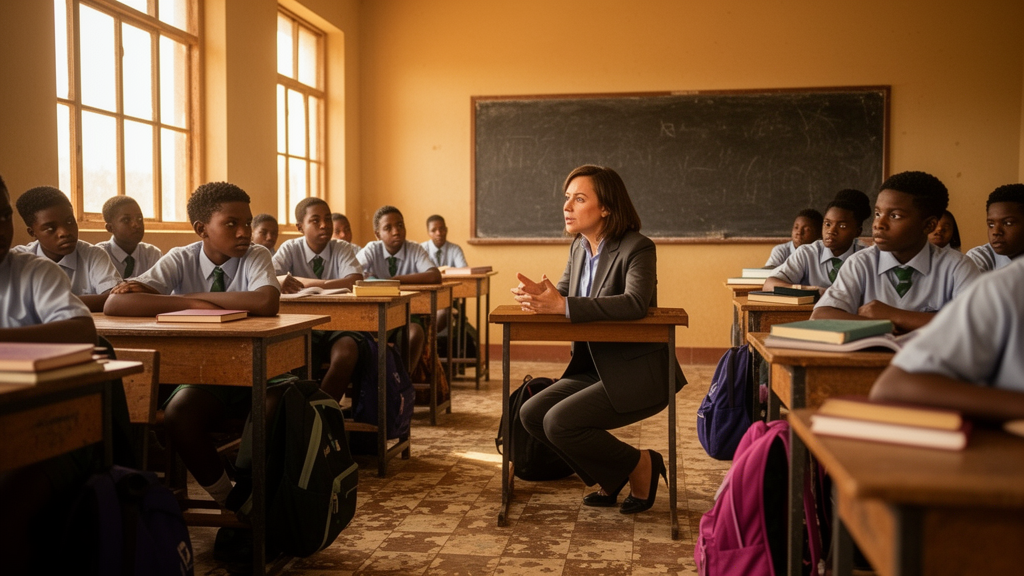
Learner violence against educators in South Africa’s Mopani District, in Limpopo Province, is shaped by interactions across multiple ecological systems and intensified by high job demands and limited institutional support, according to an exploratory qualitative study published in Discover Psychology. The study, led by Thobile Pertunia Badimo and Johannes Nkosinathi Zongozzi, explored interventions aimed at mitigating the effects of such violence on educators in the district.
The researchers conducted eleven semi-structured interviews with purposively selected educators in the Mopani District and analysed the interview transcripts thematically. The analysis was guided by two theoretical frameworks named in the study: Bronfenbrenner’s Ecological Systems Theory and the Job Demands–Resources Model.
According to the findings, learner violence in the district is shaped by interactions across multiple ecological systems. The analysis also indicated that the effects of this violence on educators are intensified by high job demands combined with limited institutional support, a pattern the authors link to the Job Demands–Resources framework used in the study.
The participating educators, who formed the studied population, highlighted several needs in response to the problem. These included stronger policy and law enforcement, improved school security, mental health support, and enhanced collaboration among educators, parents, and community structures. The authors emphasise that such measures should form part of systemic, trauma-informed, and resource-based approaches intended to strengthen educator resilience and well-being.
The study’s scope is deliberately local and exploratory. It draws on the perspectives of eleven educators in one South African district rather than on a representative sample, so its findings describe the experiences and views of the studied participants rather than measuring the prevalence of violence or testing the effectiveness of specific interventions. The authors position the results as guidance for policymakers and education leaders seeking to create safer and more supportive teaching environments in the Mopani District. The article was published open access on 26 October 2026 as an accepted manuscript carrying a permanent DOI, a version the journal notes is subject to further edits before the final Version of Record replaces it.
Subject of Research: Rethinking school safety interventions for learner violence against educators in Mopani District, South Africa: an exploratory qualitative study
Article Title: Rethinking school safety interventions for learner violence against educators in Mopani District, South Africa: an exploratory qualitative study
Article References: Badimo, T. P., & Zongozzi, J. N. (2026). Rethinking school safety interventions for learner violence against educators in Mopani District, South Africa: an exploratory qualitative study. Discover Psychology. https://doi.org/10.1007/s44202-026-00952-9
Image Credits: AI Generated
DOI: 10.1007/s44202-026-00952-9
Keywords: Rethinking, school, safety, interventions, learner, violence, against, educators, Mopani, District, South, Africa
Cite Scienmag News
Glenn Wilkins. (October 26, 2026). Educators call for systemic responses to learner violence in South Africa. Scienmag. https://scienmag.com/educators-call-for-systemic-responses-to-learner-violence-in-south-africa/
Glenn Wilkins. "Educators call for systemic responses to learner violence in South Africa." Scienmag, 26 October 2026, https://scienmag.com/educators-call-for-systemic-responses-to-learner-violence-in-south-africa/. Accessed 26 October 2026.
Glenn Wilkins. "Educators call for systemic responses to learner violence in South Africa." Scienmag. October 26, 2026. https://scienmag.com/educators-call-for-systemic-responses-to-learner-violence-in-south-africa/


