


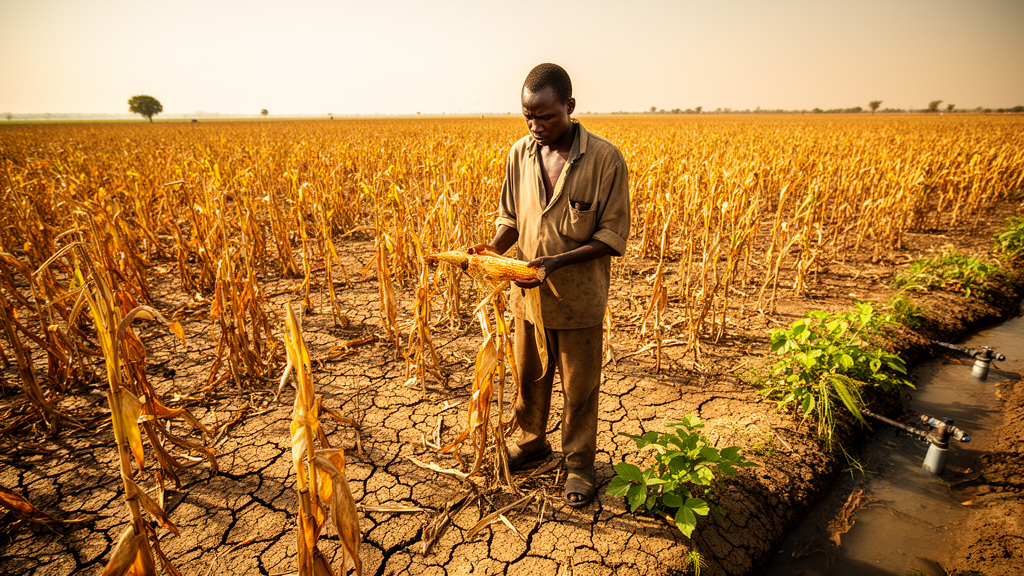
Malawi entered 2025 with a nutrition security crisis that a newly published narrative review describes as the product of converging pressures: recurrent climate shocks, an economy anchored to rain-fed smallholder maize farming, deep poverty, gender inequities, weak infrastructure, and fragmented governance. The review, published in Frontiers in Nutrition, synthesizes peer-reviewed literature and institutional reports to map how climate disruptions translate into food insecurity and malnutrition, and it arrives at stark numbers. Approximately 37 percent of Malawian children under five years of age experience stunting, and around 10 percent experience wasting. Projections for the 2025/2026 lean season suggest that up to 4 million people may face acute food insecurity, a figure that has escalated from roughly 3 million in earlier assessments, driven by El Niño impacts and high food prices.
The review’s methodology matters for interpreting its conclusions. Rather than a systematic review with meta-analysis, the authors conducted a purposive narrative synthesis, searching PubMed/MEDLINE, Scopus, Web of Science, Google Scholar, and grey literature sources including World Food Programme reports, Malawi Demographic and Health Surveys, and Food and Agriculture Organization archives. Literature published from 2000 onwards was considered, with particular attention to evidence from January 2023 to November 2025, capturing post-Cyclone Freddy impacts and El Niño-related drought conditions. From approximately 1,200 initial records, 58 sources were included after screening, with a second reviewer independently assessing a randomly selected 10 percent sample as a quality assurance procedure. The synthesis relied on thematic coding and narrative synthesis rather than quantitative pooling, which means the findings represent an interpretive overview of the evidence base rather than pooled effect estimates.
The technical core of the review concerns how climate shocks propagate through Malawi’s food system. Agriculture accounts for roughly 30 percent of the country’s gross domestic product and employs much of the rural workforce, with over 70 percent of agricultural production carried out by smallholder farmers who frequently lack access to modern technologies, quality inputs, and market links. Maize dominates the staple crop landscape, and it is highly sensitive to water stress. The review reports that climate shocks were associated with approximately 20 percent maize production losses, alongside increased food prices and reduced dietary diversity. Droughts cause acute water shortages that reduce yields substantially, while erratic rainfall interferes with planting calendars and erodes the predictability that smallholder agriculture depends upon. Floods, particularly in central and southern regions, saturate farmland, destroy roads and storage facilities, and displace rural communities.
Recent events illustrate these mechanisms concretely. Cyclone Freddy in 2023 triggered additional crop losses and increased food insecurity by exacerbating flooding and interrupting local markets. Reports assessing the 2024 El Niño-related drought period estimated that national maize production declined to approximately 2.9 million metric tons, although the review notes that the magnitude of production losses varies according to assessment methods, reference periods, and data sources. Beyond acute events, chronic environmental degradation compounds vulnerability: continual over-cultivation, deforestation, and improper soil management diminish the land’s capacity to support agricultural returns, while loss of biodiversity and ecosystem services undermines long-term agricultural viability. Projections cited in the review suggest that increased temperatures and greater climate variability will amplify droughts and extreme precipitation events, further stressing food systems already fragile from rain-fed dependence.
Food insecurity in Malawi is multifaceted, extending beyond availability to access and market dynamics. The review describes how climate-induced disruptions to maize and other critical harvests are most severe during the lean pre-harvest months, when production declines and shortages force reliance on government and humanitarian food aid imports. Access is inherently uneven between urban and rural spaces: rural households engaged in subsistence farming with lower incomes are disadvantaged by poor road networks and few market facilities, which raises the cost and degrades the predictability of food distribution, especially when local supplies run low. Price dynamics add another layer. Drought-induced crop failure shrinks supply and drives price increases, compounded by high transport costs and market uncertainty. Poor households, which devote a notably large share of income to food, lose purchasing power precisely when diversified and nutritious food baskets become least affordable in the absence of strong subsidies or price stabilization mechanisms.
The nutritional consequences are documented in detail. Recent estimates indicate that approximately 37 percent of children under five are stunted and about 10 percent are wasted, with widespread micronutrient deficiencies cited at roughly 50 percent for iron and 70 percent for vitamin A. Rural household diets rely heavily on maize, so climate-stress-induced inability to access other food sources increases risks of micronutrient deficiencies and poor growth outcomes. Maternal malnutrition plays an indirect but significant role, contributing to adverse birth outcomes such as low birth weight and perpetuating an intergenerational cycle of malnutrition and economic vulnerability. Seasonality intensifies the burden, with the lean period coinciding with decreased household food availability in many rural areas, producing acute malnutrition in the form of wasting and underweight. Early childhood nutritional deficits are associated with poor cognitive and physical development, lower educational achievement, and reduced adult productivity, which the review links to sustained human capital losses and increased health-care expenditures.
Projections presented in the review should be read as scenario-based estimates rather than observed values. Under adverse climatic and socioeconomic scenarios, stunting and wasting could increase to approximately 38 to 40 percent and 12 percent, respectively, by 2027, particularly among vulnerable groups. The review explicitly instructs that observed values describe reported population-level estimates, whereas projected values represent scenario-based estimates influenced by assumptions regarding climate conditions, economic trends, and policy responses. The food-insecure population projection of 4 million people for October 2025 to March 2026 reflects IPC Phase 3 Crisis-level acute food insecurity, attributed to high food prices and persistent El Niño impacts. A February 2025 food inflation spike of 38.5 percent is cited among the market pressures underlying these scenarios.
Intersecting vulnerabilities concentrate risk in specific populations. Children under five face lasting effects on growth, cognitive development, and future economic productivity. Pregnant and lactating women face elevated risks of low birth weight, preterm delivery, and maternal anemia, with additional micronutrient demands for iron and folic acid often unfulfilled in food-insecure conditions. Older people face chronic food insecurity due to limited mobility, declining income, and aging-related physical struggles, often falling outside focused social safety nets. People living with HIV/AIDS experience compounded impacts, as dietary deficiency relates to antiretroviral therapy effectiveness through drug-food interactions and treatment compliance issues, and immunosuppression coupled with poor nutrition creates a vicious cycle of health deterioration. Smallholder farmers, the backbone of the agrarian economy, face harvest losses that reduce household food stocks and incomes, compounded by lack of access to farm inputs, modern irrigation technologies, and effective marketplaces, which limits their capacity to invest in adaptation practices.
Interventions show potential but remain constrained. Climate-smart agriculture, including drought-resistant crop varieties, improved irrigation, and better agronomic practices, has been promoted to reduce vulnerability to erratic rainfall. Biofortification programs targeting vitamin A-enriched maize and iron-rich beans address prevalent micronutrient deficiencies directly. Early warning systems, climate information services, and weather-indexed insurance products have been developed to support farmers in preparing for and responding to climate shocks. Nutrition-sensitive agriculture aims to mainstream nutrition priorities into agricultural policies to promote micronutrient-rich crops and dietary diversity. Social protection measures, including the Malawi Social Cash Transfer Program designed to reach households with pregnant women, children, and older people, have been found to have beneficial effects on household food security and nutritional status. Health system responses, including child and maternal supplementation, therapeutic feeding programs, and community-based nutrition services, have enhanced the ability of health workers to detect, treat, and prevent malnutrition.
Yet the review is candid about implementation gaps. Limited funding, sectoral dispersion, and coordination problems have prevented many interventions from reaching scale, and pilot projects showing positive results require sustained policy investment to become embedded in long-term funding cycles. The recently launched National Multisector Nutrition Policy and Strategic Plan (2025 to 2030) represents a recommitment to reversing malnutrition trends, but it depends on addressing a K148 billion funding shortfall for the 2025/26 Lean Season Food Insecurity Response Programme. The review’s recommendations include establishing a National Nutrition Security Coordination Platform bringing together ministries of agriculture, health, finance, and environment with international partners, progressively increasing investment toward approximately 10 percent of national budgets for nutrition-sensitive agriculture and climate adaptation by 2027, distributing subsidized drought-resistant and biofortified varieties to 80 percent of smallholders by 2028, and launching a digital early warning system and weather-indexed insurance at national scale. The authors conclude that strengthening nutrition security in Malawi requires integrated approaches linking climate adaptation, resilient food systems, nutrition interventions, and multisectoral coordination, with long-term progress depending on sustained investment, improved implementation capacity, and policies that address the structural drivers of vulnerability.
Subject of Research: Nutrition security in Malawi under climate shocks
Article Title: Nutrition security in Malawi: navigating climate shocks, food insecurity, and malnutrition in the 2025 landscape—narrative review
Article References: Niyibizi, J., Samu, G. C., Sam, A., Ng’ambi, N. C., Nizeyimana, E., Ximenes, M. Y. D. S., & Mugisha, J. (2026). Nutrition security in Malawi: navigating climate shocks, food insecurity, and malnutrition in the 2025 landscape—narrative review. Frontiers in Nutrition, 13, Article 2004735. https://doi.org/10.3389/fnut.2026.2004735
Image Credits: AI Generated
DOI: 10.3389/fnut.2026.2004735
Keywords: Malawi, nutrition security, climate shocks, food insecurity, stunting, wasting, maize, climate-smart agriculture, biofortification, cash transfers, narrative review, Nutrition
Cite Scienmag News
Alan Morgan. (October 26, 2026). Malawi’s nutrition security hangs on climate shocks and maize. Scienmag. https://scienmag.com/malawis-nutrition-security-hangs-on-climate-shocks-and-maize/
Alan Morgan. "Malawi’s nutrition security hangs on climate shocks and maize." Scienmag, 26 October 2026, https://scienmag.com/malawis-nutrition-security-hangs-on-climate-shocks-and-maize/. Accessed 26 October 2026.
Alan Morgan. "Malawi’s nutrition security hangs on climate shocks and maize." Scienmag. October 26, 2026. https://scienmag.com/malawis-nutrition-security-hangs-on-climate-shocks-and-maize/


