


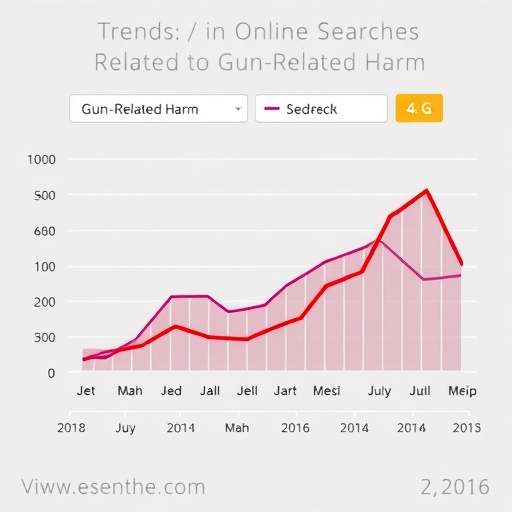
In a groundbreaking cross-sectional analysis involving participants across the United States, researchers have unveiled concerning insights into the digital search behaviors of youth and young adults regarding gun-related harm content. The study identifies that a significant subset of this population intentionally seeks out information or material linked to firearm violence and injury. This phenomenon is particularly pronounced among individuals grappling with structural disadvantages and various forms of mental health distress, painting a complex picture of how vulnerable groups interact with potentially harmful digital content.
Gun violence remains an urgent public health crisis in the United States. Despite numerous legislative and community interventions, the prevalence of gun-related injury and death continues to impact millions, with young people often disproportionately affected. This study leverages sophisticated data collection methods to explore the intersection between digital behavior and risk factors that may predispose certain individuals to gun violence, providing a novel lens through which prevention efforts might be reframed.
Central to the research’s findings is the recognition that intentional online searches for gun-related harm are not uniformly distributed across the youth and young adult population. Those facing structural disadvantages—such as economic hardship, limited access to education, and systemic marginalization—show higher engagement with such content. The researchers suggest that these search behaviors may be reflective of underlying psychosocial stressors, coping mechanisms, or even a manifestation of exposure to violence in their environments.
Mental health emerges as a critical determinant in this digital behavior landscape. Individuals experiencing psychological distress, including anxiety, depression, and trauma-related symptoms, appear more likely to seek out gun-related harm content online. This correlation raises compelling questions about the causal pathways between mental health challenges and curiosity or preoccupation with firearm violence, indicating potential windows for digital and clinical intervention.
The study utilized advanced analytical frameworks to assess data derived from self-reports and internet behavior metrics, applying rigorous statistical controls to isolate key demographic and psychological variables. This methodological rigor ensures that the associations observed are not spurious but indicative of deeper structural and behavioral patterns worthy of attention from researchers, clinicians, and policymakers alike.
One of the most promising aspects of the study is its implication for public health strategy. The findings advocate for multifaceted interventions that integrate digital platforms with structural reform policies. Digital interventions might include targeted online content moderation, algorithmic adjustments to reduce exposure to harmful material, and the deployment of supportive resources accessible through the same search channels youth are using. Meanwhile, structural reforms could address broader socioeconomic inequities that underpin risk factors for gun violence.
The research also urges a paradigm shift in how the scientific community and public health officials approach gun violence prevention. Traditional models focusing exclusively on physical environments and policy restrictions may overlook the virtual spaces where youth spend considerable time and where violent content can proliferate silently yet impactfully. A comprehensive strategy must consider these digital ecosystems as both risk landscapes and intervention venues.
Importantly, the study contributes to a nuanced understanding of the intersectionality of risk factors. The interplay of structural disadvantage, mental health, age, and digital behavior underscores the necessity for tailored, population-specific approaches rather than generalized policies. This precision in intervention design enhances the likelihood of meaningful impact and sustainable reduction in firearm-related harm among at-risk youth.
Further research is needed to elucidate the mechanisms by which digital consumption of gun-related content influences behavior—whether it serves as a risk amplifier or a manifestation of preexisting risk. Longitudinal studies and ethnographic methodologies may provide deeper insight into causality and contextual factors, enabling the development of predictive models and real-time intervention tools.
The researchers also highlight ethical considerations inherent in monitoring and intervening within digital spaces. Balancing privacy rights with preventive imperatives requires transparent policy frameworks and technological safeguards. Ensuring that interventions do not inadvertently marginalize or stigmatize vulnerable groups is paramount.
In conclusion, this seminal study marks a significant advancement in integrating digital behavioral research with public health imperatives to confront gun violence. By illuminating the digital search behaviors linked to structural and psychological vulnerabilities, it opens new avenues for intervention that are timely, scalable, and technologically sophisticated. The integration of digital and structural strategies represents an essential evolution in addressing one of the most pressing health crises of our time.
Contact for further inquiries and collaboration on this research initiative can be made with lead author Kimberly J. Mitchell, PhD, at kimberly.mitchell@unh.edu. The full study will be accessible via the JAMA Network Open platform upon embargo lift, offering comprehensive insights and data for stakeholders engaged in the multifaceted effort to curtail gun violence.
News Publication Date: [Not provided in the source content]
Web References: [Not provided in the source content]
References: (doi:10.1001/jamanetworkopen.2026.7715)
Cite Scienmag News
Ophelia Keating. (April 15, 2026). Trends in Online Searches Related to Gun-Related Harm. Scienmag. https://scienmag.com/trends-in-online-searches-related-to-gun-related-harm/
Ophelia Keating. "Trends in Online Searches Related to Gun-Related Harm." Scienmag, 15 April 2026, https://scienmag.com/trends-in-online-searches-related-to-gun-related-harm/. Accessed 4 September 2026.
Ophelia Keating. "Trends in Online Searches Related to Gun-Related Harm." Scienmag. April 15, 2026. https://scienmag.com/trends-in-online-searches-related-to-gun-related-harm/


