


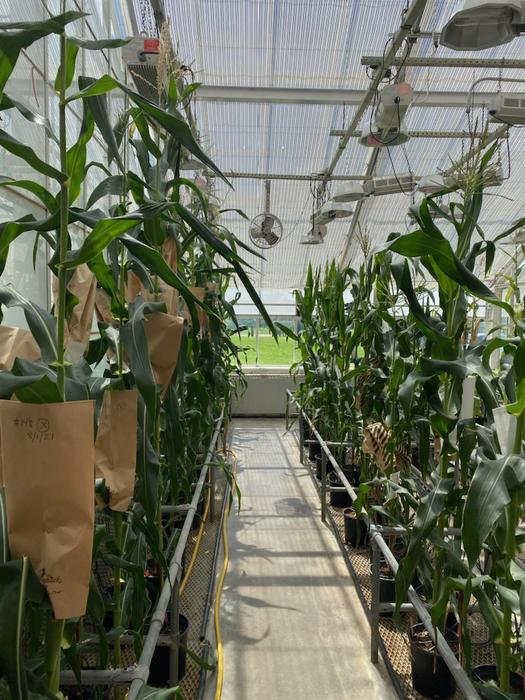
Maize is one of the world’s most widely grown crops and is essential to global food security. But like other plants, its growth and productivity can be limited by the slow activity of Rubisco, the enzyme responsible for carbon assimilation during photosynthesis. In a recent study published in the Journal of Experimental Botany, scientists from the Boyce Thompson Institute (BTI) demonstrated a promising approach to enhancing Rubisco production, thus improving photosynthesis and overall plant growth.

Credit: Boyce Thompson Institute
Maize is one of the world’s most widely grown crops and is essential to global food security. But like other plants, its growth and productivity can be limited by the slow activity of Rubisco, the enzyme responsible for carbon assimilation during photosynthesis. In a recent study published in the Journal of Experimental Botany, scientists from the Boyce Thompson Institute (BTI) demonstrated a promising approach to enhancing Rubisco production, thus improving photosynthesis and overall plant growth.
The study involved the transgenic expression of three key proteins, Rubisco Accumulation Factor 2 (Raf2) and the large and small Rubisco subunits. By overexpressing these proteins, the researchers increased Rubisco content, accelerated carbon assimilation, and boosted plant height in maize.
“Our findings demonstrate the potential of modifying Rubisco assembly to improve crop productivity,” said Kathryn Eshenour, a BTI researcher and first author of the study. “By altering the expression of these proteins, we can unlock maize’s capacity to photosynthesize more efficiently and grow more robustly, even under challenging environmental conditions.”
The research team found that Raf1 and Raf2, although acting at different steps of Rubisco assembly, could independently enhance Rubisco abundance and plant performance. This opens possibilities for further improvements by stacking the traits together, potentially leading to even greater photosynthetic capacity.
Interestingly, the transgenic plants also showed improved resilience to chilling stress, a common environmental challenge that can severely impact crop yields. The researchers observed that these plants maintained higher photosynthetic rates during cold exposure and recovered more rapidly after the stress subsided.
The team’s innovative approach holds exciting possibilities for other crops. Many staple foods with similar photosynthetic pathways to maize, such as sorghum, millet, and sugar cane, could potentially benefit from the approach used in this study, leading to improvements in photosynthetic efficiency and yield.
“This promising technology is one of several being used to enhance photosynthesis in crop plants,” said David Stern, a professor at BTI and lead author of the study. “By continuing to explore the intricacies of Rubisco assembly and its regulation, we can improve this part of a much-needed toolkit for enhancing photosynthesis across a wide range of crops.”
As food security continues to remain a pressing issue and the impacts of climate change intensify, the need for more productive and adaptable crops has never been greater. This research highlights the transformative potential of plant science-based solutions in addressing global challenges, exemplifying BTI’s commitment to shaping a future where agriculture thrives, biodiversity is preserved, and humanity benefits from a healthier, more sustainable world.
This work was supported by the intramural research program of the U.S. Department of Agriculture, National Institute of Food and Agriculture, Physiology of Agricultural Plants, Accession No. 1022304.
About the Boyce Thompson Institute (BTI)
Founded in 1924 and located in Ithaca, New York, BTI is at the forefront of plant science research. Our mission is to advance, communicate, and leverage pioneering discoveries in plant sciences to develop sustainable and resilient agriculture, improve food security, protect the environment, and enhance human health. As an independent nonprofit research institute affiliated with Cornell University, we are committed to inspiring and training the next generation of scientific leaders. Learn more at BTIscience.org.
Journal
Journal of Experimental Botany
Method of Research
Experimental study
Subject of Research
Cells
Article Title
Transgenic Expression of Rubisco Accumulation Factor2 and Rubisco Subunits Increases Photosynthesis and Growth in Maize
Article Publication Date
2-May-2024
COI Statement
No conflict of interest declared.
Cite Scienmag News
Alan Morgan. (May 28, 2024). Transgenic expression of rubisco factors increases photosynthesis and chilling tolerance in maize. Scienmag. https://scienmag.com/transgenic-expression-of-rubisco-factors-increases-photosynthesis-and-chilling-tolerance-in-maize/
Alan Morgan. "Transgenic expression of rubisco factors increases photosynthesis and chilling tolerance in maize." Scienmag, 28 May 2024, https://scienmag.com/transgenic-expression-of-rubisco-factors-increases-photosynthesis-and-chilling-tolerance-in-maize/. Accessed 5 September 2026.
Alan Morgan. "Transgenic expression of rubisco factors increases photosynthesis and chilling tolerance in maize." Scienmag. May 28, 2024. https://scienmag.com/transgenic-expression-of-rubisco-factors-increases-photosynthesis-and-chilling-tolerance-in-maize/

