


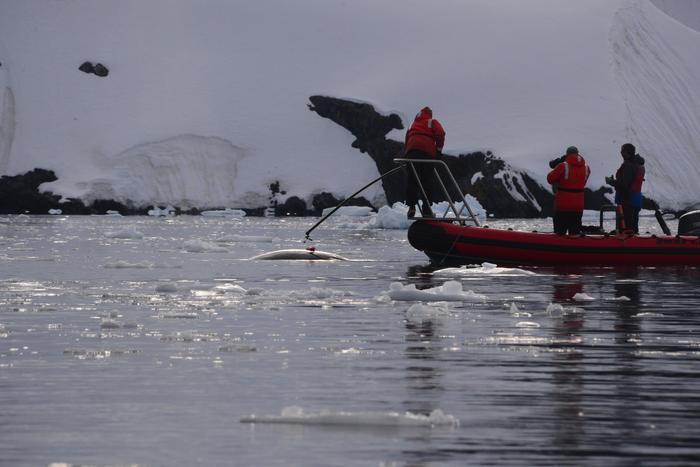
Researchers have conducted one of the first quantitative studies of social structure and social foraging in Antarctic minke whales (AMWs), using pioneering animal-borne camera tags.

Credit: Dave Cade
Researchers have conducted one of the first quantitative studies of social structure and social foraging in Antarctic minke whales (AMWs), using pioneering animal-borne camera tags.
This study sheds light on the complex social and foraging behaviours of these elusive krill specialists within the fragile Antarctic sea-ice ecosystem.
The study was led by Dr Jenny Allen as a Griffith University Research Associate in collaboration with the University of California Santa Cruz (UCSC). Data were collected in 2018 and 2019 around the Western Antarctic Peninsula as part of a research grant from the National Science Foundation’s Office of Polar Programs to Dr Ari Friedlaender, a Professor in UCSC’s Ocean Sciences Department.
The study is unique in its use of motion-sensing, video- and audio-recording tags deployed on Antarctic minke whales for the first time to study their ecological role through analysis of their diving, foraging, and social behaviours.
Data analyses focused on the whales’ diving, foraging, and social behaviours, providing fresh insights into their ecological roles.
Findings from the study indicated that Antarctic minke whales exhibit a “fission-fusion” social structure, frequently switching companions.
This social flexibility is similar to what is seen in several other baleen whale species. In 60.6% of cases, whales were observed forming short-term associations, engaging in both foraging and non-foraging activities.
Larger individuals were more likely to socialise, and this social interaction correlated with a noticeable reduction in their feeding efforts, regardless of dive depth.
Furthermore, the study documented 12 instances where tagged whales associated with each other in pairs or trios.
These groups demonstrated synchronised spatial movement and diving behaviours, suggesting that Antarctic minke whales employed group foraging strategies.
Specifically, 67.5% of associated dives and 64% of associated feeding lunges were synchronised.
“These findings provide essential baseline information on the sociality and group foraging behaviours of Antarctic minke whales,” Dr Allen said.
“Understanding these patterns is crucial, especially as climate change continues to impact the Antarctic ecosystem.”
The study underscored the importance of Antarctic minke whales as top krill predators, highlighting their role within the ecosystem.
The synchronised foraging behaviour observed suggested these whales might optimise their feeding efficiency through cooperation, a behaviour previously underappreciated in this species.
“This study is fascinating because it provides new information on complex and dynamic social and behavioural patterns by an animal that until now we had very little information about”, says Dr. Friedlaender the senior investigator on the project.
This research not only enhanced our understanding of AMW social and foraging ecology but also encouraged the need for future studies aimed at more targeted investigations.
Dr Allen is currently a National Science Foundation Postdoctoral Fellow at UCSC within the Behavioural Ecology and Bio-Telemetry Laboratory and an Adjunct Researcher with Griffith University’s Southern Ocean Persistent Organic Pollutants Program.
The study ‘Evidence of sociality and group foraging in Antarctic minke whales (Balaenoptera bonaerensis)’ has been published in Behavioral Ecology and Sociobiology, and was supported by the National Science Foundation’s Office of Polar Programs via grant nos. 1643877 and 1644209, and by World Wildlife Fund grants. P0710 and 0711-02.
Journal
Behavioral Ecology and Sociobiology
Article Title
Evidence of sociality and group foraging in Antarctic minke whales (Balaenoptera bonaerensis)
Cite Scienmag News
Violet Maxwell. (May 28, 2024). Camera tags capture social flexibility of Antarctic minke whales. Scienmag. https://scienmag.com/camera-tags-capture-social-flexibility-of-antarctic-minke-whales/
Violet Maxwell. "Camera tags capture social flexibility of Antarctic minke whales." Scienmag, 28 May 2024, https://scienmag.com/camera-tags-capture-social-flexibility-of-antarctic-minke-whales/. Accessed 4 September 2026.
Violet Maxwell. "Camera tags capture social flexibility of Antarctic minke whales." Scienmag. May 28, 2024. https://scienmag.com/camera-tags-capture-social-flexibility-of-antarctic-minke-whales/

