


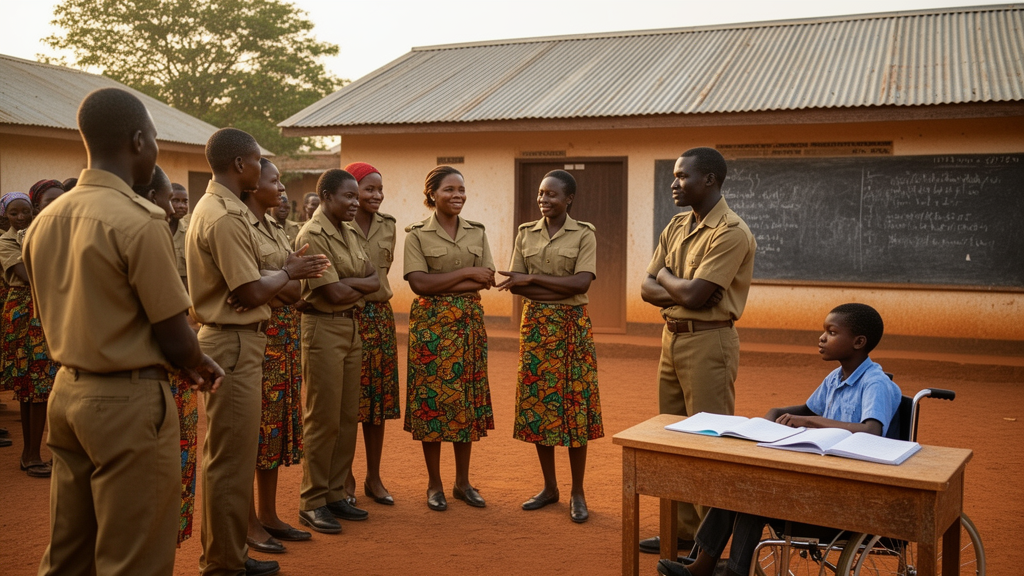
Only around 0.2 percent of boys and 0.4 percent of girls with disabilities are enrolled in Tanzanian secondary schools, even though an estimated 7.8 percent of the country’s population lives with some form of disability. A new qualitative study published in Discover Education by Emanuel Ismael Maphie of the University of Dar es Salaam offers a rare, ground-level explanation for that gap, drawing on in-depth interviews and focus group discussions with 24 teachers, school heads, and District Education Officers in inclusive secondary schools. The findings reveal a stark divide between educators trained in special needs education and those without such preparation, and they locate the roots of exclusion not in the students themselves but in environments, attitudes, and institutions that were never designed to accommodate them.
The study is anchored in the Social Model of Disability, a framework that shifts the analytical question away from what is wrong with an individual learner and toward the social, environmental, and organisational conditions that restrict participation. Where the older medical model locates disability within the body, the social model treats exclusion as a product of inaccessible classrooms, inadequate communication systems, negative expectations, and under-resourced institutions. Applied to education, this means that a student who cannot follow a lesson is not necessarily failing; the school may simply lack the assistive devices, trained staff, or consistent sign-language systems that would make participation possible. Maphie used the framework as an interpretive lens rather than a rigid coding scheme, allowing barriers to emerge inductively from participants’ accounts before mapping them onto environmental, attitudinal, and organisational dimensions.
The methodological design was a qualitative phenomenological one, conducted across three inclusive secondary schools in the Dar es Salaam and Kilimanjaro regions between July and October 2023. Purposive sampling selected 21 teachers and 3 District Education Officers, 11 of them male and 13 female, all with direct involvement in implementing or supervising inclusive education. Data collection was carried out in Kiswahili to allow participants to express themselves comfortably, with semi-structured interviews used for school heads and officers and focus group discussions for teachers. All sessions were audio-recorded with consent, transcribed verbatim, and analysed through iterative thematic analysis. Data saturation was reached after ten sessions, when successive interviews no longer produced new codes or themes. Credibility was reinforced through triangulation across participant groups, member checking, peer debriefing, and a reflective journal kept throughout the process, and ethical approval came from the University of Dar es Salaam’s Research Ethics Committee.
The most striking pattern in the findings is the near-total bifurcation of teacher experience along the line of training. Teachers with special needs education training described inclusive education in confident, expansive terms: as a bridge between students with and without disabilities, a space where every learner can develop talents, and a practice that reduces discrimination and builds mutual respect. One such teacher explained that teaching in inclusive classrooms is a rewarding process in which professional techniques, including slowing the pace of lessons, allow each student to be supported according to individual need. These teachers reported willingness to adapt arrangements, with some even proposing that secondary education be extended for students with disabilities who need additional time to adjust to school environments and assistive devices.
Teachers without that specialised training told a very different story. Several described inclusive education as something imposed on them by the education system without adequate preparation. One participant, speaking candidly, said it was his first time seeing students with disabilities in the same class as others, called the experience frustrating, and claimed that no one was benefiting, neither students with disabilities nor their peers. Another declared that having students with disabilities in class was a burden and a disturbance, while a third said that since inclusive education began, teaching was no longer enjoyable. Rather than adapting their own practice, some of these teachers reported referring students with disabilities to specially trained colleagues. From the Social Model’s perspective, these attitudes are not simply individual failings; they reflect a professional preparation deficit that leaves teachers facing complex, diverse learning needs with neither the skills nor the institutional backing to succeed.
Communication emerged as a particularly concrete environmental barrier. Teachers reported that students with hearing impairments arrive at secondary school having learned one sign-language system in primary school, while teachers themselves use yet another depending on where they were trained. The result is a classroom in which meaningful interaction can break down entirely, despite both parties being physically present and formally included. Participants called for harmonisation of sign language across all educational levels so that a common system can be used consistently. This illustrates the study’s central technical argument: the difficulty experienced by students with hearing impairments stems not from the impairment itself but from an educational environment that has failed to establish accessible and consistent means of communication.
At the school-management level, the picture was one of chronic under-resourcing. School heads reported that responsibility for inclusive education fell largely on schools themselves while external support from government, parents, and communities remained thin. One headmaster described running an inclusive school with minimal funds on an insufficient government budget that was also frequently delayed. Financial constraints directly limited the procurement of learning materials and assistive devices. Heads also expressed frustration with parents, noting that many families disengage from financially supporting their children with disabilities after enrolment on the assumption that education is solely the government’s responsibility. Weak parental and community participation was repeatedly identified as a constraint that compounded the funding shortfall.
District Education Officers, meanwhile, occupied a telling middle position. They framed inclusive education as essential rather than optional, viewing the integration of students with disabilities into general secondary schools as the necessary response to the scarcity of specialised schools. Yet their accounts acknowledged that financing inclusion is very costly, and they described a system that leans on non-governmental education partners to fund assistive devices and other critical supports. This reliance raises questions about sustainability, the study notes: where essential resources depend on fluctuating external funding, implementation becomes uneven across schools and vulnerable to disruption. The officers’ views confirm that resource constraints run through every level of the system, from the classroom to the district budget.
What makes the study analytically significant is its demonstration that these barriers are not independent but mutually reinforcing. Limited in-service training erodes teacher confidence; low confidence breeds negative perceptions; negative perceptions shape classroom interactions and reduce the opportunities offered to students with disabilities; and inadequate funding starves schools of the materials and communication systems that might otherwise change the picture. Teachers themselves pointed out that educational practices and technologies change constantly while many had received no relevant professional development in years, with one calling in-service training a necessity rather than an option. Others reported that the extra labour of inclusive teaching went unrecognised, requesting allowances and incentives for the additional hours their work demands.
Maphie’s conclusions push back against any temptation to treat inclusion as a problem of individual will. The study argues that strengthening inclusive education in Tanzania requires sustained and timely funding, harmonised communication systems, institutionalised continuous teacher training, accessible school environments, assistive devices, and coordinated collaboration among education authorities, schools, parents, communities, and development partners. It also acknowledges its own limits: with three schools in two regions and a purposive qualitative sample, the findings provide contextual and experiential understanding rather than statistical generalisation, and future work should adopt longitudinal and mixed-methods designs to track how reforms actually alter practice over time. The broader message, however, travels well beyond Tanzania: policy commitments to inclusion advance far more quickly than the resources and institutional capacity needed to realise them, and until governments close that gap, formal access will continue to fall short of meaningful participation. Inclusion, the study insists, is a shared systemic responsibility, not an adjustment demanded of individual students or heroic teachers.
Subject of Research: Teachers' and administrators' perspectives on implementing inclusive education for students with disabilities in Tanzanian secondary schools
Article Title: Perspectives of teachers and administrators on inclusive education in Tanzanian secondary schools
Article References: Perspectives of teachers and administrators on inclusive education in Tanzanian secondary schools. (n.d.). https://doi.org/10.1007/s44217-026-02290-3
Image Credits: AI Generated
DOI: 10.1007/s44217-026-02290-3
Keywords: inclusive education, Tanzania, students with disabilities, teacher training, special needs education, Social Model of Disability, secondary schools, educational policy, qualitative research, school leadership, assistive devices, education equity
Cite Scienmag News
Courtney Benton. (October 15, 2026). Training Divide: Teachers Split on Including Disabled Students in Tanzanian Schools. Scienmag. https://scienmag.com/training-divide-teachers-split-on-including-disabled-students-in-tanzanian-schools/
Courtney Benton. "Training Divide: Teachers Split on Including Disabled Students in Tanzanian Schools." Scienmag, 15 October 2026, https://scienmag.com/training-divide-teachers-split-on-including-disabled-students-in-tanzanian-schools/. Accessed 15 October 2026.
Courtney Benton. "Training Divide: Teachers Split on Including Disabled Students in Tanzanian Schools." Scienmag. October 15, 2026. https://scienmag.com/training-divide-teachers-split-on-including-disabled-students-in-tanzanian-schools/


