


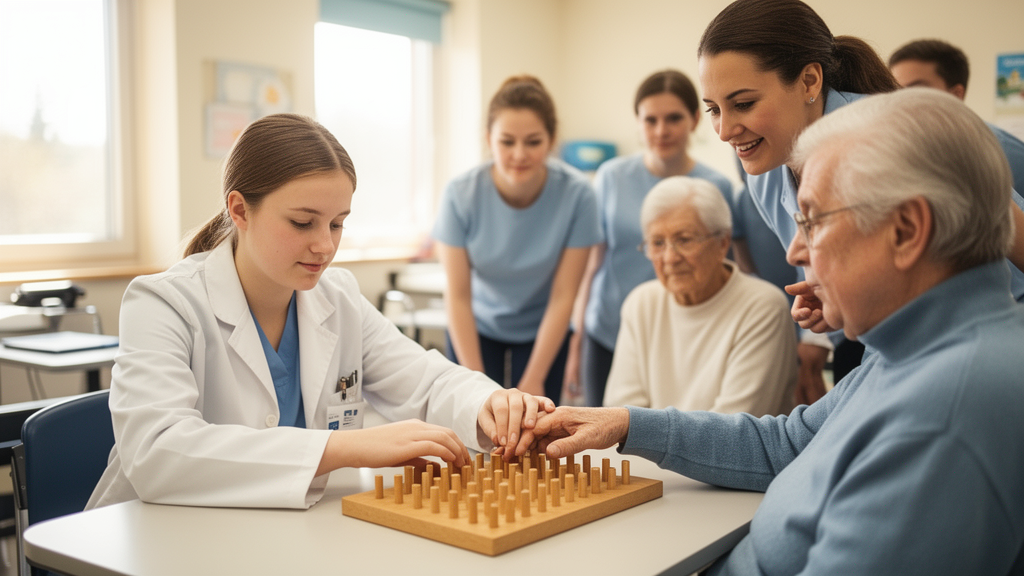
A randomised controlled trial from Suzhou, China, suggests that a structured teaching model built around authentic patient cases can substantially improve how occupational therapy students perform during their clinical placements. The study, published in BMC Medical Education, compared a multi-component programme combining the BOPPPS instructional framework with case-based learning against the traditional lecture-based instruction that has long dominated clinical education. The results showed large gains in both theoretical knowledge and hands-on clinical skills, along with markedly higher satisfaction among the students who experienced the new approach.
Occupational therapy occupies a distinctive position among the health professions. Practitioners help patients regain the ability to carry out the everyday activities that give life meaning, from dressing and cooking to returning to work after injury. Doing this well demands more than memorised facts. Students must weave together theoretical knowledge, clinical reasoning and practical technique in real time, often with patients whose presentations resist neat textbook categories. The authors of the new study argue that conventional lecture-based learning frequently falls short of preparing interns for this integration, leaving a gap between what students know and what they can actually do at the bedside.
The BOPPPS model, an acronym for Bridge-in, Objective, Pre-assessment, Participatory learning, Post-assessment and Summary, offers a scaffold for structuring any teaching session. It opens by capturing attention and connecting new material to prior experience, states clear learning objectives, gauges what students already know, then devotes the core of the session to active participation rather than passive listening. Learning is checked afterwards, and the session closes with a synthesis of key points. Case-based learning, meanwhile, anchors instruction in real clinical scenarios, asking students to analyse, discuss and solve problems the way they eventually will in practice. Combining the two produces a programme in which structured pedagogy and authentic clinical content reinforce one another across pre-class, in-class and after-class phases.
Despite encouraging reports from other health disciplines, the combination had never been formally evaluated in occupational therapy internships. To fill that gap, a team at the Department of Rehabilitation Medicine of Suzhou Municipal Hospital, affiliated with Nanjing Medical University, ran a single-centre randomised controlled trial between November 2025 and March 2026. Sixty undergraduate occupational therapy interns were enrolled and randomly assigned in equal numbers to an experimental group receiving the BOPPPS-CBL programme or a control group receiving traditional lecture-based learning.
The researchers measured outcomes with some care. Theoretical knowledge was scored on a 100-point scale, as were clinical skills, the latter assessed through an Objective Structured Clinical Examination, a widely used method in which students rotate through stations and are observed performing standardised clinical tasks. Teaching satisfaction, a secondary outcome, was measured on a 20-item questionnaire adapted from the SETQ framework, an instrument with a reported internal consistency of Cronbach’s alpha of 0.87. Statistical analysis used analysis of covariance with pre-test scores as covariates, and Bonferroni correction was applied across the five satisfaction subdomains to guard against false positives. Notably, when a significant interaction between group allocation and pre-test scores emerged for clinical skills, the team switched to change-score analysis as the primary approach and confirmed the result with a Bootstrap sensitivity analysis, a level of statistical caution not always seen in education research.
The findings were striking. The experimental group scored significantly higher than the control group on both post-test theoretical knowledge and clinical skills, with p values below 0.001 and effect sizes that are unusually large for educational interventions: partial eta-squared values of 0.91 for knowledge and 0.895 for skills. In practical terms, the structured case-driven programme accounted for the overwhelming majority of the variance in post-test performance between the groups. Satisfaction followed the same pattern. Students taught with BOPPPS-CBL reported significantly higher total teaching satisfaction, and all five subdomains, including Teaching Enthusiasm, remained significant after Bonferroni correction. The study also explored the relationship between satisfaction and knowledge, finding a strong partial correlation of 0.860 after controlling for group allocation and pre-test scores, though the authors flag this association as exploratory rather than confirmatory.
Why might the combined approach work so well? The BOPPPS structure imposes a rhythm that keeps learners engaged at every stage, while the cases give abstract theory a concrete face. A student who has debated how to adapt a bathroom routine for a patient with hemiplegia is far more likely to recall the relevant principles, and to apply them flexibly, than one who has only heard them described in a slide deck. The pre-class and after-class components extend learning beyond contact hours, turning the placement into a continuous cycle of preparation, practice and reflection rather than a series of isolated encounters. The high satisfaction scores suggest that this intensity was experienced not as a burden but as a more meaningful way to learn.
The authors are admirably candid about the limits of their evidence. Instructor identity was completely confounded with group allocation, meaning the same teachers delivered the experimental programme and different teachers delivered the lectures, so any observed difference could partly reflect who was teaching rather than what was taught. The educational dosage was also unequal between the arms, and the trial was registered retrospectively, on September 9, 2026, after enrolment had begun in November 2025, owing to administrative delays. Because of these constraints, the team interprets the results as preliminary, exploratory support for the entire educational package rather than proof that the BOPPPS-CBL model itself is the active ingredient.
That caution matters for anyone hoping to translate the findings into policy. Educational interventions are notoriously difficult to evaluate cleanly, and single-centre trials with large effect sizes sometimes shrink when replicated more rigorously. The authors call for prospectively registered, multi-centre trials with validated outcome measures, longer-term follow-up and factorial or multi-arm designs capable of isolating which components of the package actually drive the benefit while controlling for instructor effects. Until such trials exist, widespread implementation cannot be recommended, even though the signal from Suzhou is strong enough to justify the effort.
Nevertheless, the study adds to a growing body of evidence that clinical education across the health professions is being transformed by active, case-centred pedagogy. For occupational therapy, a field whose entire ethos centres on meaningful, real-world function, teaching methods that mirror the complexity of practice seem a natural fit. The trial was approved by the Ethics Committee of Suzhou Municipal Hospital, all participants gave written informed consent, and the work was funded by the hospital’s 2024 Educational Research Project. If larger, better-controlled studies confirm what this one suggests, the way rehabilitation students learn during placements could shift decisively away from the lecture hall and toward the structured, case-driven classrooms where theory and practice finally meet.
Subject of Research: A randomised controlled trial of BOPPPS combined with case-based learning in occupational therapy clinical education
Article Title: BOPPPS combined with case-based learning for occupational therapy clinical placements: a single-centre randomised controlled trial
Article References: BOPPPS combined with case-based learning for occupational therapy clinical placements: a single-centre randomised controlled trial. (n.d.). https://doi.org/10.1186/s12909-026-10559-2
Image Credits: AI Generated
DOI: 10.1186/s12909-026-10559-2
Keywords: BOPPPS model, case-based learning, occupational therapy, clinical education, randomised controlled trial, medical education, clinical skills, teaching satisfaction, Objective Structured Clinical Examination, lecture-based learning, clinical placements, rehabilitation
Cite Scienmag News
Courtney Benton. (October 15, 2026). Case-Based BOPPPS Teaching Boosts Occupational Therapy Interns’ Skills in Randomised Trial. Scienmag. https://scienmag.com/case-based-boppps-teaching-boosts-occupational-therapy-interns-skills-in-randomised-trial/
Courtney Benton. "Case-Based BOPPPS Teaching Boosts Occupational Therapy Interns’ Skills in Randomised Trial." Scienmag, 15 October 2026, https://scienmag.com/case-based-boppps-teaching-boosts-occupational-therapy-interns-skills-in-randomised-trial/. Accessed 15 October 2026.
Courtney Benton. "Case-Based BOPPPS Teaching Boosts Occupational Therapy Interns’ Skills in Randomised Trial." Scienmag. October 15, 2026. https://scienmag.com/case-based-boppps-teaching-boosts-occupational-therapy-interns-skills-in-randomised-trial/


