


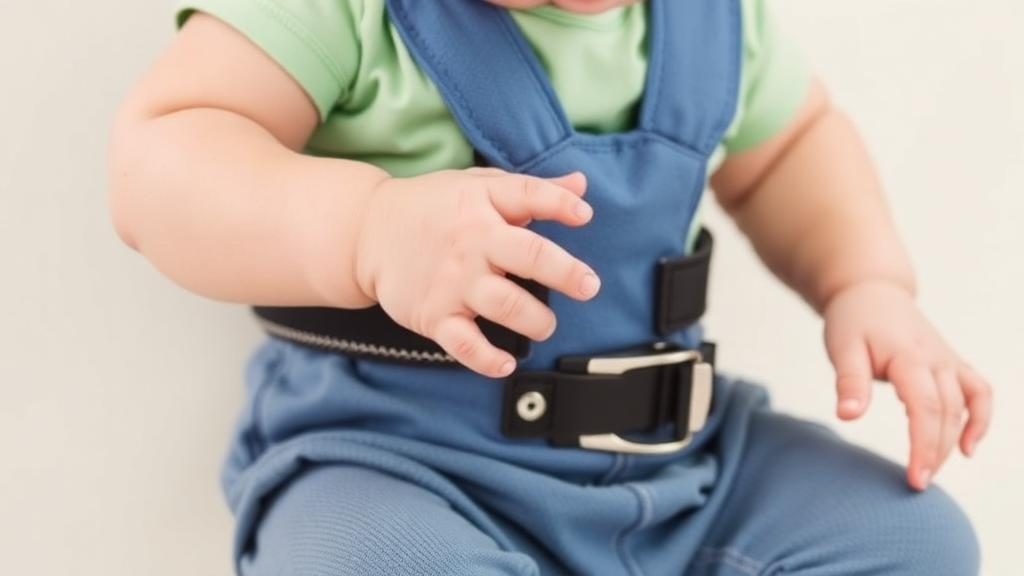
Ask any new parent and they will tell you that babies spend a surprising amount of time being held, carried, strapped into high chairs, or buckled into car seats. What has been far harder to pin down is exactly how much of an infant’s day is spent in these restrained states, and what that time means for the way babies learn about the world. A new study published in Behavior Research Methods by Hanzhi Wang, Hailey N. Rousey, and John M. Franchak of the University of California, Riverside, offers the most complete answer yet. The team developed and validated a machine learning model that reads the motion signals from tiny wearable sensors attached to a baby’s legs and ankles, and uses those signals to determine, moment by moment, whether the infant is restrained or free to move. The model reached 89 percent accuracy against human-coded video, a level of agreement the authors describe as substantial, and it worked in the messiest possible setting: real homes, with real families going about their ordinary routines.
Restraint, as the researchers define it, is any practice that limits an infant’s ability to move or change posture freely. That includes caregiver restraint, such as being held or carried, and device restraint, such as sitting in a high chair, stroller, swing, or car seat. The definition deliberately avoids a fixed list of equipment. Instead, it focuses on the infant’s real-time opportunities for movement, which means an infant strapped into a high chair counts as restrained, while an infant placed in a large crib where they can crawl and reposition freely does not. This broad framing matters because restraint is not simply a safety measure or a convenience for caregivers. It fundamentally shapes what infants can do, see, hear, and touch. Previous work has linked restraint to reduced leg movement and diminished spinal and hip muscle activity, and to fewer opportunities for object interaction and reduced exposure to adult speech. At the same time, restraint can be beneficial: supported sitting frees a baby’s hands for exploring objects, and being carried places infants higher off the ground, giving them richer views of faces and distant surroundings.
Measuring this everyday phenomenon has always been the bottleneck. Parent surveys, whether retrospective questionnaires or ecological momentary assessments delivered by phone several times a day, depend on memory or on sparse sampling, and neither can produce a continuous record of the day. Video recording solves the continuity problem in principle, but in practice it is cumbersome. Stationary cameras lose sight of infants behind furniture, handheld cameras can alter behavior, and the annotation process is so labor-intensive that prior studies typically captured only half an hour to an hour of footage, often biased toward periods when infants were awake and active. The periods most relevant to restraint research, such as a baby seated in front of a screen or parked in a seat during mealtime, were precisely the ones most likely to be skipped. What was needed was a method that could run all day, unobtrusively, without asking anything of the caregiver.
The solution the team built rests on inertial measurement units, miniature sensors that record linear acceleration from accelerometers and angular velocity from gyroscopes. In this study, four lightweight MC10 Biostamp sensors were secured in a customized infant garment at the right thigh, left thigh, right ankle, and left ankle. Each sensor sampled motion at 62.5 hertz, a rate fine enough to capture the subtle signatures of infant movement, and the battery lasted more than a full day. The dataset drew on 146 home-visit sessions from 66 infants, split into a younger cohort of 30 babies aged 4 to 7 months and an older cohort of 36 babies aged 11 to 14 months. During each visit, a GoPro camera recorded the first 1.5 hours of the session, and trained coders labeled every stretch of that footage as restrained, unrestrained, or missing when the infant left the frame. Two independent coders achieved 98.79 percent agreement, providing a trustworthy ground truth against which the machine learning model could be judged.
The modeling pipeline is a careful exercise in feature engineering. Raw motion data were aggregated within sliding windows, and within each window the researchers computed a rich set of statistics for every signal from every sensor: means, medians, minima, maxima, percentiles, skewness, kurtosis, standard deviations, and sums, along with cross-sensor and cross-orientation correlations and pairwise differences. In total, 436 features described each window. A random forest classifier, trained with leave-one-session-out cross-validation, then mapped those features onto the binary restrained or unrestrained label. Crucially, the team varied the window length, testing windows of 4, 16, and 30 seconds, because the choice of temporal scale involves a genuine trade-off. Short windows offer fine temporal resolution but may lack enough context to distinguish, say, a baby kicking freely on the floor from a baby kicking while strapped into a seat. Longer windows capture more context but risk blurring abrupt transitions.
All three window lengths performed well, with accuracies between 87 and 89 percent and kappa values between 0.70 and 0.73, but the 30-second window showed the most favorable pattern. The model carried a slight bias toward overestimating unrestrained time, likely because unrestrained periods were more common in the training data, and the longer window shrank that bias: the difference between predicted and human-annotated restraint prevalence fell from 4.70 percent with 4-second windows to 1.70 percent with 30-second windows. The authors offer an intuitive explanation for why longer windows help. Infants may look motionally similar whether restrained or not while they sit still, but the telltale differences emerge when they move: a caregiver’s lap or a seat absorbs and damps motion in ways that a bare floor does not. Those damping signatures appear only in movement episodes, and a 30-second window is far more likely to contain one. Longer windows also generalize better across the bewildering variety of restraint forms, from stationary seats to swings to being carried around the house. The practical lesson for the field is that window length should be matched to the natural duration of the behavior being detected, and restrained bouts, which typically last minutes rather than seconds, call for longer windows than the 2-to-4-second windows used in earlier body-posture classifiers.
When the final 30-second model was applied to full-day recordings, it produced estimates that converged with prior survey-based findings. Younger infants aged 4 to 7 months spent an average of 55.38 percent of their awake time restrained, while older infants aged 11 to 14 months spent 33.42 percent, a statistically significant age-related decline that mirrors earlier reports. Individual variability was striking, with some infants restrained far more than others even within the same age group. The average awake wearing time in the 133 analyzable full-day sessions was about 6.18 hours, after excluding naps and periods when the garment was removed, which caregivers logged on paper forms. The authors acknowledge that reliance on parent logs is a limitation, since caregivers may forget or misrecord these intervals, and they suggest future work could cross-validate wearing time using automated sleep detection from audio recordings or sensor-based movement detection.
The study is candid about the boundaries of its model. Machine learning classifiers are constrained by their training data, so strong performance on this dataset does not guarantee comparable accuracy on new populations, new sensor brands, or unfamiliar forms of restraint. The authors point to culturally distinctive practices such as the Tajik gahvora cradle, Tseltal slings, and the use of sandbags or heavy blankets elsewhere, all of which could produce hip and ankle movement patterns absent from the current training set. Applying the model in such contexts will require fresh ground-truth coding and possible re-tuning. There is also the deeper issue that detecting when restraint happens does not reveal what the experience is like. An infant in a high chair during animated face-to-face feeding lives a very different moment from an infant in the same chair while a caregiver washes dishes, and interpreting restraint’s developmental consequences will require pairing sensor data with audio, proximity tracking, and other contextual streams.
Even with those caveats, the implications are considerable. A validated, automated system for quantifying restraint opens questions that were previously unanswerable: what immediately precedes a caregiver’s decision to pick up or put down a baby, how restraint bouts are distributed across the day, whether prolonged individual bouts matter differently from the same total time fragmented into short ones, and how speech input, object interaction, and visual experience differ between restrained and unrestrained periods. The authors note that Tajik and US infants can show comparable overall restraint time yet different motor outcomes, suggesting that the temporal texture of restraint, not just its total, may be developmentally decisive. The team also envisions extending the approach to locomotion, steps, and falls, and to the underexplored outdoor environments where strollers, carriers, and car seats dominate. Sensor data, video annotations, and analysis code are publicly shared, lowering the barrier for other labs to build on the work. What began as a simple parental intuition, that babies spend much of their day constrained, can now be measured with second-by-second precision, and that measurement may reshape how developmental science understands the architecture of a baby’s everyday learning environment.
Subject of Research: Machine learning detection of infants' daily restraint from wearable inertial sensors
Article Title: Quantifying infants’ everyday restrained experiences in the home using wearable inertial sensors
Article References: Wang, H., Rousey, H. N., & Franchak, J. M. (2026). Quantifying infants’ everyday restrained experiences in the home using wearable inertial sensors. Behavior Research Methods, 58(11), Article 305. https://doi.org/10.3758/s13428-026-03185-9
Image Credits: AI Generated
DOI: 10.3758/s13428-026-03185-9
Keywords: infant development, wearable sensors, machine learning, physical restraint, motor development, inertial measurement units, home observation, random forest, caregiving, Behavior Research Methods, developmental psychology, motion classification
Cite Scienmag News
Glenn Wilkins. (September 30, 2026). Tiny Wearable Sensors Reveal How Much of a Baby’s Day Is Spent Restrained. Scienmag. https://scienmag.com/tiny-wearable-sensors-reveal-how-much-of-a-babys-day-is-spent-restrained/
Glenn Wilkins. "Tiny Wearable Sensors Reveal How Much of a Baby’s Day Is Spent Restrained." Scienmag, 30 September 2026, https://scienmag.com/tiny-wearable-sensors-reveal-how-much-of-a-babys-day-is-spent-restrained/. Accessed 16 October 2026.
Glenn Wilkins. "Tiny Wearable Sensors Reveal How Much of a Baby’s Day Is Spent Restrained." Scienmag. September 30, 2026. https://scienmag.com/tiny-wearable-sensors-reveal-how-much-of-a-babys-day-is-spent-restrained/


