


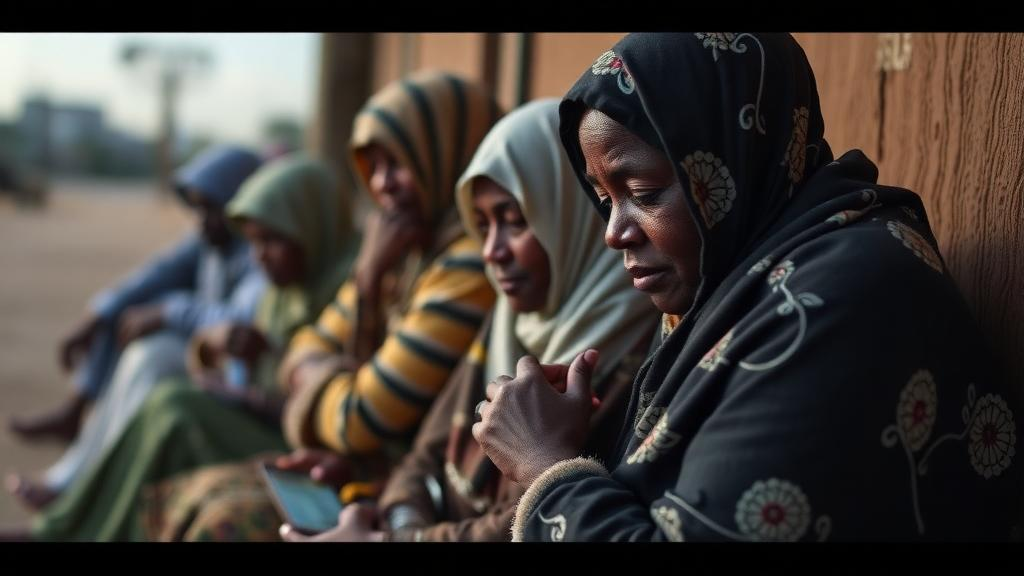
When violence erupts around contested elections, the world’s attention tends to fix on the political drama: the disputed tallies, the street confrontations, the official statements. A new study argues that this focus misses the people who carry the longest burden. In research published in BMC Psychology, Emanuel Ismael Maphie of the University of Dar es Salaam documents the psychological and psychosocial experiences of 28 family members who lost relatives in protest-related fatalities connected to Tanzania’s 2025 post-election violence. His qualitative analysis suggests that many of these families are trapped in what grief researchers call frozen grief, a state in which mourning cannot proceed normally because social, political and material conditions block the path toward acceptance.
The study, published on 16 October 2026 as an open-access research article, used semi-structured interviews with participants recruited through purposive and snowball sampling across three Tanzanian regions affected by the protest-related violence. Snowball sampling, in which early participants refer the researcher to others in similar circumstances, is a standard technique for reaching populations that cannot be enumerated in advance, and it proved essential here because no official registry of bereaved families existed for the researcher to draw upon. The interviews explored grief, coping strategies, household disruption, and participants’ perceptions of recognition and accountability in the aftermath of their losses.
Methodologically, the analysis followed the thematic analysis framework developed by Virginia Braun and Victoria Clarke, one of the most widely used approaches in qualitative psychology. In this method, researchers immerse themselves in interview transcripts, code meaningful segments of text, and iteratively group codes into broader themes that capture patterns across the dataset. From this process, five distinct themes emerged from the Tanzanian families’ accounts: continuing attachment and intrusive recollections; constrained expression of grief; material and economic hardship; religious, family and community coping; and meaning-making amid perceived limited recognition and accountability.
The first theme, continuing attachment and intrusive recollections, reflects a well-documented phenomenon in bereavement science. Rather than simply severing bonds with the deceased, mourners often maintain an internal relationship with them, remembering their voices, advice and presence. When the death is sudden and violent, however, this attachment frequently coexists with intrusive memories: unwanted flashbacks, nightmares and ruminative thoughts about the circumstances of the death. For families bereaved in political violence, these intrusions can be compounded by the public nature of the loss, since the circumstances of the death may be discussed in news coverage, social media debates and neighborhood conversations that the family cannot avoid.
The second theme, constrained expression of grief, is where the concept of frozen grief becomes most visible. Grief researchers have long recognized that mourning is not only an internal psychological process but also a social one, requiring safe spaces, recognized rituals and community acknowledgment. When families feel unable to hold funerals openly, speak freely about how their relatives died, or publicly express anger and sorrow, the normal trajectory of grieving can stall. The study suggests that participants experienced precisely this kind of constraint, with limited recognition of their losses and restricted opportunities to mourn complicating their adaptation. In the psychological literature, blocked or disenfranchised grief is associated with prolonged grief disorder, depression and complicated bereavement outcomes, making this finding clinically significant beyond its local context.
Material and economic hardship formed the third theme, underscoring that psychological trauma and financial devastation are intertwined rather than separate problems. In many East African households, the deceased may have been a primary breadwinner, and protest-related fatalities can strip families of income at the same moment that funeral costs, medical bills and lost labor compound their burdens. The study documents how this economic disruption fed back into the psychological experience of grief, since families struggling to meet basic needs have fewer resources for mourning rituals, memorialization and the time-intensive work of emotional processing. Any psychosocial intervention that addresses trauma without addressing livelihood, the findings imply, addresses only half of the problem.
Against these pressures, the fourth theme revealed the adaptive resources families drew upon: religious faith, family networks and community solidarity. Religious coping is among the most extensively studied forms of meaning-making in psychology, with research consistently showing that spiritual frameworks can help bereaved individuals interpret loss, sustain hope and maintain social connection. In the Tanzanian context, where religious institutions are deeply embedded in community life, faith communities and extended family networks provided practical support and emotional containment. The study is careful to frame this not as mere passive consolation but as active agency, highlighting what the author calls participant agency and adaptive resilience alongside the evident suffering.
The fifth theme, meaning-making amid perceived limited recognition and accountability, may be the most politically charged. Meaning-making theory holds that recovering from traumatic loss depends heavily on the survivor’s ability to construct a coherent narrative about what happened and why. When deaths occur in circumstances where families perceive that no institution acknowledges responsibility, explains the events, or pursues accountability, that narrative construction becomes extraordinarily difficult. Participants in the study described a search for meaning that unfolded against what they perceived as limited institutional communication and recognition, leaving questions about the deaths unresolved. The author suggests that appropriate institutional communication could play a meaningful role in easing this burden, a recommendation that connects psychological science directly to questions of governance and transitional justice.
The study’s contribution lies partly in who it studies. Research on political violence in Tanzania, the author notes, has largely overlooked bereaved families as a population in their own right, focusing instead on political dynamics, human rights documentation or aggregate casualty figures. By foregrounding the intimate psychological aftermath, the research fills an empirical gap while also demonstrating how concepts from bereavement science, such as frozen grief, can travel productively into the study of political violence. The findings point toward trauma-informed psychosocial support, safe opportunities for mourning, practical family assistance and appropriate institutional communication as concrete directions for policy and intervention, while the documentation of resilience cautions against portraying bereaved families solely as passive victims.
For a global readership, the study carries implications well beyond Tanzania. Electoral violence has scarred numerous countries in recent years, and the psychological architecture of bereavement in its aftermath, blocked mourning, economic collapse of households, unresolved meaning, and coping through faith and community, is likely to recur wherever such violence occurs. The research also exemplifies the value of qualitative methods in trauma psychology: where standardized surveys might miss the texture of constrained grief or the nuance of religious coping, thematic analysis of in-depth interviews captures it. As debates about political violence continue to dominate headlines, this study reminds us that the deepest wounds are often carried quietly, in households where grief has nowhere to go, and that recognizing those wounds is itself a step toward healing.
Subject of Research: Psychological and psychosocial experiences of families bereaved by protest-related fatalities in Tanzania's 2025 post-election violence
Article Title: Psychological experiences of families bereaved by 2025 post-election protest-related fatalities in Tanzania: a qualitative thematic analysis
Article References: Maphie, E. I. (2026). Psychological experiences of families bereaved by 2025 post-election protest-related fatalities in Tanzania: a qualitative thematic analysis. BMC Psychology. https://doi.org/10.1186/s40359-026-05668-y
Image Credits: AI Generated
DOI: 10.1186/s40359-026-05668-y
Keywords: frozen grief, traumatic grief, electoral violence, bereaved families, Tanzania, qualitative research, thematic analysis, religious coping, psychosocial support, political violence, meaning-making, trauma psychology
Cite Scienmag News
Glenn Wilkins. (October 16, 2026). Grief Without Closure: Tanzanian Families Bereaved in 2025 Post-Election Violence Show Frozen Mourning. Scienmag. https://scienmag.com/grief-without-closure-tanzanian-families-bereaved-in-2025-post-election-violence-show-frozen-mourning/
Glenn Wilkins. "Grief Without Closure: Tanzanian Families Bereaved in 2025 Post-Election Violence Show Frozen Mourning." Scienmag, 16 October 2026, https://scienmag.com/grief-without-closure-tanzanian-families-bereaved-in-2025-post-election-violence-show-frozen-mourning/. Accessed 16 October 2026.
Glenn Wilkins. "Grief Without Closure: Tanzanian Families Bereaved in 2025 Post-Election Violence Show Frozen Mourning." Scienmag. October 16, 2026. https://scienmag.com/grief-without-closure-tanzanian-families-bereaved-in-2025-post-election-violence-show-frozen-mourning/


