


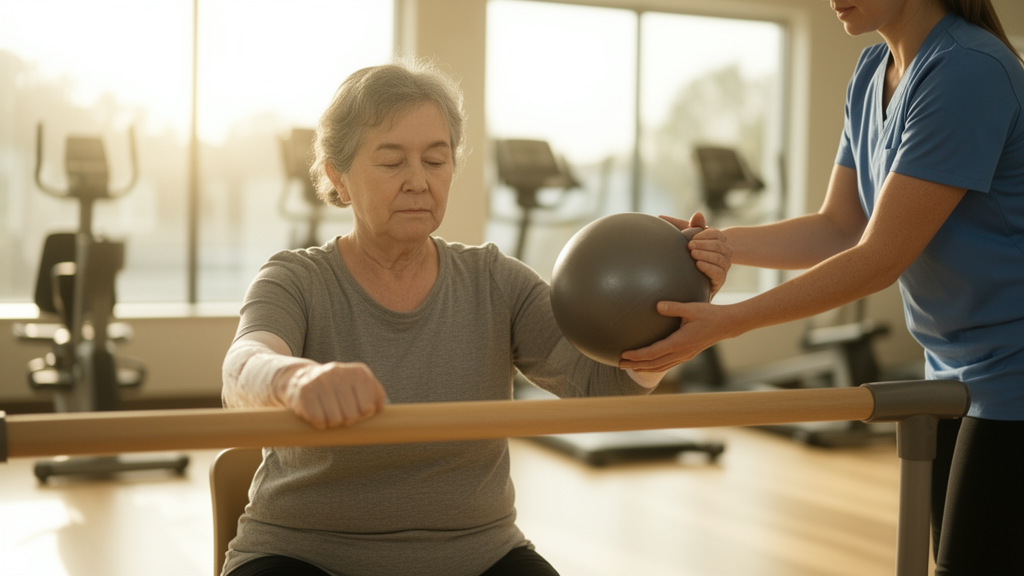
For millions of people who survive a stroke each year, the moment of the brain attack is only the beginning of a far longer struggle. A new qualitative study from India, published in BMC Psychology, offers an unusually intimate account of what rehabilitation actually feels like from the inside, documenting how survivors confront sudden dependence, unfamiliar bodies, lost roles, and emotional turmoil before slowly rebuilding hope through family support and structured therapy.
Researchers at SRM College of Nursing, part of SRM Institute of Science and Technology in Tamil Nadu, interviewed sixteen stroke survivors undergoing rehabilitation at the Department of Physical Medicine and Rehabilitation at SRM Medical College Hospital and Research Center. Using purposive sampling and in-depth, semi-structured interviews, the team captured audio-recorded conversations that were transcribed verbatim and analyzed with Colaizzi’s seven-step descriptive phenomenological method, a rigorous qualitative framework designed to distill lived experience into essential themes while staying anchored to participants’ own words.
The analysis yielded five major themes that together map the arc of recovery. The first, described by the authors as A Life Interrupted – From Independence to Unexpected Illness, captures the shock of a sudden transition from full autonomy to unexpected illness and dependence on others for even basic daily activities. The second theme, Adjusting to a New Body, reflects the physical challenges survivors face as they learn to live with impaired function, weakness, and altered mobility during rehabilitation.
The third theme, Change in Roles and Identity, documents how stroke reshapes family and work-related roles. Survivors described navigating a shift in who they were within their households and workplaces, a renegotiation of identity that the study identifies as central to the rehabilitation experience. The fourth theme, Emotional Challenges and Psychological Adjustments, records the emotional distress and psychological work involved in accepting a changed body and an uncertain future.
The fifth theme, Building Strength through Support and Adaptations, offers the study’s most hopeful finding. Despite the difficulties encountered during rehabilitation, participants adapted with the help of their families, rehabilitation programs, and personal resilience, gradually building hope and motivation toward recovery. The researchers conclude that rehabilitation after a stroke goes beyond physical healing and includes psychological and social adjustment, and that understanding survivors’ lived experiences can aid in designing customized rehabilitation programs.
The technical significance of the study lies in its methodology and its corrective message. Descriptive phenomenology, as operationalized through Colaizzi’s seven steps, requires researchers to bracket their assumptions, extract significant statements from transcripts, formulate meanings, cluster them into themes, produce an exhaustive description, and validate findings with participants. This disciplined process is what allows the five themes to be presented as a faithful structure of experience rather than a loose collection of anecdotes.
Stroke is a common cause of permanent disability, affecting body functions, emotional status, and socialization. While rehabilitation aims to improve recovery and independent living, the authors note there remains a lack of information about how stroke survivors perceive the rehabilitation process. By addressing that gap directly, the study gives clinicians a patient-centered evidence base for tailoring interventions, suggesting that programs which integrate psychological support and family involvement may align better with what survivors actually need than purely physical protocols.
The findings also carry implications for how recovery timelines should be communicated. Survivors in the study faced future uncertainties alongside their immediate physical and emotional challenges, indicating that rehabilitation is experienced as an open-ended process rather than a fixed course of therapy. Health systems that frame rehabilitation in terms of milestones alone may therefore underestimate the identity and role changes that survivors are simultaneously processing.
The research was supported by the Chancellor’s Research Fellowship for Ph.D. at SRM-MHS, SRM Institute of Science and Technology, with publishing costs borne by SRM College of Nursing. Ethical approval was obtained from the Institutional Ethics Committee of SRM Medical College Hospital and Research Center under approval number IEC: 9157, and all participants provided written informed consent, were informed of their right to withdraw at any time, and were assured of confidentiality, with procedures conducted in accordance with the 1964 Declaration of Helsinki and its later amendments.
For a condition that interrupts a life in an instant, the study’s central insight is quietly powerful: recovery is not merely the restoration of movement but the reconstruction of a person. Survivors rebuild through families, therapy, and resilience, and rehabilitation programs that recognize the physical, emotional, and social dimensions of that reconstruction stand the best chance of helping survivors not just survive a stroke, but resume a life worth living.
What makes the phenomenological approach particularly valuable in stroke research is its refusal to reduce recovery to clinical metrics. Where conventional rehabilitation studies might measure gains in motor function, walking distance, or activities-of-daily-living scores, this study asks survivors what the experience of recovery actually is from the inside. That distinction matters because the subjective dimension of stroke recovery — how people interpret their losses, how they narrate their changed identities, and how they find meaning in incremental progress — is increasingly recognized as a driver of rehabilitation engagement itself. A survivor who feels emotionally defeated may attend therapy sessions but not truly participate in them, whereas one who has reconstructed a sense of purpose may push through plateaus that would otherwise end progress.
The setting of the study also deserves attention. India’s stroke burden is substantial and rising, with rehabilitation services unevenly distributed and often concentrated in urban tertiary centers. Family involvement, which emerged so strongly in the fifth theme as a source of strength, carries particular weight in contexts where formal rehabilitation resources are limited and families function as the primary continuity of care after discharge. The finding that adaptation was achieved through families, rehabilitation programs, and resilience is therefore not merely a descriptive observation but a signal about where intervention leverage may lie in similar settings. Programs that deliberately train and support caregivers, rather than treating family members as peripheral to recovery, may amplify the adaptive capacity the study documented.
The theme of role and identity change also connects to a broader body of stroke literature describing the disruption of self-concept after acquired brain injury. Survivors frequently describe a split between the person they were before the stroke and the person they are becoming, and the renegotiation of household and occupational roles is often as distressing as the physical impairment itself. When a breadwinner becomes a dependent, or a caregiver becomes the one needing care, the psychological reverberations extend through entire family systems. The study’s attention to these shifts suggests that rehabilitation planning should routinely include conversations about role expectations with both survivors and their family members, rather than assuming that role reassignment will resolve itself naturally.
The emotional dimension captured in the fourth theme aligns with well-documented post-stroke phenomena, including depression and anxiety, which are among the most common complications following stroke and are frequently underrecognized in busy clinical settings. Emotional distress can directly undermine rehabilitation participation, creating a feedback loop in which poor engagement limits functional gains, which in turn deepens despair. The study’s finding that survivors moved from emotional turmoil toward hope and motivation through support and adaptation underscores the importance of embedding psychological screening and counseling within rehabilitation pathways rather than treating mental health as a separate concern addressed only when problems become severe.
Methodologically, the sample of sixteen participants sits within the range typically considered adequate for descriptive phenomenological studies, where data saturation rather than statistical power governs sample size. The use of purposive sampling ensured that participants had direct, ongoing experience of rehabilitation, though it also means the findings reflect the perspectives of survivors who remained engaged with a hospital-based program at a single tertiary center. Readers should therefore interpret the five themes as a rich, internally coherent account of one group’s experience rather than a statistically generalizable portrait of all stroke survivors. The transferability of the findings to other settings is a judgment for clinicians and researchers to make by comparing the described experiences with their own populations.
The open-access publication of the study, under a Creative Commons licence that permits non-commercial sharing with attribution, means that the full account is available to rehabilitation professionals, nursing educators, and patient advocacy groups who may wish to use survivor narratives in training. First-person accounts of illness have long served as powerful teaching tools, humanizing conditions that clinical curricula often present primarily through pathology and protocol. For nursing students and rehabilitation trainees in particular, exposure to the lived experience literature can cultivate the empathic communication skills that survivors repeatedly identify as central to feeling respected during recovery.
Ultimately, the study adds its voice to a growing consensus in rehabilitation science that outcome frameworks should encompass participation, well-being, and identity, not only impairment. The survivors in this study did not describe recovery as a return to a previous self but as a negotiated process of building strength through adaptation, supported by people and programs around them. That reframing — from restoration to reconstruction — is perhaps the study’s most durable contribution, offering clinicians, families, and survivors themselves a vocabulary for what the long months after a stroke are actually for.
Subject of Research: Neuroscience & Psychology
Article Title: A life interrupted: lived experiences of stroke survivors navigating physical, emotional, and social recovery: a descriptive phenomenological study
Article References: R, S., Shaji J C, H., & Kalikotay, B. (2026). A life interrupted: lived experiences of stroke survivors navigating physical, emotional, and social recovery: a descriptive phenomenological study. BMC Psychology. https://doi.org/10.1186/s40359-026-05795-6
Image Credits: AI Generated
DOI: 10.1186/s40359-026-05795-6
Keywords: stroke, stroke rehabilitation, phenomenology, qualitative research, rehabilitation psychology, recovery, BMC Psychology, patient experience, life, interrupted, lived, experiences
Cite Scienmag News
Cassandra Pierce. (October 16, 2026). A Life Interrupted: What Stroke Survivors Say Recovery Really Feels Like. Scienmag. https://scienmag.com/a-life-interrupted-what-stroke-survivors-say-recovery-really-feels-like/
Cassandra Pierce. "A Life Interrupted: What Stroke Survivors Say Recovery Really Feels Like." Scienmag, 16 October 2026, https://scienmag.com/a-life-interrupted-what-stroke-survivors-say-recovery-really-feels-like/. Accessed 16 October 2026.
Cassandra Pierce. "A Life Interrupted: What Stroke Survivors Say Recovery Really Feels Like." Scienmag. October 16, 2026. https://scienmag.com/a-life-interrupted-what-stroke-survivors-say-recovery-really-feels-like/


