


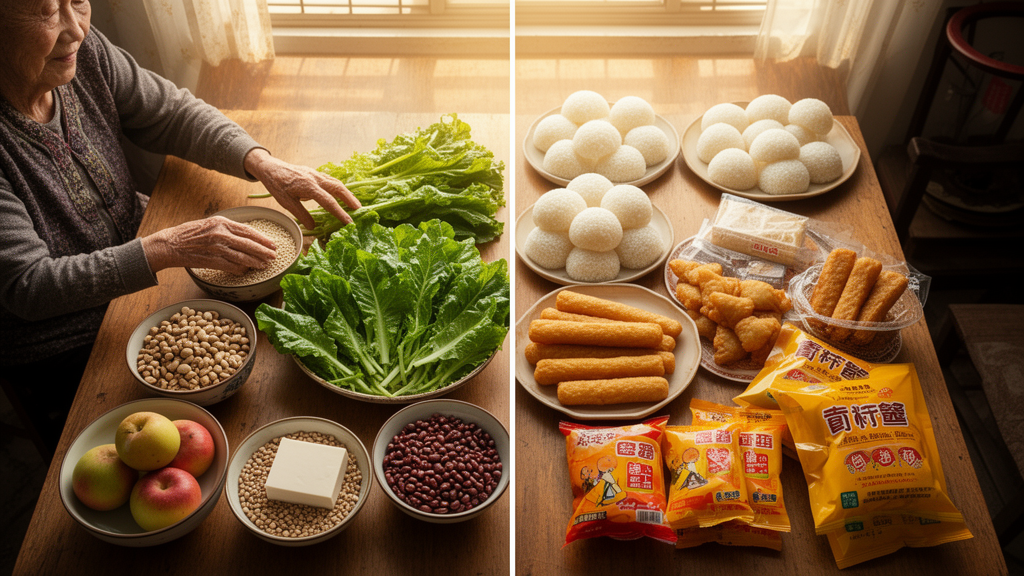
When the American Heart Association formally introduced cardiovascular-kidney-metabolic (CKM) syndrome as a staging framework in 2023, it gave clinicians a way to catch cardiometabolic risk long before heart attacks or kidney failure appear. A new prospective cohort study from the China Longitudinal Healthy Longevity Survey (CLHLS) now adds a striking dietary dimension to that framework: among older Chinese adults in the earliest CKM stages, the quality of plant-based foods—not plant-based eating itself—appears to shape survival. The research, published in Frontiers in Nutrition, followed 5,872 adults aged 65 and older for a median of nine years and found that healthful plant foods were associated with lower mortality, while refined grains, sugar, and preserved vegetables were associated with higher mortality.
The study team, led by researchers from Chengdu University of Traditional Chinese Medicine and collaborating institutions, applied the 2023 AHA CKM staging criteria in a data-adapted form suited to the CLHLS database. Stage 0 was defined by a body mass index below 24.0 kg/m², waist circumference below Chinese population thresholds, and no physician-diagnosed hypertension, diabetes, dyslipidemia, or chronic nephritis. Stage 1 marked excess adiposity without metabolic disease, and stage 2 captured the presence of any diagnosed metabolic or kidney-related risk factor. Participants with prevalent cardiovascular disease were excluded, leaving a cohort at the preclinical frontier of the syndrome—precisely the window in which preventive interventions are thought to matter most.
Dietary exposure was quantified using three distinct indices derived from a validated food frequency questionnaire administered during face-to-face interviews. The overall plant-based diet index (PDI) scored all plant foods positively and all animal foods negatively, regardless of nutritional quality. The healthful plant-based diet index (hPDI) rewarded whole grains, fresh fruits, fresh vegetables, legumes, nuts, and tea, while the unhealthful plant-based diet index (uPDI) rewarded refined grains, preserved vegetables, and sugar. Each of the 16 food groups was scored from 1 to 5 by consumption frequency, yielding total scores ranging from 16 to 80. This design allowed the researchers to disentangle what previous literature had largely conflated: the sheer quantity of plant-based eating versus the quality of the plants being eaten.
Over a median follow-up of 108 months, 2,870 deaths occurred in the cohort. In multivariable-adjusted Cox proportional hazards models accounting for age, sex, ethnicity, marital status, education, smoking, alcohol consumption, income, occupation, physical activity, sleep duration, and sleep quality, each one-point increase in hPDI was associated with a 1.1 percent lower mortality risk (hazard ratio 0.989, 95 percent confidence interval 0.982–0.995). Conversely, each one-point increase in uPDI was associated with a 1.2 percent higher risk (hazard ratio 1.012, 95 percent confidence interval 1.006–1.019). When participants were divided into quartiles, those in the highest hPDI quartile had a 13.2 percent lower mortality risk than those in the lowest quartile, while those in the highest uPDI quartile had a 19.2 percent higher risk. Restricted cubic spline analyses confirmed that both associations were approximately linear, with no evidence of non-linear dose-response relationships.
The most provocative finding concerned the overall PDI. In unadjusted analyses, higher PDI was strongly associated with lower mortality—the highest quartile showed a 25.1 percent risk reduction. But after multivariable adjustment, that association vanished entirely (hazard ratio 1.001, 95 percent confidence interval 0.994–1.007). This pattern suggests that the apparent survival benefit of plant-based eating in crude analyses was largely explained by other characteristics of people who eat more plant foods, such as younger age, higher education, or healthier lifestyles. Once those confounders were stripped away, only the quality dimension of plant-based diets retained an independent signal.
Stratified analyses by CKM stage revealed a numerically stronger pattern in stages 1 and 2 than in stage 0. Among participants with CKM stage 1—characterized by excess adiposity—the adjusted hazard ratio for hPDI was 0.961 per point, and for stage 2 it was 0.983, whereas in stage 0 the association was not statistically significant. A similar gradient appeared for uPDI. However, formal interaction tests did not reach statistical significance (p = 0.062 for hPDI and p = 0.824 for uPDI), meaning the evidence for effect modification by CKM stage remains limited. The authors caution that within-stratum significance does not imply between-stratum interaction, and that the pattern should be interpreted as hypothesis-generating rather than definitive.
The biological plausibility of these findings rests on well-characterized pathways. Healthful plant foods are rich in dietary fiber, polyphenols, unsaturated fatty acids, minerals, and phytochemicals, which can improve glycemic control, lipid metabolism, blood pressure, systemic inflammation, oxidative stress, endothelial function, and gut microbiota composition. These mechanisms are central to CKM pathophysiology: the 2023 AHA presidential advisory emphasized that insulin resistance, chronic inflammation, oxidative stress, and declining kidney function collectively drive progression from early to advanced CKM stages. Conversely, unhealthful plant foods dominated by refined carbohydrates, added sugars, and sodium-laden preserved products may worsen glycemic fluctuation, sodium load, and metabolic dysfunction, accelerating the very pathways the syndrome describes.
The robustness of the findings was tested through multiple pre-specified sensitivity analyses. Excluding deaths within the first three years of follow-up—designed to reduce reverse causation—did not alter the results. Excluding participants with baseline cancer, excluding strict vegetarians, and removing participants classified as CKM stage 2 solely on the basis of dyslipidemia or chronic nephritis all preserved the direction and magnitude of the associations. An extended model additionally adjusting for hypertension, diabetes, dyslipidemia, chronic nephritis, and body mass index yielded nearly identical estimates, with the highest hPDI quartile showing a hazard ratio of 0.867 and the highest uPDI quartile a hazard ratio of 1.186. Inverse probability-of-selection weighting, applied to address systematic differences between included and excluded participants, also produced directionally consistent results, though with attenuated effect sizes.
The study has important limitations that temper causal interpretation. The CKM staging relied on self-reported physician diagnoses and anthropometric measurements rather than laboratory biomarkers of kidney function, lipid profiles, or glycemic status, introducing potential misclassification. Dietary intake was assessed only once at baseline using frequency data without portion sizes, so changes in eating habits over the nine-year follow-up could not be captured, and adjustment for total energy intake was not possible. Information on medication use, frailty, cognitive function, and activities of daily living was unavailable, leaving residual confounding as a persistent concern. Cause-of-death data were not accessible, precluding cause-specific mortality analysis. The authors also note that participants excluded for missing diagnostic data were older and had less healthful diets, which may have influenced the magnitude of observed associations.
From a public health perspective, the message is deceptively simple but consequential: increasing plant food intake alone is not enough. In China, where traditional diets often combine fresh vegetables and whole grains with high-sodium preserved plant foods and refined staples, the distinction between healthful and unhealthful plant-based eating carries particular weight. The findings suggest that dietary guidance for older adults with early-stage CKM risk should focus on shifting the composition of plant foods toward whole grains, fresh produce, legumes, nuts, and tea, while reducing refined grains, sugar-rich items, and preserved vegetables. Whether these associations hold when CKM staging is confirmed with complete biomarker panels—and whether they extend to cardiovascular and kidney-specific mortality—remains a question for future research using cohorts with laboratory-verified staging and death-registry linkage.
Subject of Research: Plant-based diet quality and all-cause mortality in older Chinese adults with early-stage cardiovascular-kidney-metabolic syndrome
Article Title: The associations between healthful and unhealthful plant-based dietary patterns and all-cause mortality among older Chinese adults with data-adapted early-stage cardiovascular-kidney-metabolic syndrome (stages 0–2): a prospective cohort study from the CLHLS
Article References: Zhang, S., Tang, E., Jiang, Y., Zhu, K., Zhuang, X., Wang, H., He, X., Lu, Y., Zhang, Q., Li, X., & Song, J. (2026). The associations between healthful and unhealthful plant-based dietary patterns and all-cause mortality among older Chinese adults with data-adapted early-stage cardiovascular-kidney-metabolic syndrome (stages 0–2): a prospective cohort study from the CLHLS. Frontiers in Nutrition, 13, Article 1915953. https://doi.org/10.3389/fnut.2026.1915953
Image Credits: AI Generated
DOI: 10.3389/fnut.2026.1915953
Keywords: plant-based diet, cardiovascular-kidney-metabolic syndrome, all-cause mortality, hPDI, uPDI, older adults, CLHLS, China, Cox proportional hazards, dietary quality, American Heart Association, prospective cohort
Cite Scienmag News
Daisy Hatcher. (October 16, 2026). Not All Plant-Based Diets Are Equal: Food Quality Decides Survival in Older Chinese Adults. Scienmag. https://scienmag.com/not-all-plant-based-diets-are-equal-food-quality-decides-survival-in-older-chinese-adults/
Daisy Hatcher. "Not All Plant-Based Diets Are Equal: Food Quality Decides Survival in Older Chinese Adults." Scienmag, 16 October 2026, https://scienmag.com/not-all-plant-based-diets-are-equal-food-quality-decides-survival-in-older-chinese-adults/. Accessed 16 October 2026.
Daisy Hatcher. "Not All Plant-Based Diets Are Equal: Food Quality Decides Survival in Older Chinese Adults." Scienmag. October 16, 2026. https://scienmag.com/not-all-plant-based-diets-are-equal-food-quality-decides-survival-in-older-chinese-adults/


