


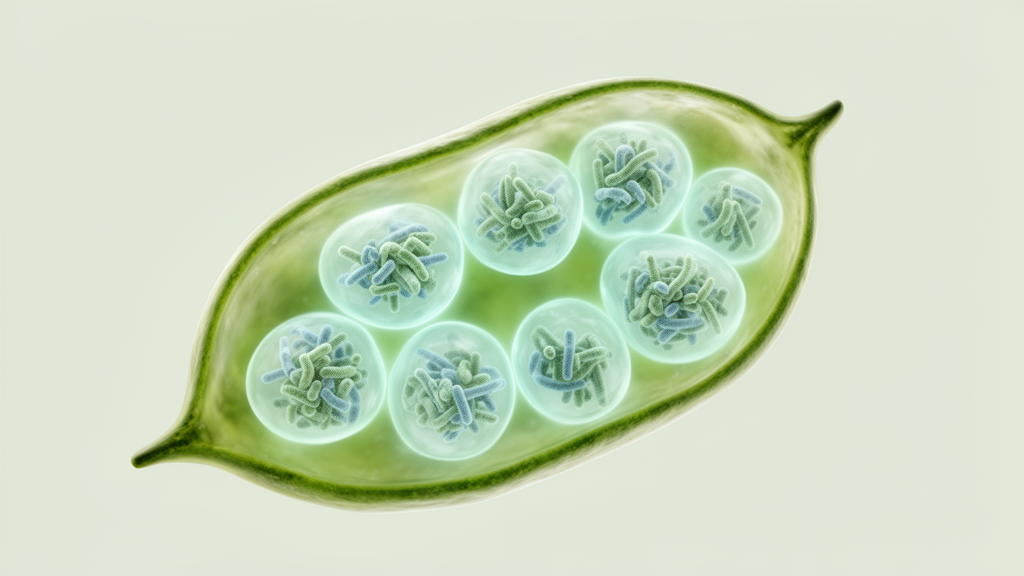
Beneath the surface of the world’s oceans drifts one of the smallest free-living cells ever described: Ostreococcus tauri, a single-celled green alga so tiny that an entire organism can fit comfortably within the volume of a red blood cell. Despite its minuscule size, this marine picoeukaryote carries a genome packed with surprises, and none have puzzled biologists longer than its so-called outlier chromosomes. Ever since the first genome of the Mamiellales order was sequenced nearly two decades ago, researchers have noticed that two of its chromosomes contain stretches of DNA with a strikingly low guanine-cytosine content, standing apart from the rest of the genome like foreign accents in an otherwise uniform language. What has remained unknown until now is whether these peculiar regions occupy a distinct physical position inside the nucleus, or whether their strangeness is purely a matter of sequence.
A new study published in BMC Genomics provides the first three-dimensional answer, and the result is remarkable. A team led by Martha Valiadi and Adam Monier at the University of Exeter, working with colleagues in Greece and at the Institut Pasteur in Paris, applied high-throughput chromosome conformation capture, or Hi-C, to O. tauri and mapped how its genome folds in space. Hi-C works by chemically cross-linking DNA segments that sit close together in the nucleus, fragmenting the genome, and then sequencing the paired fragments to build a contact map of physical interactions. When the team analysed these maps, they found that the low-GC regions of the two outlier chromosomes fold into self-contained loops of interaction that resemble the topologically associating domains, or TADs, familiar from animal and plant genomes. These TAD-like structures have sharp boundaries that effectively wall the outlier regions off from the rest of their own chromosomes and from the rest of the genome.
The finding is significant because spatial insulation was never previously demonstrated in organisms with genomes this compact. O. tauri holds the record as the smallest known free-living eukaryote, and its genome of roughly thirteen million base pairs is squeezed into a nucleus that occupies only a fraction of the cell. In larger eukaryotes, TADs are thought to help regulate gene expression by limiting the reach of regulatory elements such as enhancers, so that signals from one part of the genome do not bleed into another. Finding TAD-like architecture in an organism with so little genomic real estate suggests that the physical compartmentalisation of DNA is not a luxury of complex life but a fundamental feature that even the most streamlined eukaryotic genomes maintain.
The outlier regions themselves carry a distinctive chromatin fingerprint that the researchers uncovered by mining existing transcriptomic, methylation and nucleosome positioning data across the Mamiellales. Compared with the rest of the genome, the outlier regions are hypomethylated, meaning they carry fewer chemical methyl tags on their cytosine bases, and they are transcriptionally hyperactive, with genes inside them being expressed at unusually high levels. Nucleosome spacing across these regions is also altered, indicating that the DNA is packaged differently around the histone proteins around which it is wound. Taken together, these features describe a chromatin environment that is open, active and chemically distinct from the surrounding genome, and this profile is conserved across the species of the order that the team examined.
Yet the two outlier chromosomes are not identical twins in behaviour. The team found that transcription is consistently elevated in the low-GC region of the big outlier chromosome, which they designate BOC1, in every Mamiellales species they analysed. The small outlier chromosome tells a different story: transcriptional activity in its low-GC region, SOC1, varies from species to species. This asymmetry hints that the two outlier chromosomes may have different evolutionary origins or different functional roles, even though both share the same hallmark sequence composition and the same spatial sequestration within the nucleus. Understanding why one outlier region is universally busy while the other is more permissive remains an open question for future work.
One long-standing hypothesis about outlier chromosomes has been that they serve as repositories for transposable elements, the mobile genetic sequences that can copy and paste themselves around the genome. Because transposable elements often carry different GC compositions than host DNA and can be silenced by methylation, sequestering them in a separate chromatin compartment would be a sensible genome-defence strategy. The new study confirms that outlier regions are indeed enriched in transposable elements in most Mamiellales species, including a variety of element types such as Mutator-like elements and long terminal repeat retrotransposons. But the correlation is not universal, and this is where the study delivers its most conceptually important twist.
In two species, Bathycoccus prasinos and Ostreococcus lucimarinus, the researchers found no substantial enrichment of transposable elements in the outlier regions, yet those regions still retain their characteristic low-GC composition and their elevated BOC1 transcription, and the Hi-C data show that they remain spatially insulated. This decoupling demonstrates that the three-dimensional isolation of outlier chromosomes is not simply a by-product of harbouring mobile DNA. Spatial insulation, in other words, is a property that tracks the chromatin state of these regions rather than their transposable element content alone. It adds a genuine three-dimensional criterion to the list of sequence-based features, such as GC content and gene density, by which outlier chromosomes have traditionally been defined.
To test whether this compartmentalisation extends beyond the Mamiellales, the team reanalysed published Hi-C data from two other compact marine eukaryotes: Mantoniella tinhauana, a close relative within the same order, and Pelagomonas calceolata, a stramenopile alga only distantly related to the green lineage. In both cases, the data revealed consistent patterns of insulation around the outlier regions, suggesting that the spatial sequestration of compositionally distinct chromosome segments may be a recurrent feature of compact picoeukaryotic genomes more broadly. If this holds, it would imply that the physical organisation of the nucleus in these tiny cells follows rules that have evolved independently multiple times, converging on the same solution of walling off unusual DNA into its own neighbourhood.
The technical achievement behind these conclusions should not be understated. Hi-C experiments typically require millions of cells, and working with an organism as small as O. tauri demanded careful optimisation of cross-linking, digestion and ligation steps to recover enough informative contacts from such a tiny genome. The team also used iterative correction to normalise their contact matrices, removing biases introduced by restriction site distribution and read depth, before calling the boundaries of the TAD-like domains. The resulting maps provide the first glimpse of how a eukaryotic genome at the extreme lower limit of cellular complexity arranges itself in three dimensions, and they demonstrate that even a nucleus barely larger than a bacterial cell can sustain organised chromosomal architecture.
For the broader field of genome biology, the study reframes outlier chromosomes from curiosities of sequence composition into bona fide spatial compartments with conserved epigenetic identities. It raises new questions about how their boundaries are established and maintained in an organism that lacks many of the architectural proteins found in larger eukaryotes, and about what functional advantages insulation confers, whether in protecting the core genome from transposable elements, regulating the expression of specialised gene families, or managing the conflicts between different chromatin states within a single nucleus. As sequencing and chromosome conformation capture technologies continue to reach ever smaller and stranger organisms, the humble O. tauri, long a model of genomic minimalism, now also stands as a model of how much organised structure can be packed into the smallest of packages.
Subject of Research: Three-dimensional genome organisation and spatial insulation of outlier chromosomes in the picoeukaryote Ostreococcus tauri
Article Title: Three-dimensional genome organisation reveals spatially insulated outlier chromosomes in Ostreococcus tauri
Article References: Valiadi, M., Harrison, K., Loe-Mie, Y., Williams, B., Ankrett, D., Smirnoff, N., & Monier, A. (2026). Three-dimensional genome organisation reveals spatially insulated outlier chromosomes in Ostreococcus tauri. BMC Genomics. https://doi.org/10.1186/s12864-026-13416-0
Image Credits: AI Generated
DOI: 10.1186/s12864-026-13416-0
Keywords: Ostreococcus tauri, Hi-C, chromosome conformation capture, topologically associating domains, outlier chromosomes, picoeukaryotes, Mamiellales, genome organisation, transposable elements, chromatin, DNA methylation, BMC Genomics
Cite Scienmag News
Juliet Wilcox. (October 8, 2026). Tiny Alga’s Oddball Chromosomes Live in Their Own Private Nuclear Neighborhoods. Scienmag. https://scienmag.com/tiny-algas-oddball-chromosomes-live-in-their-own-private-nuclear-neighborhoods/
Juliet Wilcox. "Tiny Alga’s Oddball Chromosomes Live in Their Own Private Nuclear Neighborhoods." Scienmag, 8 October 2026, https://scienmag.com/tiny-algas-oddball-chromosomes-live-in-their-own-private-nuclear-neighborhoods/. Accessed 8 October 2026.
Juliet Wilcox. "Tiny Alga’s Oddball Chromosomes Live in Their Own Private Nuclear Neighborhoods." Scienmag. October 8, 2026. https://scienmag.com/tiny-algas-oddball-chromosomes-live-in-their-own-private-nuclear-neighborhoods/


