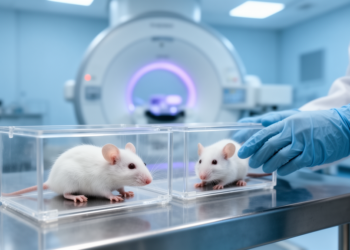
Recovering from an acute viral infection has long been understood as a straightforward sequence of events: a virus enters the body, expands, triggers symptoms, is brought under control by the immune system, and eventually disappears, leaving behind a population of memory cells that protects against future encounters with the same pathogen. A new study from the Infection Biology Laboratory at Pompeu Fabra University in Barcelona challenges the assumption that this sequence ends with a full return to normal. Working in a mouse model of acute infection, the researchers found that even after the virus was cleared and the animals appeared to have recovered, their immune systems remained substantially altered for a prolonged period, compromising their ability to respond effectively to new immunological challenges.
The study, published in the journal Cell Death & Disease under the title “Temporal lymphatic tissue destruction and impairment of de novo T cell responses after an acute virus infection,” was led by Andreas Meyerhans, an ICREA research professor at Pompeu Fabra University. According to Meyerhans, there is a general perception that an acute viral infection is a relatively minor and transient event: once the virus is controlled and symptoms have resolved, the body is assumed to have fully recovered. He argues that this view may underestimate consequences that are not immediately visible and can persist long after the infection itself has resolved, a possibility that the new experimental data now support in concrete structural and functional terms.
The central finding concerns the spleen, a lymphoid organ that serves as a critical hub for filtering blood and orchestrating immune responses. As a collateral effect of the immune response generated to control and clear the virus, the researchers observed substantial disruption of the splenic architecture in mice that had recovered from acute infection. The tissue developed fibrosis, a process in which normal functional tissue is replaced by fibrous connective tissue, while the organization and localization of immune cells within the organ were markedly altered. These structural changes were not merely cosmetic; they impaired the cellular interactions required for the proper activation of T cells, the adaptive immune cells that recognize and eliminate infected cells throughout the body.
The functional consequences of this structural damage were measurable. After recovering from the acute phase of infection, the animals showed a prolonged impairment in their ability to mount new immune responses when exposed to subsequent challenges. In practical terms, the mice were left in an immunocompromised state, one that could not be detected simply by confirming that the virus was no longer present. Dr. Paula Cebollada Rica, first author of the study, emphasized this distinction, noting that the infection can be controlled without the host necessarily having fully recovered. She explained that the immune-related consequences of an acute viral infection can persist beyond the period in which the virus is detectable, leaving the animals vulnerable in ways that standard measures of recovery would miss.
This observation reframes the clinical significance of common acute infections. Illnesses often dismissed as minor and self-limiting, such as many respiratory or gastrointestinal viral infections, may carry hidden immunological costs that extend well beyond the symptomatic phase. The study does not establish that the same phenomenon occurs in humans, since the work was carried out in an experimental mouse model, but it provides a mechanistic proof of principle: the inflammatory and tissue-remodeling processes deployed to clear an acute virus can themselves inflict lasting damage on the lymphoid tissues that immune responses depend upon. Fibrosis of lymphoid tissue, once established, is generally difficult to reverse, which helps explain why the impairment the researchers documented was so persistent.
Having established that recovery from acute infection left the mice immunologically compromised, the research team turned to the obvious next question: whether anything could be done to prevent these long-term consequences. Vaccination was a natural candidate, because a vaccine exposes the immune system to a harmless form or fragment of a pathogen, allowing protective immunity to develop without the tissue damage associated with a full-blown infection. In the mouse model, this reasoning proved correct. Previously vaccinated animals that were subsequently infected showed none of the alterations observed in unvaccinated mice after recovery from acute infection. Their splenic architecture remained intact, and their T-cell functionality was comparable to that of naive animals that had never been infected at all.
Cebollada Rica summarized the significance of this result: vaccinated animals did not experience T-cell dysfunction or splenic alterations after recovering from an acute viral infection. This means, she explained, that vaccination not only prevented the disease resulting from the acute infection but also preserved the immune system’s ability to cope with new challenges. In other words, the vaccine’s protective effect operated on two levels simultaneously. It blunted the acute disease, and by doing so it prevented the collateral structural damage to lymphoid tissue that would otherwise have degraded immune function for an extended period afterward. The benefit of vaccination, in this framework, is not limited to avoiding a specific illness but extends to safeguarding the integrity of the immune system itself.
The findings arrive at a moment when vaccination policy is the subject of intense public and political debate. The researchers note that scientific evidence on the consequences of infections and the benefits of vaccination is particularly important at a time when political decisions can compromise collaborative disease prevention efforts. Their results suggest that the calculus used to evaluate vaccines may be incomplete if it considers only the prevention of acute disease. If acute infections leave behind lasting immunological impairment, as the mouse model indicates is possible, then each prevented infection also represents an avoided period of heightened vulnerability to other pathogens, reduced responsiveness to future vaccinations, and potentially diminished capacity to control emerging infections. These downstream effects are rarely captured in conventional assessments of vaccine value.
Meyerhans argued that the benefits of vaccination highlighted by this research matter not only for healthcare but also for how the value of vaccination is communicated to the public. He stressed that people should be aware of the broader protection that vaccination can provide and continue to trust vaccines as one of the most effective tools to prevent disease, adding that, put simply, vaccines provide strong health benefits at a relatively low cost to society. The study’s authors declared no competing interests, and the work was published as an experimental study in animals, with the article appearing in Cell Death & Disease on 10 September 2026.
For the field of infection biology, the study opens several lines of inquiry. The demonstration that an acute viral infection can trigger temporal lymphatic tissue destruction and impair de novo T cell responses provides a model system for dissecting how inflammation, fibrosis, and disrupted immune-cell localization translate into functional immunosuppression. It also raises questions about which viruses, which doses, and which host factors determine whether recovery is complete or leaves residual damage, and whether interventions beyond vaccination, such as anti-fibrotic or immunomodulatory treatments, could restore lymphoid architecture after infection. For now, the clearest message is preventive: in the mouse model, avoiding the acute infection altogether through vaccination preserved both the structure of the spleen and the functional competence of the T-cell compartment. The benefits of vaccination, the study concludes, extend beyond protection from infection to the protection of the immune system’s long-term capacity to respond to whatever comes next.
Subject of Research: Long-term immune impairment after acute viral infection and its prevention by vaccination in mice
Article Title: The benefits of vaccination extend beyond protection from infection
Article References: The benefits of vaccination extend beyond protection from infection. (n.d.). Original publication
Image Credits: AI Generated
DOI: Not provided
Keywords: vaccination, acute viral infection, spleen, fibrosis, T cells, immune impairment, Pompeu Fabra University, Cell Death & Disease, mouse model, lymphoid tissue, immunology, public health
Cite Scienmag News
Kristina Jarvis. (October 8, 2026). Vaccination shields the immune system from lasting damage after viral infection. Scienmag. https://scienmag.com/vaccination-shields-the-immune-system-from-lasting-damage-after-viral-infection/
Kristina Jarvis. "Vaccination shields the immune system from lasting damage after viral infection." Scienmag, 8 October 2026, https://scienmag.com/vaccination-shields-the-immune-system-from-lasting-damage-after-viral-infection/. Accessed 8 October 2026.
Kristina Jarvis. "Vaccination shields the immune system from lasting damage after viral infection." Scienmag. October 8, 2026. https://scienmag.com/vaccination-shields-the-immune-system-from-lasting-damage-after-viral-infection/