


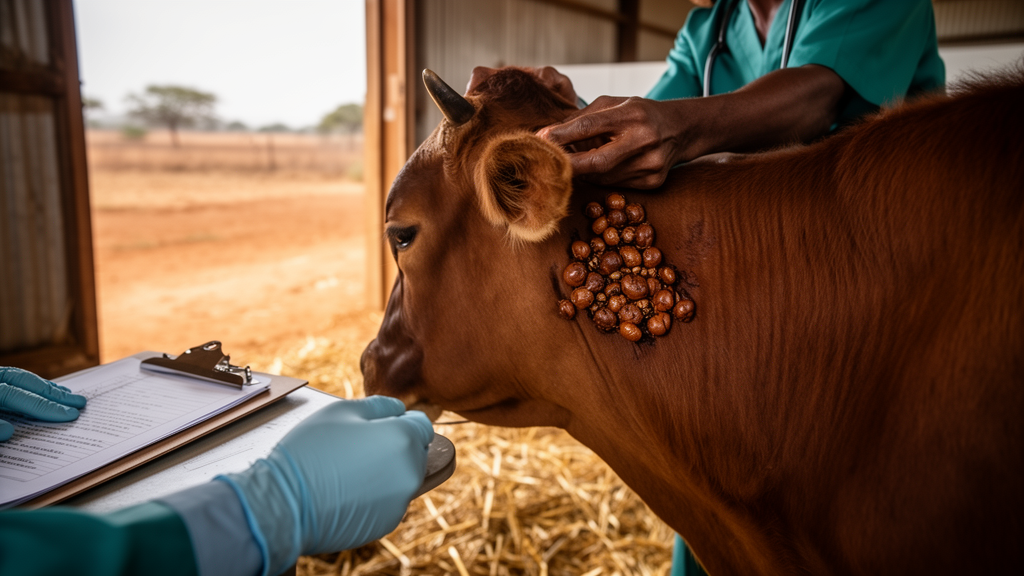
Researchers reviewing nearly a decade of veterinary clinic records in and around Gondar, northwestern Ethiopia, have found that almost one in seven cattle presented for treatment carried a documented ectoparasite diagnosis, with ticks accounting for more than half of all recorded infestations. The retrospective analysis, published in Discover Animals, examined 77,500 cattle health records collected between January 2017 and June 2026 at four veterinary clinics: the University of Gondar Veterinary Teaching Clinic, Hawariaw Paulos Veterinary Clinic, Azezo Veterinary Clinic, and Kola Diba Veterinary Clinic. Of these records, 11,441 — or 14.8 percent — contained a documented ectoparasite diagnosis, underscoring the persistent burden that ticks, lice, mange mites, and fleas place on cattle health and productivity in the region.
The study’s approach was deliberately comprehensive in scope but constrained by its data source. Rather than conducting a field survey, the researchers screened all eligible cattle health records available in the case registration books, diagnostic records, and treatment registers of the four participating clinics. Records with illegible entries, duplicate registrations, missing diagnostic information, or incomplete data on breed, sex, age, season, or year of presentation were excluded. After verification and cleaning, 77,500 records remained for analysis. Because the study was based on retrospective clinic records and important potential confounding variables were unavailable, the team did not perform multivariable logistic regression. Instead, associations between ectoparasite diagnoses and explanatory variables were evaluated using Pearson’s chi-square test, with statistical significance declared at P < 0.05, and the authors stress that the resulting associations are descriptive rather than independent risk-factor estimates.
Ticks emerged as the overwhelmingly dominant ectoparasite category, accounting for 6,154 documented diagnoses, or 53.8 percent of all ectoparasite-positive records. Tick-lice co-infestations followed at 1,523 diagnoses (13.3 percent), then lice alone at 1,306 (11.4 percent), and mange mites at 556 (4.9 percent). Mixed infestations of other combinations appeared at lower frequencies: lice-mange mite co-infestations accounted for 5.9 percent, flea-lice co-infestations for 3.0 percent, tick-mange mite co-infestations for 2.9 percent, tick-flea co-infestations for 2.6 percent, and fleas alone for 2.2 percent. This hierarchy is consistent with earlier cross-sectional studies from western Amhara, Haramaya, Bedele, Gursum, and North Wollo, which likewise identified ticks as the most widespread and economically important ectoparasites of Ethiopian cattle, and it highlights the continued potential role of ticks in transmitting economically significant pathogens.
The distribution of documented diagnoses differed significantly across veterinary clinics, breeds, sexes, age groups, and seasons, with all comparisons reaching P < 0.001. Kola Diba Veterinary Clinic recorded the highest proportion of ectoparasite diagnoses at 21.6 percent of its cattle records, followed by Hawariaw Paulos at 14.5 percent, the University of Gondar Veterinary Teaching Clinic at 12.7 percent, and Azezo at 9.2 percent. Among breed categories, local cattle had the highest proportion of documented diagnoses at 15.8 percent, compared with 13.6 percent for crossbred and 11.7 percent for exotic cattle. Female cattle registered a slightly higher proportion than males, at 15.9 percent versus 13.9 percent, and adult cattle accounted for 16.5 percent of diagnoses compared with 11.8 percent in young animals aged one year or younger.
The authors urge caution in interpreting several of these contrasts. Clinic-level differences may reflect the fact that the location of a veterinary clinic does not necessarily correspond to the geographical origin of the animals presented, and may also capture variation in animal populations, management systems, and case submission patterns among the clinics. Similarly, the higher proportion among local breeds may largely reflect the greater representation of local cattle in the clinic records rather than any inherent breed susceptibility, since the retrospective design was not intended to evaluate breed resistance. The modest differences by sex and age cannot be traced to biological or management-related factors using the available data, because such information was not captured in the routine registers. These constraints mean the observed patterns describe who was diagnosed at clinics, not who was most at risk in the wider cattle population.
Seasonal variation was pronounced and followed a clear gradient. The highest proportion of documented ectoparasite diagnoses occurred during the summer months of June to August, which coincide with the main rainy season, at 19.8 percent of records. Spring, corresponding to the short rainy period from March to May, followed at 17.8 percent, while autumn and winter registered 10.7 percent and 7.6 percent, respectively. Seasonal fluctuations of this kind have been reported previously in Ethiopia and elsewhere and are often attributed to environmental conditions that influence parasite survival, development, reproduction, and rates of host contact. However, because the study did not measure environmental variables directly, the authors interpret the pattern as seasonal variation in documented cases rather than evidence of specific climatic effects.
The temporal picture was more difficult to reconstruct. The proportion of cattle records with documented ectoparasite diagnoses varied widely across the study period, ranging from 3.1 percent in 2021 to 35.5 percent in 2026. The largest number of ectoparasite-diagnosed records was logged in 2026, with 3,485 records, while the lowest count was 230 records in 2018. Based on the archived records available, ticks were the most frequently documented category in 2017, 2018, 2020, 2022, and 2026, whereas mange mites led in 2019, lice in 2021, lice-mange mite co-infestations in 2023 and 2024, and tick-mange mite co-infestations in 2025. Because complete year-specific records for all ectoparasite categories were not consistently available, the researchers could report only the predominant category for each year and could not comprehensively compare all categories over time. They emphasize that the absence of a particular ectoparasite category in a given year should not be read as evidence of its actual absence during that period, and that records for 2026 covered only January through June and therefore did not represent a full calendar year.
Treatment information extracted from the registers indicated that ivermectin was the most frequently recorded treatment among ectoparasite-positive cases. The authors are careful to note, however, that the retrospective treatment data lacked details on dosage, treatment response, compliance, and parasite resistance status, so the findings cannot be interpreted as evidence of treatment effectiveness. They argue that effective ectoparasite control remains essential for reducing animal health and production losses and should incorporate appropriate acaricide use, strategic treatment programs, and sound herd management practices. The economic stakes are considerable: ectoparasites affect cattle through blood loss, skin irritation, dermatitis, reduced feed utilization, impaired growth, decreased milk production, and increased susceptibility to secondary infections, while infestations also damage hides and skins, reducing their quality and market value in a livestock sector that contributes to food security, rural livelihoods, and foreign exchange earnings in a country with approximately 70.3 million cattle.
The study’s limitations frame its conclusions. Because the findings derive from cattle presented to participating veterinary clinics, they may not reflect the wider cattle population, and the authors explicitly caution that the results should be understood as patterns of documented diagnoses rather than population-level prevalence estimates. Diagnostic and recording practices may have varied among clinics and across years, and information on ectoparasite species, infestation intensity, management practices, environmental factors, treatment outcomes, and other potential risk factors was unavailable. Individual animal identification numbers were not consistently recorded, so repeated presentations of the same animal could not always be distinguished from records of different animals. The study area, situated between roughly 1,800 and 2,300 meters above sea level with mean annual rainfall of approximately 880 to 1,172 millimeters and a mean annual temperature of about 19.1 degrees Celsius, is dominated by a mixed crop-livestock production system in which cattle rearing contributes substantially to household livelihoods.
Looking forward, the researchers call for continued surveillance, strategic ectoparasite control programs, and improved veterinary record-keeping systems across the region. They propose that future studies prioritize species-level identification of ectoparasites, assessment of acaricide and insecticide resistance, evaluation of management- and environment-related risk factors, and prospective study designs capable of supporting more robust assessment of temporal trends and independent risk factors. Within the limits of the retrospective data, the analysis delivers a clear message: more than nine years of clinic records from Gondar and its surrounding districts confirm that ectoparasites remain an important and dynamic animal health constraint, one whose documented burden rises with the rains, varies across clinics and host characteristics, and demands sustained, targeted attention from veterinary services in northwestern Ethiopia.
Subject of Research: Long-term retrospective analysis of documented cattle ectoparasite diagnoses in veterinary clinic records from Gondar, northwestern Ethiopia
Article Title: Long-term retrospective analysis of cattle ectoparasite records in and around Gondar, Northwestern Ethiopia
Article References: Bitew, A., Temesgen, A. B., Yayeh, B. T., Habtewelde, N. W., Shiferaw, K. A., Kebede, M. C., & Getnet, M. A. (2026). Long-term retrospective analysis of cattle ectoparasite records in and around Gondar, Northwestern Ethiopia. Discover Animals, 3(1), Article 105. https://doi.org/10.1007/s44338-026-00266-z
Image Credits: AI Generated
DOI: 10.1007/s44338-026-00266-z
Keywords: cattle, ectoparasites, ticks, Ethiopia, Gondar, veterinary records, retrospective study, livestock health, lice, mange mites, seasonality, parasite control
Cite Scienmag News
William Thompson. (October 23, 2026). Ticks Dominate Cattle Ectoparasite Diagnoses in Nine-Year Ethiopian Clinic Record Review. Scienmag. https://scienmag.com/ticks-dominate-cattle-ectoparasite-diagnoses-in-nine-year-ethiopian-clinic-record-review/
William Thompson. "Ticks Dominate Cattle Ectoparasite Diagnoses in Nine-Year Ethiopian Clinic Record Review." Scienmag, 23 October 2026, https://scienmag.com/ticks-dominate-cattle-ectoparasite-diagnoses-in-nine-year-ethiopian-clinic-record-review/. Accessed 23 October 2026.
William Thompson. "Ticks Dominate Cattle Ectoparasite Diagnoses in Nine-Year Ethiopian Clinic Record Review." Scienmag. October 23, 2026. https://scienmag.com/ticks-dominate-cattle-ectoparasite-diagnoses-in-nine-year-ethiopian-clinic-record-review/


