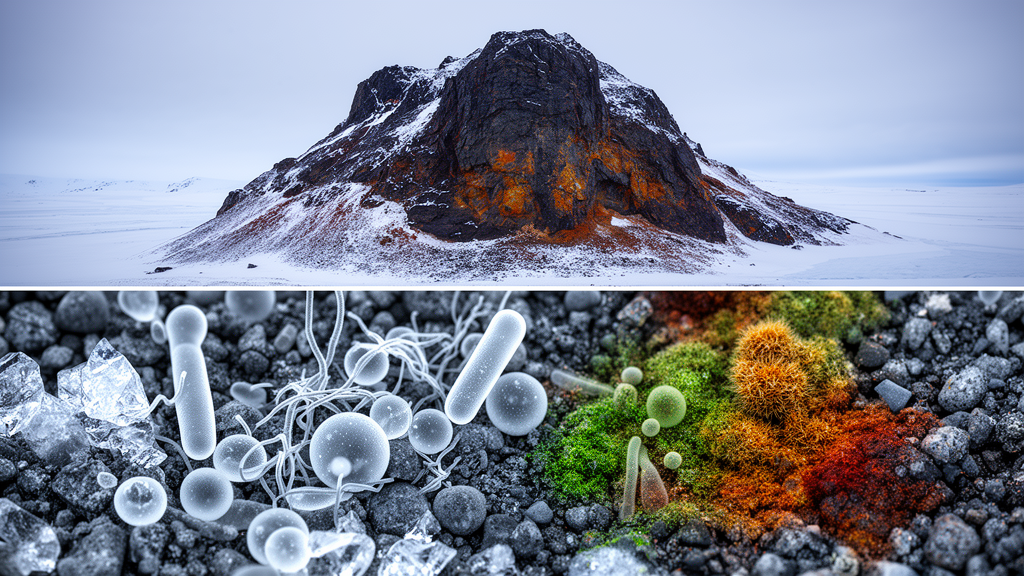
Soil microbes cultured from nine isolated nunataks in Western Dronning Maud Land, Antarctica, revealed a taxonomically diverse community that grows at temperatures as low as 1°C and carries membrane-lipid profiles consistent with adaptation to cold, nutrient-poor conditions. The study identified 37 bacterial species in 27 genera, along with five fungal taxa, and found repeated recovery of organisms such as Arthrobacter, Dermacoccus and Kocuria across geographically separated sites. Most bacteria grew from 1°C to 22°C, generally peaked near 15°C and tolerated salt concentrations of 1–7%.
These findings describe only organisms recoverable under the laboratory conditions used, rather than the full microbial community present in the soil. The researchers sampled ice-free soils from the Jutulsessen and Ahlmannryggen mountain ranges, including Flårjuven, Valterkulten, Slettfjel, Schumacherfjellet, Grunehogna, Robertskollen, Lorentzenpiggen, Vesleskarvet and Vassdalen. To reduce the influence of surface contamination, the uppermost 1–2 centimeters were removed and subsurface material was collected aseptically.
Each replicate combined multiple subsamples collected within a one-meter radius and was stored at −20°C. The investigation forms part of a broader culture-based and metagenomic effort focused on this geographically remote part of continental Antarctica. The sampled soils were heterogeneous and generally nutrient limited. Available nitrogen ranged from approximately 17.0 to 50.0 parts per million, phosphorus from 14.3 to 45.6 parts per million and organic carbon from 0.89% to 1.84%.
Soil pH was generally close to neutral, ranging from about 6.0 to 7.0, which was less restrictive than the combined effects of low temperature, scarce liquid water, desiccation and seasonal fluctuations. Elemental measurements also revealed strong local differences. Lorentzenpiggen was enriched in chromium, nickel and cobalt; Robertskollen in arsenic; Valterkulten and Robertskollen in copper and zinc; and Vassdalen in cadmium, thallium, lead, cesium, uranium, lithium and iron.
Such variation creates distinct chemical settings that may influence which organisms can establish and persist. To recover a broad range of cultivable organisms, the team used nutrient agar, marine broth, Antarctic bacterial medium and R2A agar, including versions diluted to one-tenth strength, as well as three media for fungi: Rose Bengal agar, potato dextrose agar and malt extract agar. Plates were incubated for two to four weeks at 1°C, 4°C or 15°C. This combination of media, temperatures and reduced nutrient concentrations supported the isolation of 200 morphologically distinct representatives from the colony-forming units that developed.
The isolates displayed varied pigmentation, including white, cream, yellow, orange and red colonies, and included both coccoid and rod-shaped bacteria. Taxonomic identity was assessed through a combination of matrix-assisted laser desorption ionization time-of-flight mass spectrometry, or MALDI-TOF MS, 16S ribosomal RNA gene sequencing, fungal internal transcribed spacer sequencing and phylogenetic analysis. Of 96 bacterial cultures examined by MALDI-TOF MS, 75 produced reproducible, good-quality protein spectra and 21 produced poor-quality spectra.
Only 13 received reliable database-supported assignments, covering seven genera and 11 species, while 62 generated informative spectra that did not match references in the MALDI BioTyper library. This high rate of unmatched profiles reflects the limited representation of Antarctic and other environmental organisms in databases built largely around clinically encountered microbes. The 16S rRNA analysis supplied a broader taxonomic picture, identifying 37 bacterial species belonging to 27 genera and 19 families, with most sequences showing 98–100% similarity to their closest references.
Arthrobacter was particularly prominent, represented by 27 strains assigned to seven species, while Dermacoccus was the second most frequently recovered genus with 12 isolates. Dermacoccus nishinomiyaensis appeared at eight locations, making it the most widely distributed taxon in the dataset. Other recurring or locally concentrated taxa included Kocuria palustris, Bacillus, Pseudomonas, Sphingomonas, Microbacterium, Acinetobacter, Methylobacterium, Rhodococcus and various members of the Pseudarthrobacter group.
The recovery of several related strains at individual sites also indicated strain-level diversity rather than repeated isolation of one organism alone. Community composition varied markedly among locations. Schumacherfjellet yielded the highest bacterial richness in the dataset, with 10 identified species, followed by the penguin rookery with eight and Valterkulten and Vassdalen with six each.
Grunehogna produced the lowest richness, at two species. Valterkulten repeatedly yielded Arthrobacter flavus alongside Brevundimonas vesicularis, Dermacoccus nishinomiyaensis, Stenotrophomonas pavanii, Brachybacterium rhamnosum and Kocuria palustris. Vassdalen contained a compositionally distinct set that included Bacillus paramycoides, Bacillus altitudinis, Bacillus cereus, Janibacter indicus, Pontibacter amylolyticus and Dermacoccus nishinomiyaensis.
The penguin rookery supported taxa not detected at the nunataks, including Paracoccus acridae, Lysinibacillus sphaericus, Kytococcus aerolatus, Methylobacterium rhodesianum and Curtobacterium luteum, patterns that may be associated with local biological inputs. Ten fungal isolates represented five taxa: Samsoniella alpina, Pseudogymnoascus roseus, Tolypocladium ovalisporum, Leuconeurospora bharatiensis and Gelatinofungus brunneus. Most came from Robertskollen, while Gelatinofungus came from the penguin rookery.
The recovery of Pseudogymnoascus was consistent with its documented association with Antarctic soils, while a Leuconeurospora bharatiensis-affiliated isolate had previously been reported from the Larsemann Hills in continental Antarctica. Its detection in Western Dronning Maud Land suggests that the lineage may have a broader Antarctic distribution. ITS sequence similarities for the fungal isolates ranged from 95.84% to 100%, with the lower values indicating that some assignments may require confirmation through additional taxonomic evidence.
Fatty acid methyl ester analysis provided physiological evidence consistent with cold-associated membrane adaptation. Across 27 bacterial isolates examined, branched and unsaturated fatty acids made up highly variable proportions: saturated fatty acids ranged from 0.51% to 53.66%, iso-branched fatty acids from 0.34% to 73.14%, anteiso-branched fatty acids from 0.31% to 94.59% and unsaturated fatty acids from 0.46% to 95.54%. Several Arthrobacter and related isolates contained roughly 64–82% total branched-chain fatty acids, with anteiso-C15:0 accounting for approximately 30–64% of the profile in some strains.
Branching reduces the efficiency with which fatty-acid chains pack together, potentially preserving membrane fluidity at low temperatures, while unsaturated fatty acids provide another route to membrane remodeling. Together with growth at 1°C and tolerance to moderate salt, the lipid profiles are consistent with physiological flexibility, although they do not by themselves demonstrate how much of the pattern is caused by Antarctic conditions rather than inherited taxonomic traits. The findings establish a culture-based baseline for microbes living in Western Dronning Maud Land’s nunatak soils and broaden the known diversity of cultivable Antarctic bacteria and fungi.
The 62 unmatched but high-quality MALDI-TOF MS spectra are also potentially useful as future reference material for environmental identification. At the same time, culture methods recover only microbes capable of growing on the selected media under the tested conditions, and the study did not directly quantify carbon cycling, decomposition, growth rates or ecosystem function in the field. Its broader significance therefore lies in showing that isolated, nutrient-poor Antarctic soils contain a varied and physiologically versatile culturable microbiota, while leaving the full diversity and ecological activity of those communities to be resolved through genomic, metabolomic and field-based investigations.
Subject of Research: Culture-based characterization of bacterial and fungal diversity and membrane adaptation in Western Dronning Maud Land nunatak soils.
Article Title: Microbial diversity and adaptation Strategies in the nunataks of Western Dronning Maud Land, Antarctica
Article References: Singh, P., & Singh, S. M. (2026). Microbial diversity and adaptation Strategies in the nunataks of Western Dronning Maud Land, Antarctica. Frontiers in Microbiology, 17, Article 1921961. https://doi.org/10.3389/fmicb.2026.1921961
Image Credits: AI Generated
DOI: 10.3389/fmicb.2026.1921961
Keywords: Antarctic soil microbes, Nunatak ecosystems, Culturable microbial diversity, Cold adaptation, Fatty acid profiles, MALDI-TOF MS, 16S rRNA sequencing, Fungal ITS sequencing, Western Dronning Maud Land, Antarctic biogeography, Microbial, diversity
Cite Scienmag News
Drew Townsend. (October 23, 2026). Antarctic Nunatak Soils Reveal Diverse Cold-Adapted Microbes. Scienmag. https://scienmag.com/antarctic-nunatak-soils-reveal-diverse-cold-adapted-microbes/
Drew Townsend. "Antarctic Nunatak Soils Reveal Diverse Cold-Adapted Microbes." Scienmag, 23 October 2026, https://scienmag.com/antarctic-nunatak-soils-reveal-diverse-cold-adapted-microbes/. Accessed 23 October 2026.
Drew Townsend. "Antarctic Nunatak Soils Reveal Diverse Cold-Adapted Microbes." Scienmag. October 23, 2026. https://scienmag.com/antarctic-nunatak-soils-reveal-diverse-cold-adapted-microbes/