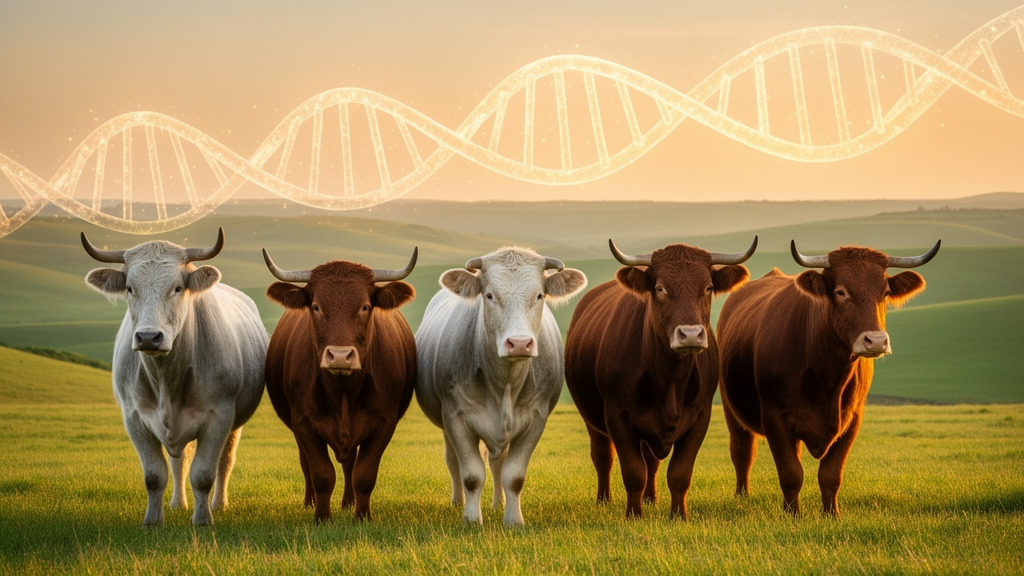
A sweeping analysis of more than 16,000 genotyped animals has mapped the genomic regions shaped by selection in Italy’s five native beef cattle breeds, revealing that Marchigiana, Chianina, Romagnola, Maremmana, and Podolica carry distinct evolutionary signatures despite their shared Podolian ancestry. The study, published in Frontiers in Animal Science, applied two complementary haplotype-based statistics, the integrated haplotype score (iHS) and cross-population extended haplotype homozygosity (XP-EHH), to the complete genotyped herd-book populations of each breed: 4,816 Marchigiana, 5,030 Chianina, 2,283 Romagnola, 1,096 Maremmana, and 3,058 Podolica animals. The results paint a picture of selective divergence driven by centuries of different breeding goals, environments, and farming systems across the Italian peninsula.
The five breeds all descend from Podolian cattle, which themselves arose from admixture between bovine and indicine ancestors that spread from Central Europe into Italy. All five share black skin and predominantly white coats, although calves are born wheat colored. Their histories, however, diverged markedly. Marchigiana, Chianina, and Romagnola were dual-purpose meat and work animals until the mid-twentieth century, after which decades of intense selection by the National Association of Italian Beef Cattle Breeders (ANABIC) transformed them into highly specialized beef breeds, now exported to countries including Ireland, France, the UK, and the USA. Maremmana and Podolica remained rustic local breeds, reared year-round on open pastures and exceptionally adapted to harsh conditions. Meat from the three specialized breeds carries the Protected Geographical Indication label Vitellone Bianco dell’Appennino Centrale.
To detect selection signatures, the researchers genotyped animals with a 33K SNP chip and, after quality control, retained roughly 21,000 to 24,000 single nucleotide polymorphisms per breed across the 29 bovine autosomes. The iHS method scans within a single population for unusually long haplotypes carrying a particular allele, a hallmark of recent positive selection, while XP-EHH compares haplotype homozygosity between populations, flagging regions where one group is nearly fixed while the other remains polymorphic. Each breed was compared with a reference pool of the other four, and an additional analysis contrasted the three specialized breeds against the two rustic ones. Significant regions were identified using a conservative threshold, merged into candidate intervals, and then annotated with genes and quantitative trait loci (QTL) from the Cattle QTL Database.
One of the most striking findings was a candidate region on Bos taurus autosome 3, at approximately 33 megabases, shared by all five breeds. This interval harbors genes including LAMTOR5 and SLC16A4, previously linked to growth and weight gain, as well as a cluster of potassium channel genes such as KCNA3, KCNA2, and KCNA10. These channel genes dominated the Gene Ontology enrichment results, which pointed overwhelmingly toward voltage-gated potassium channel and ion transporter activity. The authors note that such genes have also been associated with meat tenderness, marbling score, and male fertility in prior studies, although their precise role in Podolian cattle adaptation remains unclear and will require functional follow-up work.
The breeds otherwise showed distinctive profiles. Marchigiana displayed a high number of QTLs associated with production, meat, and carcass traits, largely concentrated in a region on BTA7 containing the gene ADGRV1, which has been linked to carcass weight, marbling, and rib-eye area in Angus cattle. Marchigiana is renowned for its muscularity, with dressing percentage reaching 63 percent in heterozygous myostatin bulls. Chianina’s most significant QTL enrichments related to inhibin levels, while Romagnola showed numerous QTLs tied to milk production and quality. Maremmana’s enrichments centered on teat placement and conformation, and Podolica showed the most QTLs, mainly for milk traits and body conformation.
The genetic relationships among the breeds, assessed by principal component analysis and effective population size estimates, matched their documented histories. Chianina and Romagnola were the most differentiated breeds, separated along the first principal component explaining 30.7 percent of genetic variance, while the rustic Maremmana and Podolica grouped together and were distinguished only by the fourth component. Podolica showed the highest effective population size, 466 at 13 generations ago, consistent with its wide geographic distribution and milder selection, whereas Romagnola had the lowest at 151, reflecting a severe population bottleneck after the Second World War that reduced the breed to fewer than 10,000 head today.
Notably, Romagnola shared candidate regions on BTA19 and BTA23 with the two rustic breeds, corroborating its intermediate position between the specialized and rustic groups. The authors attribute this pattern to Romagnola’s retained genetic proximity to Maremmana and Podolica, despite its much more intensive selection for meat production. The study also caution that many milk-related QTL enrichments appeared across all breeds even though none of them is milked, apart from regional Podolica cheesemaking. They explain this as likely reflecting a discovery bias toward milk traits in cattle databases, pleiotropic effects of conserved genes, and links to maternal ability in harsh grazing systems, rather than evidence of selection toward dairy characteristics.
When the three specialized breeds were compared against the two rustic ones, the analysis revealed a strong selection signal on BTA6 at roughly 33 to 40 megabases, spanning the well-known LCORL-NCAPG locus. This region harbors genes repeatedly implicated in growth, muscularity, carcass traits, and feed intake, including IBSP, LAP3, MED28, FAM184B, DCAF16, NCAPG, LCORL, and SLIT2. However, follow-up comparisons showed that the signal is mainly driven by a distinct haplotype pattern in Podolica, while Marchigiana, Chianina, Romagnola, and Maremmana share more similar patterns in this region, so it should not be read as exclusive to the specialized group. A second strong signature on BTA13, spanning 59 to 70 megabases, contained MYH7B and MYL9, genes tied to muscle structure, contraction, and intramuscular fat metabolism, supporting a shared selective pressure associated with beef-oriented production in the specialized trio.
The authors are careful to spell out the study’s limitations. The SNP panel, at roughly 22,000 markers after filtering, is relatively low density, comparable to previous work but capable of detecting only broad genomic regions rather than pinpointing individual causal genes. Low marker density also raises the risk of false negatives in haplotype-based scans, which depend on accurate reconstruction of extended haplotypes. Only one alternative random subsample was tested for robustness, so stability across repeated draws was not evaluated, and the scans were not repeated after removing closely related animals, meaning residual family structure could influence local haplotype patterns.
Nevertheless, the findings provide the first comprehensive comparative map of selection signatures across these five breeds within a single analytical framework, using the totality of the genotyped herd-book populations rather than subsets of candidate bulls. The results confirm divergent evolutionary and selection trajectories shaped by each breed’s history and production system, and they offer a genomic foundation for future informed selection strategies. As the researchers conclude, this knowledge may also highlight the value of preserving the distinctiveness of local genetic resources, an increasingly important consideration as these breeds face new environmental and productive challenges.
Subject of Research: Haplotype-based selection signature analysis in five Italian beef cattle breeds
Article Title: Detection of selection signatures reveals different genomic backgrounds and selective divergence in five Italian beef cattle breeds
Article References: Colombi, D., Gomez Proto, G., Perini, F., Mancin, E., Sbarra, F., Quaglia, A., Tiezzi, F., Mantovani, R., Sartori, C., & Lasagna, E. (2026). Detection of selection signatures reveals different genomic backgrounds and selective divergence in five Italian beef cattle breeds. Frontiers in Animal Science, 7, 1856885. https://doi.org/10.3389/fanim.2026.1856885
Image Credits: AI Generated
DOI: 10.3389/fanim.2026.1856885
Keywords: selection signatures, Italian beef cattle, Podolian breeds, iHS, XP-EHH, genomics, LCORL-NCAPG, herd book, animal breeding, QTL enrichment, Marchigiana, Chianina
Cite Scienmag News
Juliet Wilcox. (October 23, 2026). Genomic Footprints of Selection Reveal Divergent Evolution in Five Italian Beef Cattle Breeds. Scienmag. https://scienmag.com/genomic-footprints-of-selection-reveal-divergent-evolution-in-five-italian-beef-cattle-breeds/
Juliet Wilcox. "Genomic Footprints of Selection Reveal Divergent Evolution in Five Italian Beef Cattle Breeds." Scienmag, 23 October 2026, https://scienmag.com/genomic-footprints-of-selection-reveal-divergent-evolution-in-five-italian-beef-cattle-breeds/. Accessed 23 October 2026.
Juliet Wilcox. "Genomic Footprints of Selection Reveal Divergent Evolution in Five Italian Beef Cattle Breeds." Scienmag. October 23, 2026. https://scienmag.com/genomic-footprints-of-selection-reveal-divergent-evolution-in-five-italian-beef-cattle-breeds/