


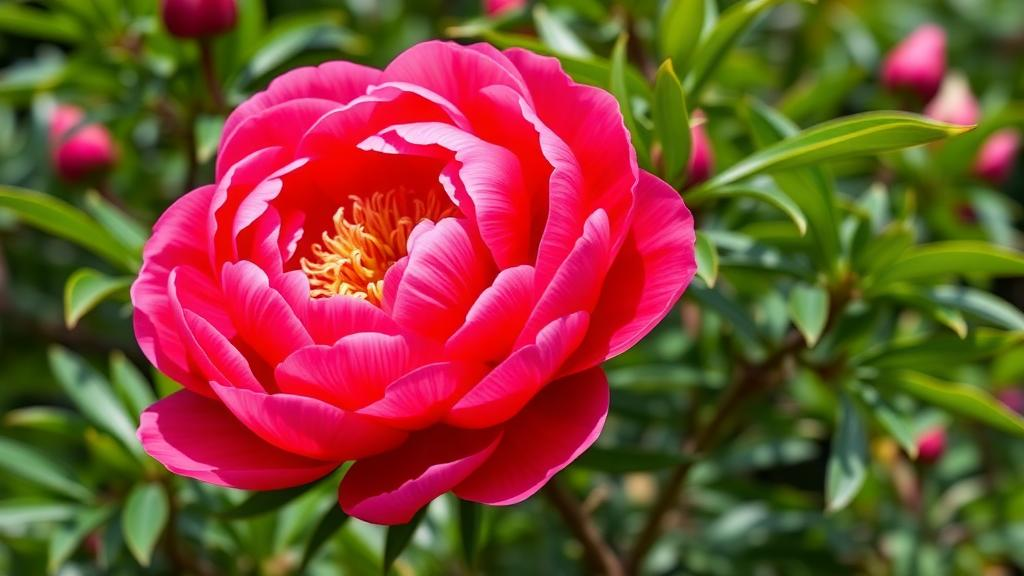
The rich reds of a tree peony petal are not simply a matter of pigment being present; they depend on a tightly controlled molecular chain that determines when, where and how much anthocyanin accumulates. Research in BMC Plant Biology identifies a compact regulatory module that helps explain this striking variation, linking three WRKY transcription factors to a key structural gene in the pigment pathway. The findings show that PsWRKY27, PsWRKY51 and PsWRKY66 activate PsDFR2, a gene associated with the formation of tree peony petal colour, and that all three also promote anthocyanin accumulation when tested in another flowering plant.
Anthocyanins are the flavonoid pigments responsible for many red, purple and blue hues in flowers, fruits and leaves. Their production depends on a connected biosynthetic pathway, with individual enzymes converting successive chemical compounds into pigments. Dihydroflavonol reductase, commonly abbreviated DFR, acts within this pathway and is represented in tree peony by several related genes. The new study focused on which of those genes is most closely associated with intense petal pigmentation and how their activity is controlled by regulatory proteins.
The researchers began by comparing two cultivars with contrasting flower colours. Petals of the red-flowered cultivar ‘Hongxialanman’ contained far more anthocyanin than those of ‘Fengdan’. Analysis of the DFR gene family then revealed that two structural genes, PsDFR1 and PsDFR2, were expressed at markedly elevated levels in the pigment-enriched ‘Hongxialanman’ petals, whereas PsDFR3 was barely detectable. This pattern pointed to PsDFR2 as a particularly strong candidate for controlling the difference in colour, although gene expression alone cannot establish the direction of regulation.
To investigate how the PsDFR2 gene is switched on, the team turned to WRKY transcription factors, proteins that bind specific regulatory DNA sequences and influence the expression of other genes. Six PsWRKY proteins were shown to bind W-box motifs in the PsDFR2 promoter. The finding supplied a direct molecular link between those regulatory proteins and the pigment-pathway gene, but the researchers went further to determine which of the six candidates actually track anthocyanin production in living petals.
Reverse-transcription quantitative PCR, or RT-qPCR, showed that PsWRKY27, PsWRKY51 and PsWRKY66 were significantly upregulated in the pigment-rich petals of ‘Hongxialanman’. Expression levels of all three were positively correlated with anthocyanin accumulation. The result does more than associate the genes with red colour: it places their activity in the same tissue and developmental context as the increase in pigment. Nevertheless, correlation alone could not determine whether these transcription factors directly cause stronger PsDFR2 expression or whether other pathways influence both.
Dual-luciferase reporter assays provided a functional test of that regulatory connection. In this assay, activity from a candidate transcriptional regulator is compared with activity from a reporter carrying the target promoter. The results confirmed that PsWRKY27, PsWRKY51 and PsWRKY66 activate transcription from the PsDFR2 promoter. Together with the W-box binding results, the experiments support a direct mechanism in which these three WRKY proteins bind regulatory sequences associated with PsDFR2 and increase its expression, thereby supporting production of the anthocyanin pigments responsible for the red petal phenotype.
The researchers also examined whether the three regulators behave identically across plant tissues and cultivars. PsWRKY27, PsWRKY51 and PsWRKY66 displayed distinct tissue-specific expression patterns in the two tree peony cultivars. This distinction matters because transcription factors do not act as interchangeable switches. A factor may be abundant in petals yet weakly represented in leaves, stems or other organs, and its activity in one genetic background may differ from that in another. The distinct patterns suggest that the WRKY–DFR2 module is embedded in a broader network of tissue-specific and cultivar-dependent control rather than operating as a universal on-off mechanism.
Transient overexpression experiments in petunia provided an independent functional test of the three genes. When PsWRKY27, PsWRKY51 or PsWRKY66 was introduced temporarily into the alternative flowering plant, each effectively increased anthocyanin accumulation. Because petunia does not share the complete experimental history or genetic background of tree peony, this result is best understood as evidence that the factors retain colour-promoting activity in a heterologous system. It strengthens the case that their effect is not confined to a peculiar feature of the two peony cultivars, while the cultivar-specific expression patterns show why tuning the module may still be important in peony itself.
Together, the experiments define a regulatory chain that connects flower colour to gene activity. The pigment-rich ‘Hongxialanman’ petals contain more anthocyanin and show elevated expression of PsDFR1 and especially, among the DFR genes tested, PsDFR2. Six WRKY proteins can bind W-box motifs in the PsDFR2 promoter, and three of them—PsWRKY27, PsWRKY51 and PsWRKY66—are upregulated in pigment-enriched tissue, activate the PsDFR2 promoter and enhance anthocyanin accumulation when overexpressed in petunia. The research therefore proposes a molecular module, PsWRKY27/51/66–PsDFR2, in which transcription-factor activity controls a structural component of anthocyanin biosynthesis and contributes to the formation of tree peony petal colour.
The mechanism also offers a useful framework for studying floral pigmentation in other ornamental plants. Flower colour is a complex trait shaped by pigment chemistry, enzyme activity, developmental timing and environmental conditions, but regulatory networks can help explain why identical or related biosynthetic machinery produces dramatically different blooms. By identifying upstream factors that tune a core biosynthetic gene, the work provides potential targets for colour research and, more broadly, for understanding how plants coordinate specialized metabolism with organ development. It also sharpens an important distinction in ornamental biology: producing the same class of pigment is only one part of the system, while controlling where and when that pigment accumulates determines the final visual result.
Subject of Research: Molecular regulation of anthocyanin accumulation and petal colour in tree peony
Article Title: PsWRKY27, PsWRKY51 and PsWRKY66 activate PsDFR2 to promote anthocyanin accumulation in tree peony petals
Article References: Lan, L., Yuan, X., Cao, L., Wang, X., Wang, H., Li, Y., Fu, Z., & Zhang, H. (2026). PsWRKY27, PsWRKY51 and PsWRKY66 activate PsDFR2 to promote anthocyanin accumulation in tree peony petals. BMC Plant Biology. https://doi.org/10.1186/s12870-026-09925-5
Image Credits: AI Generated
DOI: 10.1186/s12870-026-09925-5
Keywords: tree peony, anthocyanin, petal pigmentation, WRKY transcription factors, PsDFR2, flavonoid biosynthesis, transcriptional regulation, flower colour, plant molecular biology, PsWRKY27, PsWRKY51, PsWRKY66
Cite Scienmag News
Juliet Wilcox. (October 19, 2026). Three WRKY proteins switch on red pigment production in tree peony. Scienmag. https://scienmag.com/three-wrky-proteins-switch-on-red-pigment-production-in-tree-peony/
Juliet Wilcox. "Three WRKY proteins switch on red pigment production in tree peony." Scienmag, 19 October 2026, https://scienmag.com/three-wrky-proteins-switch-on-red-pigment-production-in-tree-peony/. Accessed 19 October 2026.
Juliet Wilcox. "Three WRKY proteins switch on red pigment production in tree peony." Scienmag. October 19, 2026. https://scienmag.com/three-wrky-proteins-switch-on-red-pigment-production-in-tree-peony/


