


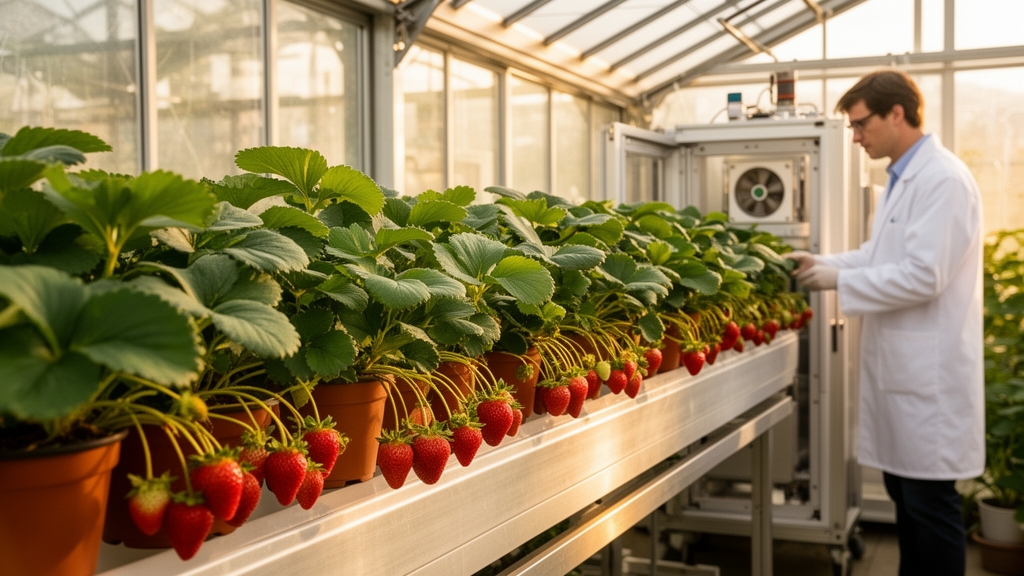
A modest blast of gamma radiation may be exactly what strawberry plants need to grow bigger, root deeper, and flower more profusely, according to a new study published in BMC Plant Biology. Researchers at the Nuclear Science and Technology Research Institute in Karaj, Iran, together with a colleague from Shiraz University, exposed strawberry plants to eleven different doses of gamma radiation ranging from zero to 100 gray, the standard unit for absorbed radiation dose, and tracked how each level shaped survival, vegetative growth, and reproductive performance. The results reveal a striking dose-dependent pattern in which a moderate dose of 30 gray produced the best overall plant performance, while higher doses proved increasingly destructive.
The experiment was designed as a radiosensitivity test, a foundational step in mutation breeding programs. Before plant breeders can use gamma irradiation to generate genetic variation, they must establish which doses stress plants enough to induce mutations without wiping out the population entirely. The research team irradiated strawberry plants and measured a suite of traits including survival rate, leaf area, leaf fresh and dry weight, root length, and flower number across the full dose range. This systematic approach allowed them to construct a quantitative profile of how strawberry responds as radiation exposure climbs.
The sweet spot turned out to be remarkably low on the dose scale. At 30 gray, plants achieved the highest leaf area of any treatment group, produced an average of 16.66 flowers per plant, extended their roots to a maximum length of 20.66 centimeters, and accumulated the greatest leaf fresh and dry weights, at 2.69 grams and 0.83 grams respectively. These plants outperformed even the untreated controls on several measures, a pattern the researchers suggest may reflect a phenomenon known as hormesis, in which low doses of an otherwise harmful agent stimulate biological activity rather than suppress it.
Hormesis remains one of the more intriguing concepts in radiation biology. The idea is that a small stressor can trigger repair mechanisms and physiological responses that leave an organism better off than before. In plants, low-dose radiation has occasionally been linked to enhanced germination, increased enzyme activity, and stimulated growth, though the underlying mechanisms are still debated. The strawberry findings add a horticulturally relevant data point: whatever the mechanism, the 30 gray treatment did not merely spare the plants but appeared to actively boost their vegetative and flowering traits.
Beyond that optimum, the picture darkened quickly. Doses of 60 gray and above markedly reduced survival and dragged down most growth and reproductive parameters. At the harshest exposures of 80 to 100 gray, the effects were severe, with plants struggling to survive and showing dramatic losses across the measured traits. The dose-response curve that emerged is steep, illustrating how quickly the balance tips from stimulation to damage as absorbed dose increases. High-energy gamma rays break DNA strands and generate reactive oxygen species within cells, and once the damage load exceeds repair capacity, growth collapses.
To make the results practically useful, the team calculated lethal dose benchmarks, the radiation levels at which 25, 50, and 75 percent of plants would be expected to die. These came out at 28.05 gray for LD25, 52.53 gray for LD50, and 77.01 gray for LD75. Such values are the currency of mutation breeding. Breeders typically aim for doses that kill roughly a third to half of the treated material, enough to ensure mutagenic damage in survivors while keeping a viable population for selection. The newly established radiosensitivity profile gives strawberry breeders a quantitative map for choosing doses in future experiments rather than relying on trial and error.
The study also identifies candidate doses for the next phase of research. The authors note that doses above 50 gray, while harmful to plant performance, are the levels most likely to generate heritable genetic variation, which is the raw material mutation breeding depends on. Any promising variants would still need confirmation that their altered traits are genetically stable and transmissible rather than temporary physiological responses. The researchers are explicit on this point, stating that higher doses qualify as potential candidates pending confirmation of heritable variation.
Strawberry is a high-value crop with a complex genome, and improvement programs constantly seek new sources of variation for traits such as fruit quality, disease resistance, and flowering behavior. Conventional crossbreeding is complicated by the plant’s octoploid genetics in many cultivated species and by the clonal propagation methods that preserve elite varieties but limit genetic reshuffling. Induced mutation offers a shortcut, allowing breeders to nudge the genome of an already successful cultivar without introducing foreign germplasm. Determining the correct irradiation dose, as this study does, is the gatekeeping step that determines whether such programs succeed.
The research was carried out by Ali Akbar Ghasemi-Soloklui, Saeed Moori, and Mojtaba Kordrostami of the Nuclear Agriculture Research School at the Nuclear Science and Technology Research Institute in Karaj, along with Masoud Shahmoradi of the Department of Horticultural Science at Shiraz University. The team stresses that the moderate 30 gray dose produced the most favorable growth, root development, and flowering responses, a finding they interpret as evidence of a possible hermetic, or hormetic, effect in strawberry. The work received no external funding, and the authors declare no competing interests.
For growers and breeders alike, the study delivers a clear practical message: in the world of gamma irradiation, more is definitely not better. A carefully calibrated dose near 30 gray can coax strawberry plants into more vigorous vegetative growth and more abundant flowering, while anything approaching the lethal benchmarks risks losing the crop altogether. As the team moves toward mutation-breeding trials with higher candidate doses, the strawberry industry may soon see whether radiation-induced variation can translate these greenhouse-scale responses into new varieties with traits worth savoring.
Subject of Research: Dose-dependent effects of gamma irradiation on strawberry plant growth and reproductive traits
Article Title: Dose-dependent effects of gamma irradiation on growth and reproductive traits of strawberry
Article References: Ghasemi-Soloklui, A. A., Moori, S., Kordrostami, M., & Shahmoradi, M. (2026). Dose-dependent effects of gamma irradiation on growth and reproductive traits of strawberry. BMC Plant Biology, 26(1), Article 1675. https://doi.org/10.1186/s12870-026-09912-w
Image Credits: AI Generated
DOI: 10.1186/s12870-026-09912-w
Keywords: strawberry, gamma irradiation, mutation breeding, radiosensitivity, hormesis, plant biology, flowering, LD50, radiation dose, vegetative growth, reproductive traits, BMC Plant Biology
Cite Scienmag News
Alan Morgan. (October 19, 2026). Gamma Rays at Just the Right Dose Make Strawberry Plants Thrive, Study Finds. Scienmag. https://scienmag.com/gamma-rays-at-just-the-right-dose-make-strawberry-plants-thrive-study-finds/
Alan Morgan. "Gamma Rays at Just the Right Dose Make Strawberry Plants Thrive, Study Finds." Scienmag, 19 October 2026, https://scienmag.com/gamma-rays-at-just-the-right-dose-make-strawberry-plants-thrive-study-finds/. Accessed 19 October 2026.
Alan Morgan. "Gamma Rays at Just the Right Dose Make Strawberry Plants Thrive, Study Finds." Scienmag. October 19, 2026. https://scienmag.com/gamma-rays-at-just-the-right-dose-make-strawberry-plants-thrive-study-finds/


